By Lucy
Oh boy. Buckle up.
I noticed, as we exited the immigration office, signs everywhere declaring “a tourist visa is not a working visa”. They must have a real problem with it, because I haven’t seen anywhere else with a sign like that.
Vlad was still upset I had gone; he was convinced a single entry into Cambodia would prevent me from ever entering Thailand again. I think it’s because he gets his information largely from other Russian expats, who like to avoid applying for visas, and Thailand gets fed up with people trying to cycle through 90 day visa stays.
The rest of the journey was fairly uneventful. At first, Cambodia largely looked like Vietnam, except poorer. Water buffalo wandered down the road freely.
Then we started driving past wats, and I felt like I was back in Thailand.
A quick primer on Cambodia; for over a thousand years, it was the controlling force in South East Asia, actually. The city of Angkor, where Angkor Wat is located, was the largest (confirmed) pre-Industrial population, reaching a million people at times. It was built starting in the 8th century and the Khmer empire controlled much of what is now south Thailand and south Vietnam, including where Bangkok and Saigon are now. However, as the Thai and Viet people moved into the area, they slowly chipped away at its power. It lost a lot of its power when Angkor was sacked multiple times by Ayutthaya, and the capital was moved to Phnom Penh.
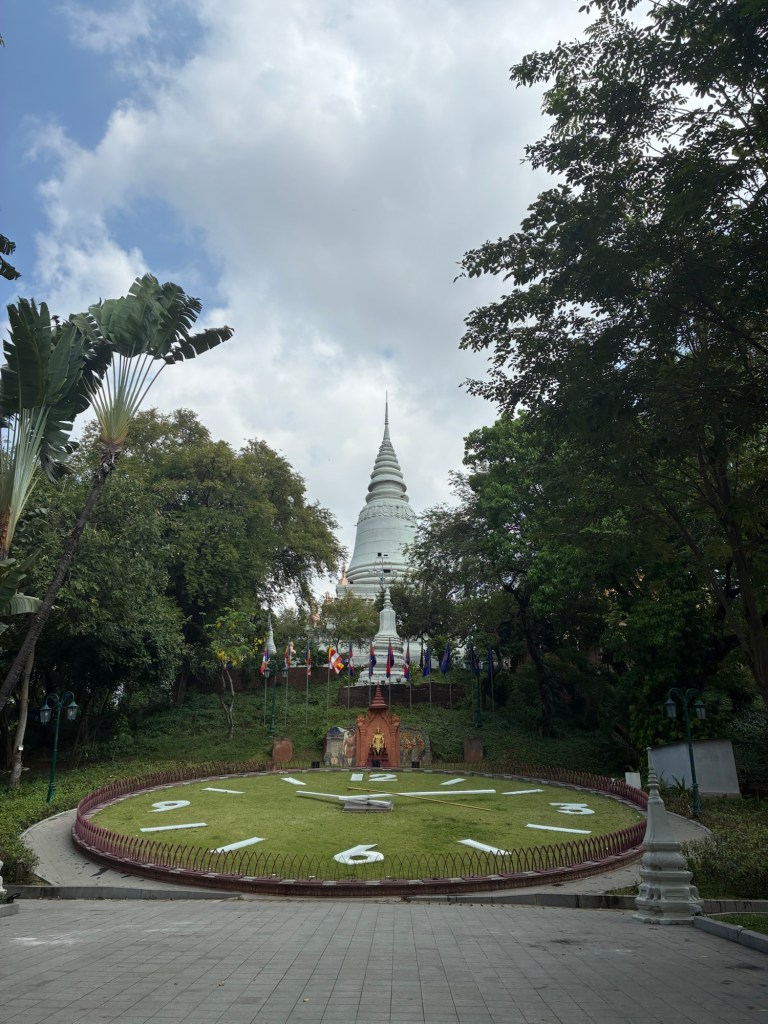
Phnom Penh, funnily enough, is named for a Wat at what used to be the centre of the city, Wat Phnom Daun Penh (I’ve seen Daun spelled multiple ways, don’t correct me). The apocryphal story is that the temple was built by a wealthy widow on the only hill in the area, and the city grew around it (Phnom means “hill”, and Penh means “grandmother”, so the city is literally called “the hill temple of the old lady”). It’s also at the juncture of where the Tonle Sap river meets the Mekong (Tonle Sap is the lake by Angkor, and literally means “big lake”)
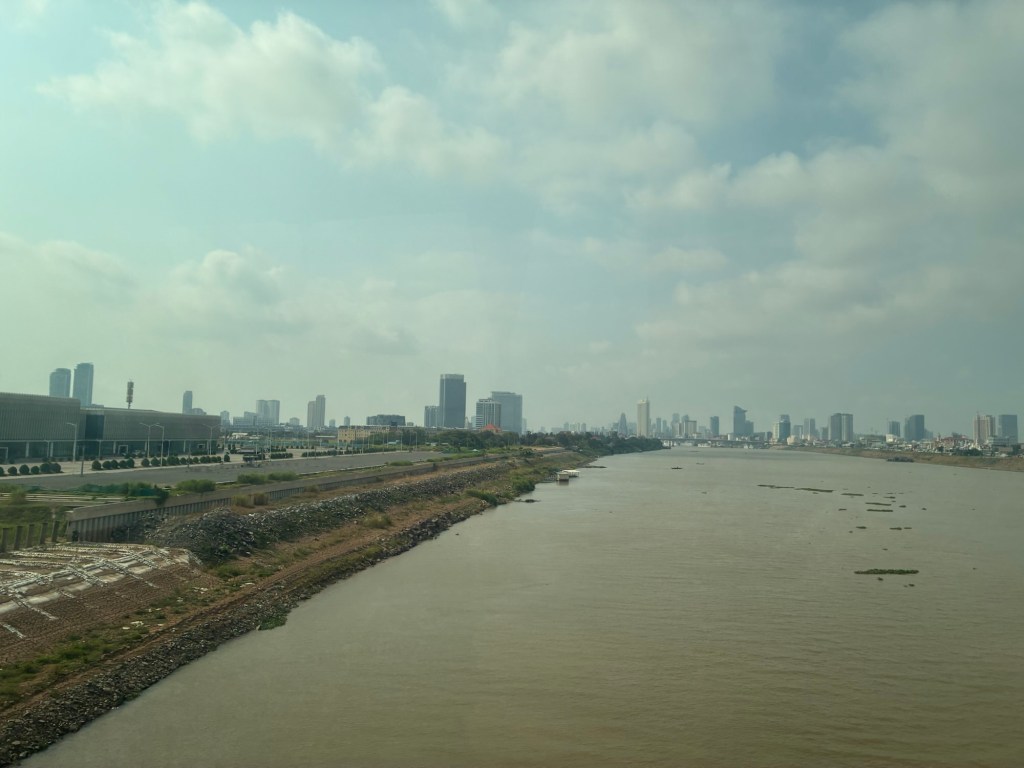
I noticed fairly quickly that the writing on signs looks a lot like the writing on my tattoo! Maybe someone here can translate it.
The bus informed us that the street their station is on is closed on Sundays, so we’d be dropped off on an adjacent street. I didn’t mind; it was closer to my hostel anyway.
I walked there in about ten minutes. As I walked down the road, I got passed by a British couple I recognized from the bus! I caught up to them and laughed that it took them as long to get a ride as it took me to walk!
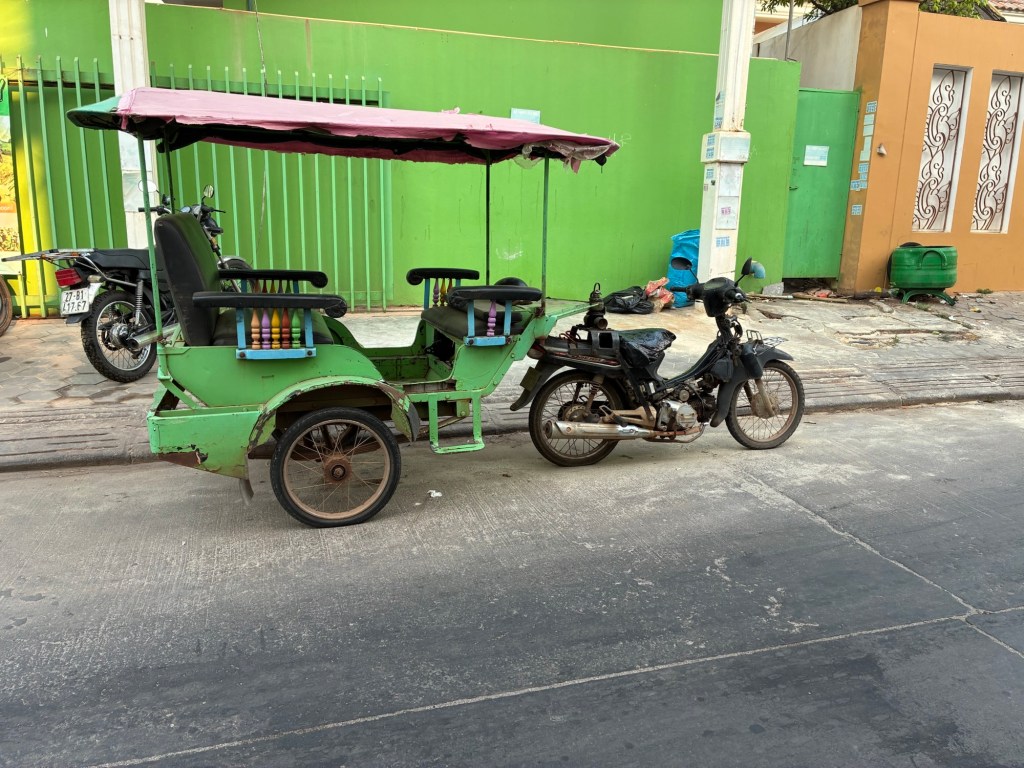
Cambodia had tuk tuks on Grab as well, but they also have something else called a remorque, which these days is a carriage attached to the passenger seat of a motorcycle. It’s basically a modern day rickshaw, but tourists love them.
After 2-3 weeks of hanging out with Vlad the cheapskate, I regretted the price I paid for my hostel room in Phnom Penh. I’m sure there was cheaper, but I was too tired to bother trying. I did cancel the hostel I had booked in Siem Reap and found a cheaper option there.
Also, despite the popular opinion of Cambodia as the cheapest corner of South-East Asia, I found it more expensive than Thailand or Vietnam. I couldn’t find a meal cheaper than 2 USD, when we had found meals for 50 cents in Vietnam. I later learned that a lot of their food is imported, but I suspect part of it is lack of volume. Because they don’t reliably have high tourist numbers, there’s no incentive in coming up with some high-volume low-margin foods.
I also found that most hostels, or at least the ones I looked at, have an attached restaurant and don’t like you bringing in outside food. Not that it matters much, it’s not hard to find a street food vendor and grab a quick bite, but I do enjoy bringing food back to the hostel sometimes. Not to mention, the hostel in Phnom Penh had waaay overpriced food.
I didn’t do much that night. I had an idea of swimming in the rooftop pool, but it was infested with 20-somethings and I didn’t fancy trying to mingle. I ordered an overpriced meal at the restaurant and went to bed.
I woke up in the middle of the night freezing cold, and put my socks and jacket on to sleep. I later found out the hostel had the room temp set to 16! That’s just wasteful. I asked them to put it to 21, but honestly that was still pretty chilly as well. You get used to insanely high temps after a while, and too much AC is a shock to the system.
My roommate was another Canadian, funnily enough, although she came from the other direction, which I thought was a bit insane, but what do I know. She was heading to HCMC the next day, so I traded her my leftover dong for some riels.
Money is funny in Cambodia. The generally accepted exchange rate is 4’000 riels to a USD. Prices are priced in USD about half the time, so lots of mental math. You can pay with USD at the counter, but they’ll usually give you riels as change. Of course, I was keen to break the 100 dollar bill Vlad gave me and have some smaller bills to carry around, anyway.
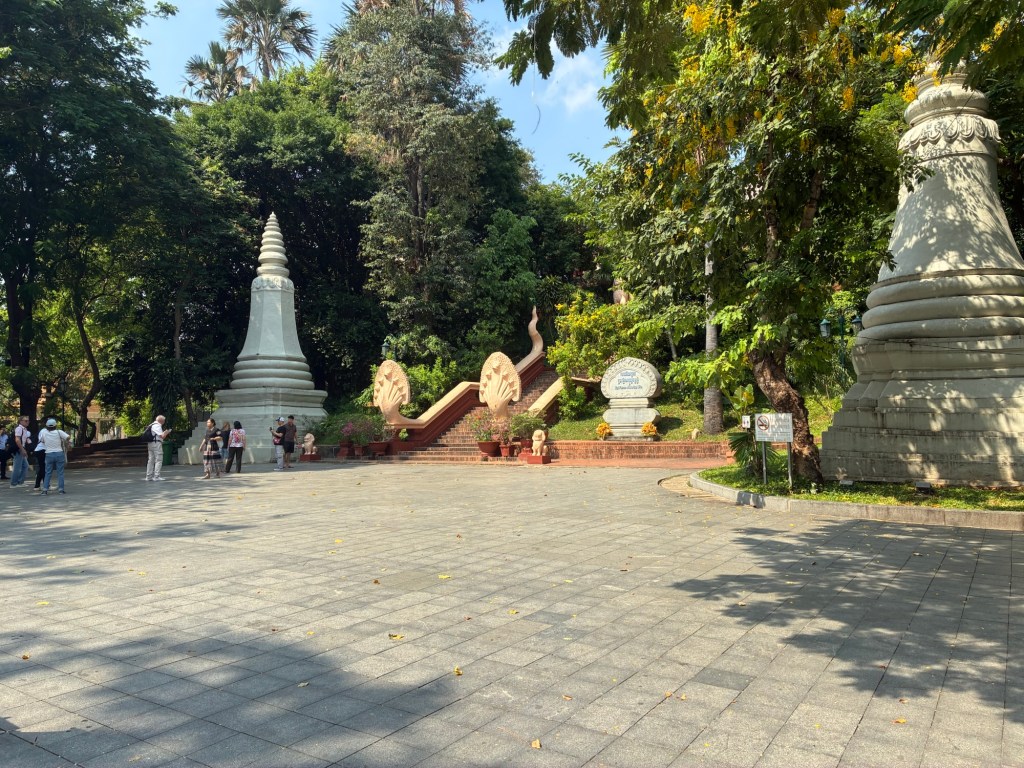
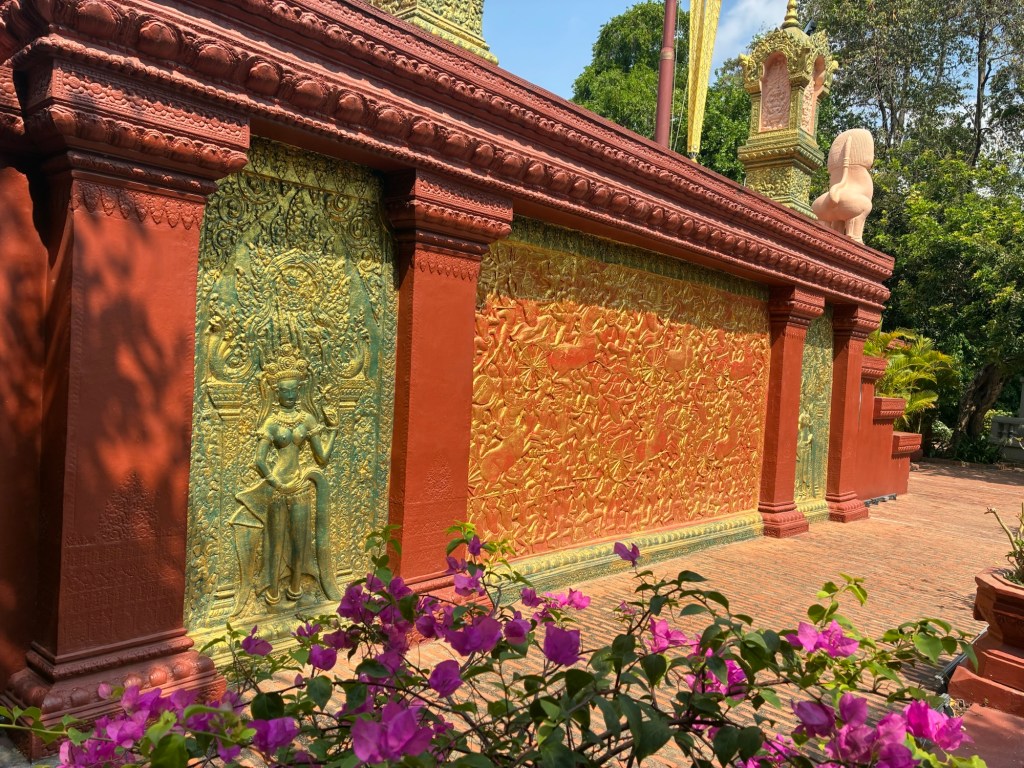
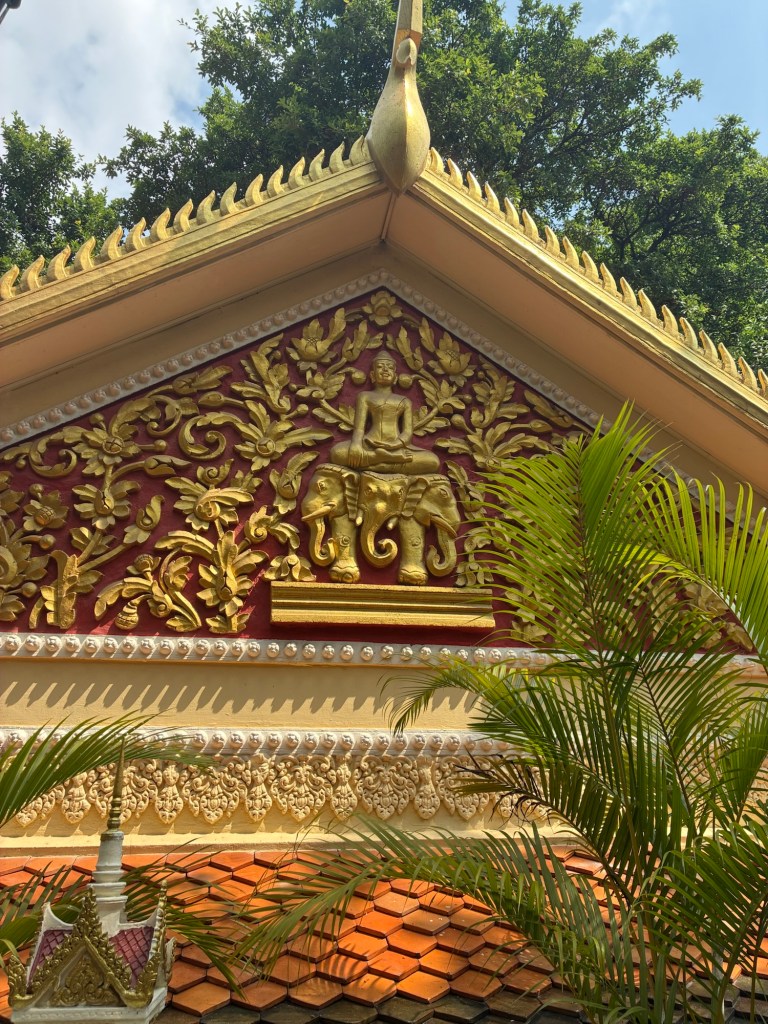
After I got breakfast, I went on a stroll. Wat Phnom Daun Penh is just around the corner from this hostel. It costs one dollar to enter (get used to having “one dollar” yelled at you).
Another thing I noticed right away in Cambodia is the number of Naga statues; they are everywhere. Some people have odd familiarity with Naga, like DND nerds – people tend to use Naga as a shorthand for “snake people”. They are snake people, half snake-half human, 7 headed snakes… the iconography is varied. The general gist is that they are water spirits and the spiritual ancestors of the Khmer people. It’s said that the Khmer empire was created by a mysterious woman named Queen Soma, a Naga who was a warrior queen, also known as Neang Neak (dragon lady). Statues of her walking with her husband carrying her train are common.
I say mysterious because I’m sure there’s more stories out there about her, but I can’t find anything more than what I have relayed.
Anyway! The temple was nice, if simple and small. Despite having been around since 1373, it’s in pretty good shape. The monkhood isn’t strong here like it is in Thailand, so there’s less of them around. I was also amused by the number of topless apsaras in the reliefs. I guess female topless nudity wasn’t that big of a deal before, but it’s funny now, since we have to cover our shoulders to walk past a bunch of nipples. The main temple also had some lovely original artwork on the ceiling that I could not photograph.
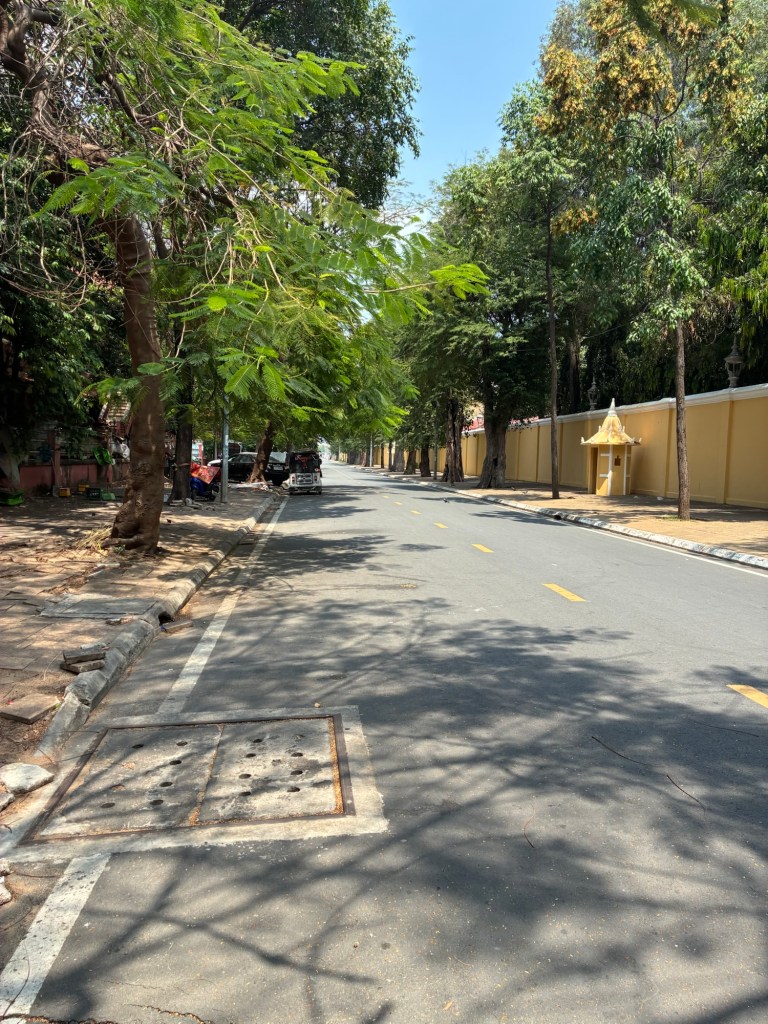
After I was done, I walked on a circuit around the main tourist core. I was burned out from travelling, so I had already decided I wasn’t going to bother doing the museum or the palace here. I only stopped here for the Soroptimist club, actually.
I had a hard time finding an ATM with money in it. The first couple I tried appeared to be out of cash. I was also being a little finicky, trying to find ATM’s that dispensed 20’s so I wouldn’t end up with 100’s. 100 dollar bills can be especially hard to break here; clerks will often reject them.
Tube and clamp appears to be common here; bracing, less so. They seem to use tie-ins infrequently – I noticed a lot of scaffolds leaning on a prayer.
I found a vendor selling Korean corn dogs for a dollar and bought a couple. I also grabbed some food for my breakfast the next day.
The hassling continued from Vietnam, although not to the same degree, some touts will chase you down the road yelling “one dollar!” and it can be hard to dissuade them.
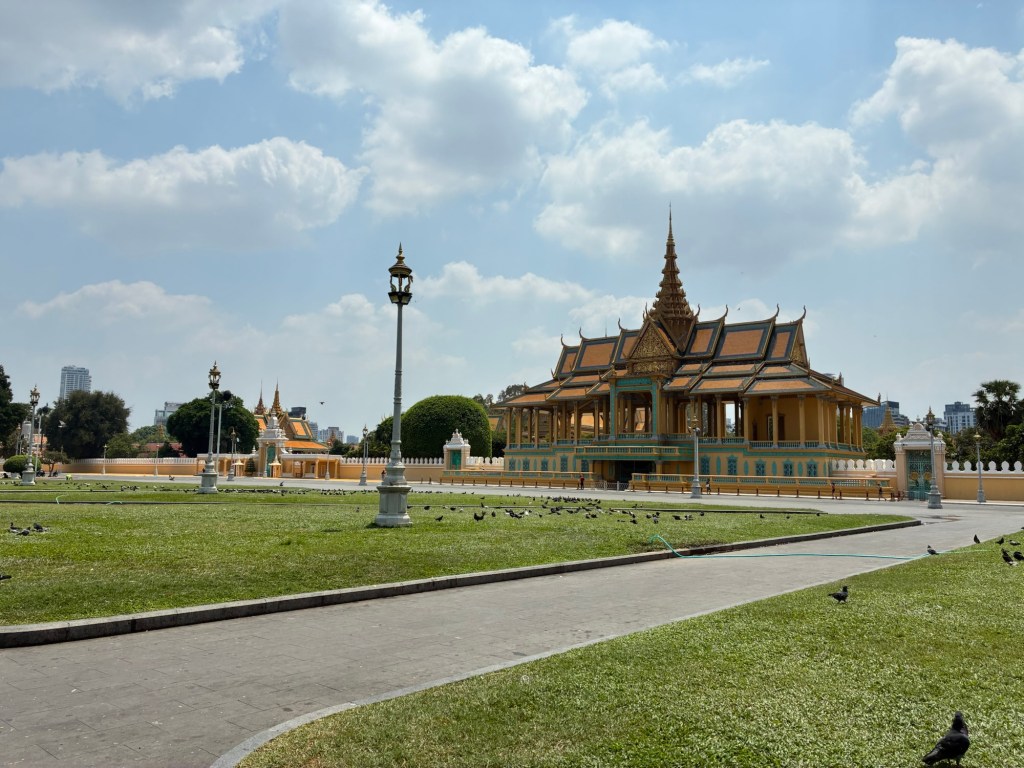
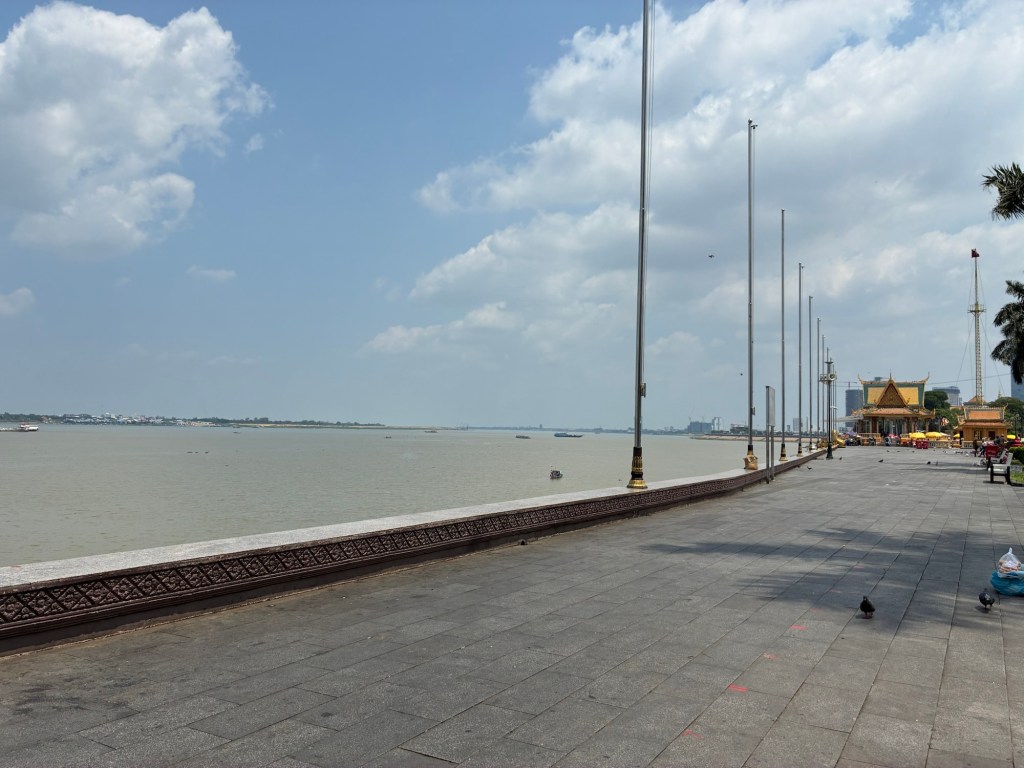
Around 2, I went back to the hostel and flopped in my bunk for some AC. At 5:30 I had to meet Linna for dinner.
When I went through the lobby, I stopped to ask the clerk if she could read my tattoo. She knew what I was going to ask before I even finished asking, “Ah, no, no one can! That ancient writing, only monk can read.”
Hmm…
The place wasn’t that far to walk – only 40 minutes – but I was still tired and it was the heat of the day, so I got a Grab there.
Linna was slightly late. She arrived riding a hot pink scooter and dressed nicely in a white suit. She seemed surprised I had come at all, even though I sent a courteous “looking forward to meeting you” the week and the day before. The first thing she said to me was “wow, you’re tall!”.
No, I’m not tall. I just wasn’t raised in poverty.
She talked to the hostess in Khmer, and I was instantly transported to a world of luxury. White-gloved waiters even pressed the buttons in the elevator for us. We went up to the top floor, where there was a rooftop restaurant with a glass railing.
She insisted on a hug at this point.
We sat at the table and ordered drinks (I just got water). The waiters arrived every time the ice in my glass melted to deposit a fresh cube.
I leafed through a menu, but I was hopeless lost. After the second member of her club joined us, Linna ordered some standard Khmer dishes to share. The second member introduced herself as Bunthary, and she was also dolled us, she later said because she had come from a meeting with a government official. Both of them stared at me like I was a rare creature.
It probably doesn’t help that when I am unsure of how formal to be, I go for maximum formal. I wore my black shirt with my pencil skirt, and I immediately unfolded my napkin and laid it across my lap. I made sure to pick up everything with chopsticks, but then I noticed Linna using her fingers and realized I was trying too hard.
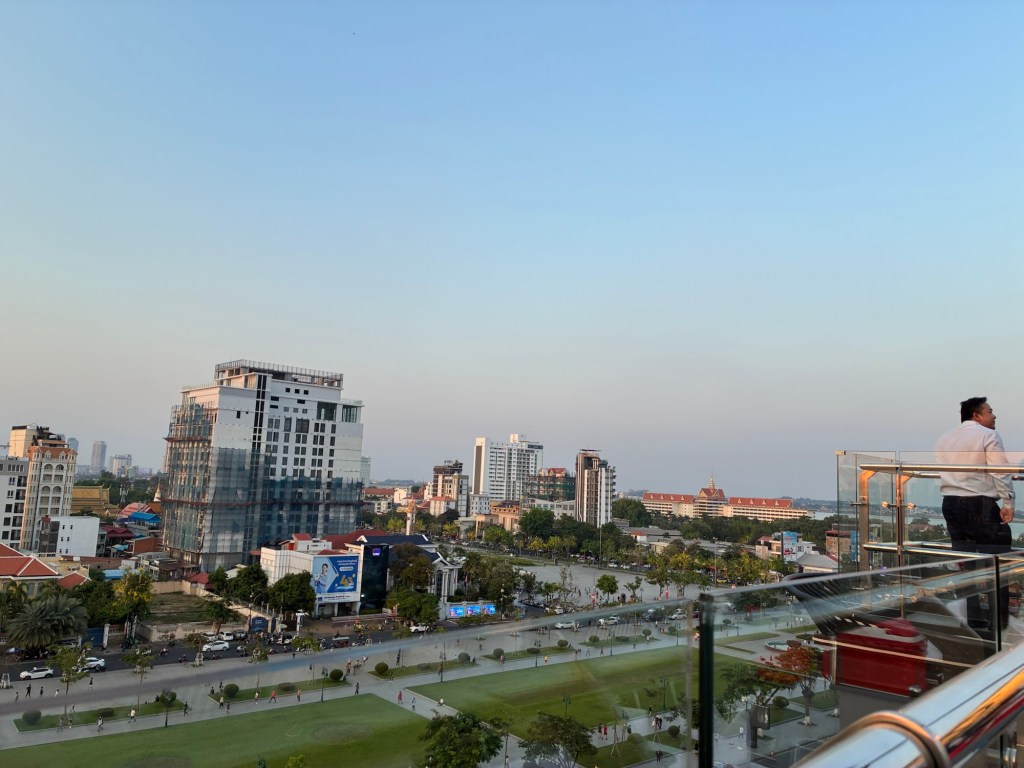
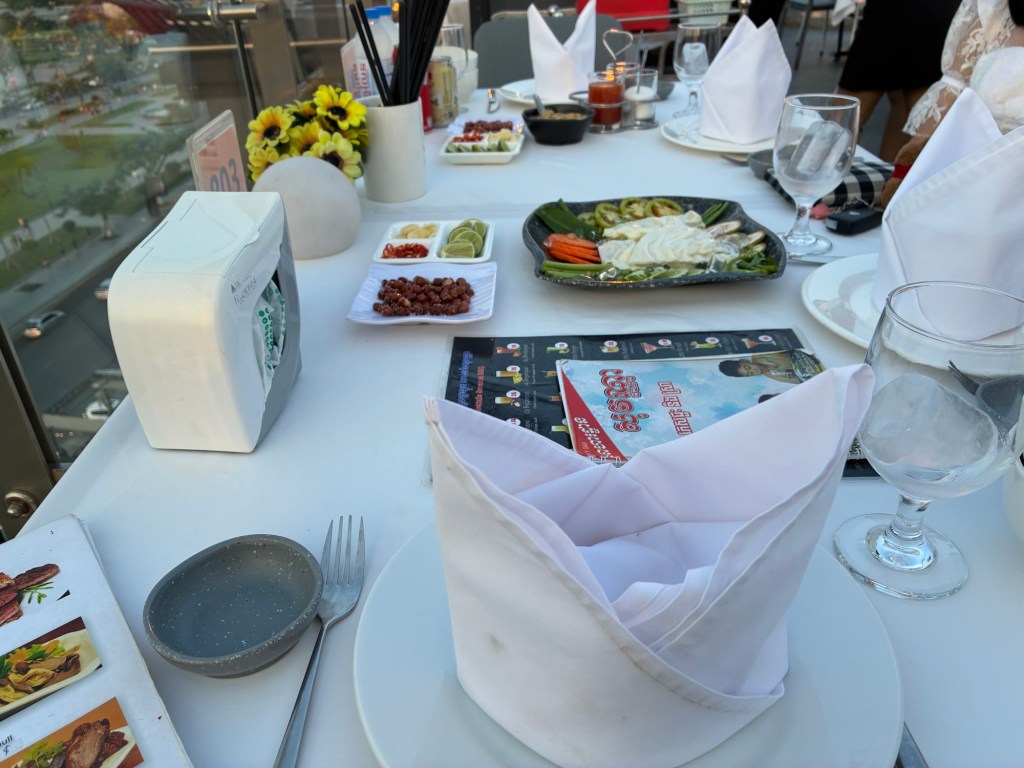
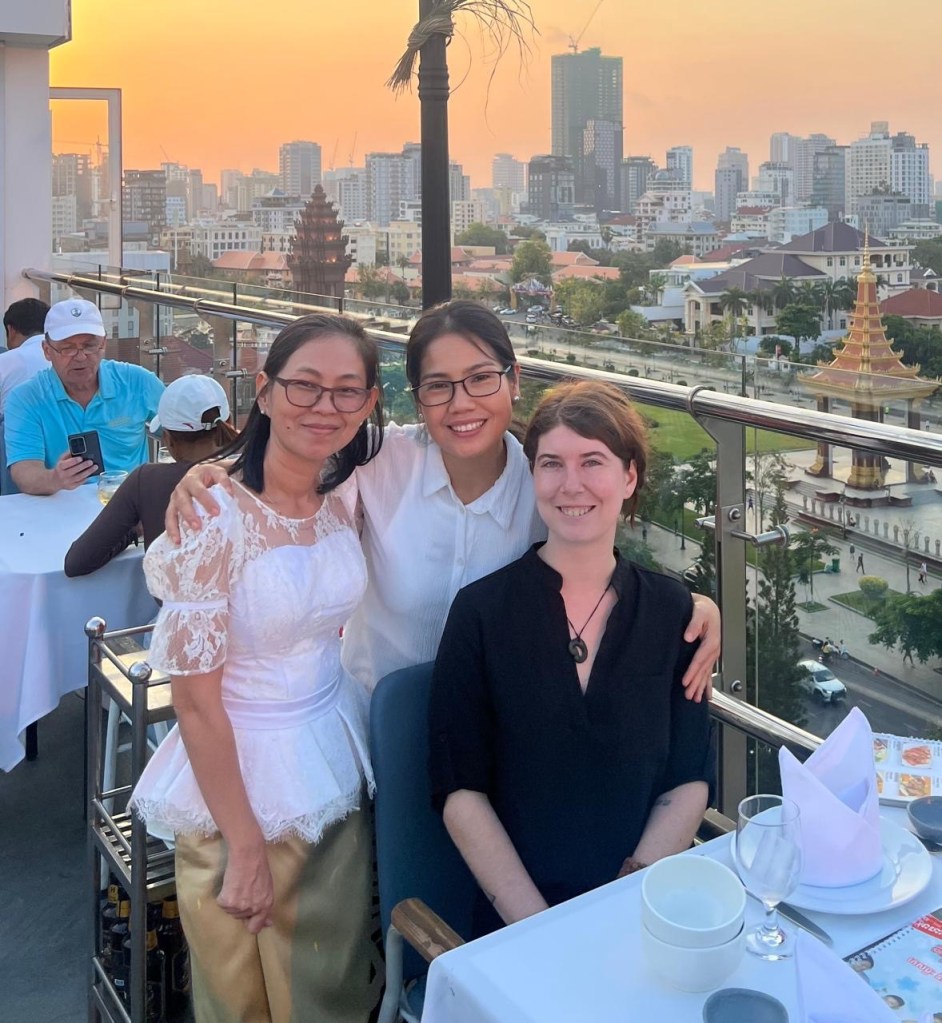
They were very interesting to talk to, very driven. Bunthary works for a NGO that works with wild animals, such as protecting sea turtles on the coast. Linna works full time for the government and is also raising 4 boys; 3 sons, and one nephew (I didn’t ask). The club has been around for 17 years, holding steady at 20-ish members.
It’s hard to comment on someone’s poverty in a delicate way. I asked about the economy, and Linna readily admitted their economy is crashing. A good chunk of their money came from USAID, which is now dead. The war at the border with Thailand is giving them trouble as well; the town that serviced the border crossing now has no income.
“I am going to the conference in Kota Kinabalu. Will you be there?” I asked.
They looked at each other. “Not this year.” They said, in a tone that implied the answer is usually no anyway.
I looked out over the city for a minute, trying to compose myself. My heart twisted right away, my bleeding heart… It’s hard to have a voice when you don’t have a seat at the table. And considering this federation also includes the Australia, Singapore and Hong Kong, they aught to help out with making sure everyone can join.
Am I crazy? I thought for a long moment.
“I know my Federation offers one free attendance to a representative. Is it just the airfare? I could help out…” I offered tentatively. After all, the price of a flight there and back, while not a small chunk of change, is still much smaller for me than them.
They looked at each other again, “We don’t get a free attendance either. We have to pay conference fees, airfare, accommodations…”
“Oh jeez. That’s…” That’s not fair!
“If you could cover accommodations, we can manage the conference fees.” Bunthary says.
“But, could you find a second donor, so two can go?” Linna adds.
My heart sunk immediately. I’ll never convince anyone to join me. But I nod, “I’ll ask.” They’ll tell me no, but who knows. Maybe someone will remember some obscure funding option. Or have an equally bleeding heart.
The rest of dinner was fun. They ordered some beef dish, some fried taro dish, sliced vegetables, Khmer sauces. None of it was particularly foreign, but maybe that’s just how well travelled I am. I remember some pho Vlad bought us, he explained that the beef is raw and then the boiling hot stock cooks it, and I knew that already because I’d had it with my mother and her professor when I was 14. Dessert was mung bean in gelatin, wrapped in banana leaves.
We all gelled really well and I liked these girls better than the ones in Bangkok. I mentioned I might work in Cambodia as an English teacher and they really liked that idea.
After dinner was paid for – Linna accepted the bill – we went downstairs to hop into Bunthary’s car. Her niece was waiting downstairs for us; her name is Sineat, and she is both happy for an opportunity to talk to me and visibly terrified of me. She used to be a Soroptimist; she says she quit because she was too busy, but I discern that the real reason is lack of money. I try a few times to break the ice for her and eventually manage to reach her by asking which country she would want to visit if she could visit any.
“Switzerland.” She says without hesitation. She rattles off a fantasy about the snow capped mountains.
Hmm… doable. What do you think? I love the idea of seeing the look on her face as she steps off the plane in Switzerland. I feel like she would love it more than I would.
We drive around downtown for a bit, pointing out things. We stop at a night market and walk around. Everyone adds me on Facebook, then Bunthary drops me off at my hostel.
I woke up naturally around 7:30. Since I already had food, all I needed was a drink and a tuk tuk.
I walked up the road a bit and got an iced matcha from a kiosk for 2$. Then I summoned a tuk tuk with Grab; 4 dollars. The drive was almost 40 minutes, being 11 kilometers outside of town (tuk tuks are not fast). I ate my breakfast and drank my matcha and absorbed the scenery.
The Killing Fields museum is a small, modest establishment. You pay 6$ to enter, they give you an audio guide for free, and most of it is outdoors, in a small field maybe 200 meters across.
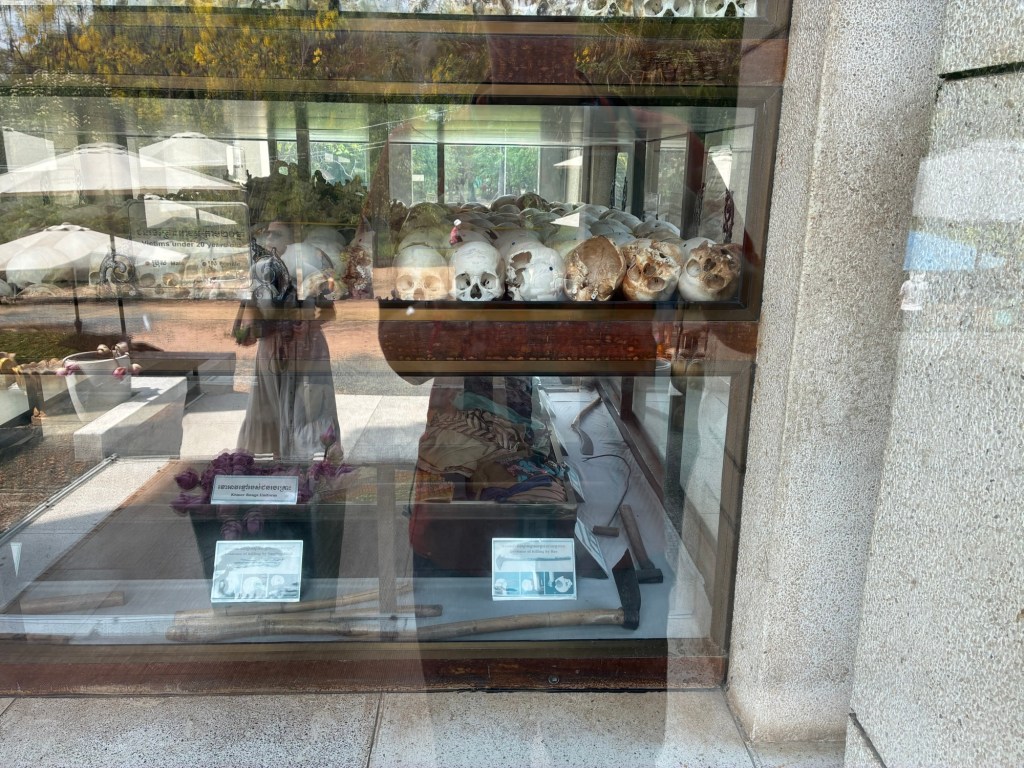
The first thing that confronts you is the large stupa in the middle. From the distance, with the glare of the sun, I didn’t notice what was inside it. As I got closer, I realized…
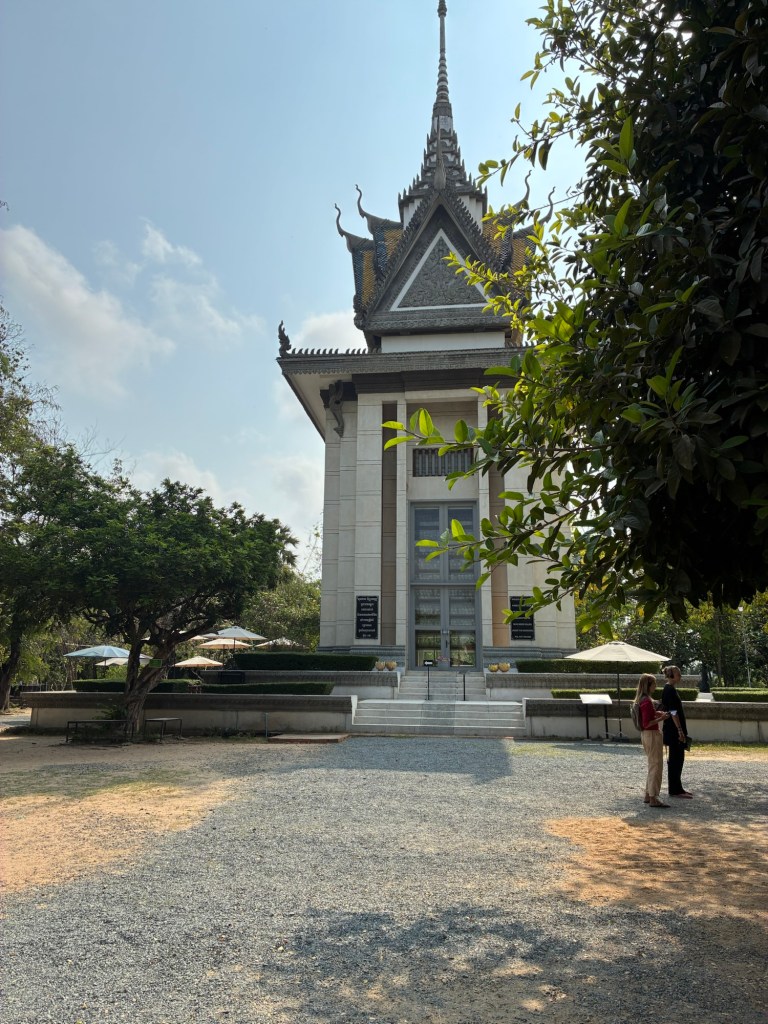
Skulls.
9’000 skulls.
I assume most people had heard about the shelves and shelves of skulls, but to be confronted with them, grinning from behind the gleaming glass doors, was something else.
I burst into tears immediately. A few people listening to their audio guides nearby turned to look at me, in curiosity.
Stop crying.
I ground my teeth together and the tears cut off immediately. I wiped the trails away.
In case you haven’t heard of the Killing Fields, a brief history. Cambodia has suffered for a century; both Thailand and Vietnam have hacked off bits of the territory France assigned them. The Vietnam war spilled into their borders, and in the midst of the fighting, the Khmer Rouge rose to power, led by a man named Pol Pot.
Pol Pot is the antithesis of Ho Chi Minh, depending on your opinion of Uncle Ho (I, for one, have a pretty good opinion of him). Both are men of myth and legend; born to obscure rural origins, they were both educated by the French Communist party in Europe and came back to change their countries, adopting an alias in the process. Except no one even knows what Pol Pot means… it’s not Khmer.
Pol Pot had a dream of a “pure” agrarian society, happy rice farmers who wanted for nothing but owned little, and knew nothing of the influence of Europe. When his uprising seized power in 1975, he declared it Year One.
Then the marches began.
They emptied out cities around the country, like Phnom Penh, and marched the urbanites into the jungle to become rice farmers. Owning anything was forbidden, and no training was provided to the city dwellers who had never farmed a day in their lives.
With an efficiency surpassing the Nazis, they set about killing anyone who disturbed Pol Pot’s vision. Even having glasses was enough to mark you for death; it meant you were an intellectual, tainted by Western influence. Bullets are expensive, so prisoners were executed by whatever was handy; knives, the infamous gardening hoes, even sharpened spears of bamboo. The bodies were thrown into pits and dusted with chemicals, to hide the smell and to finish off anyone who might cling to life. Loudspeakers at the Fields blared patriotic music all hours of the night and day, to cover the sound of screaming. In the space of 4 years, somewhere between 2 and 4 million people died; a quarter of Cambodia’s population at the time.
No one was spared; entire families were wiped out. Babies were ripped from their mother’s arms and their skulls bashed open on tree trunks, to prevent anyone from coming after them for revenge. Any soldier who was though to be a traitor was beheaded and buried without their head.
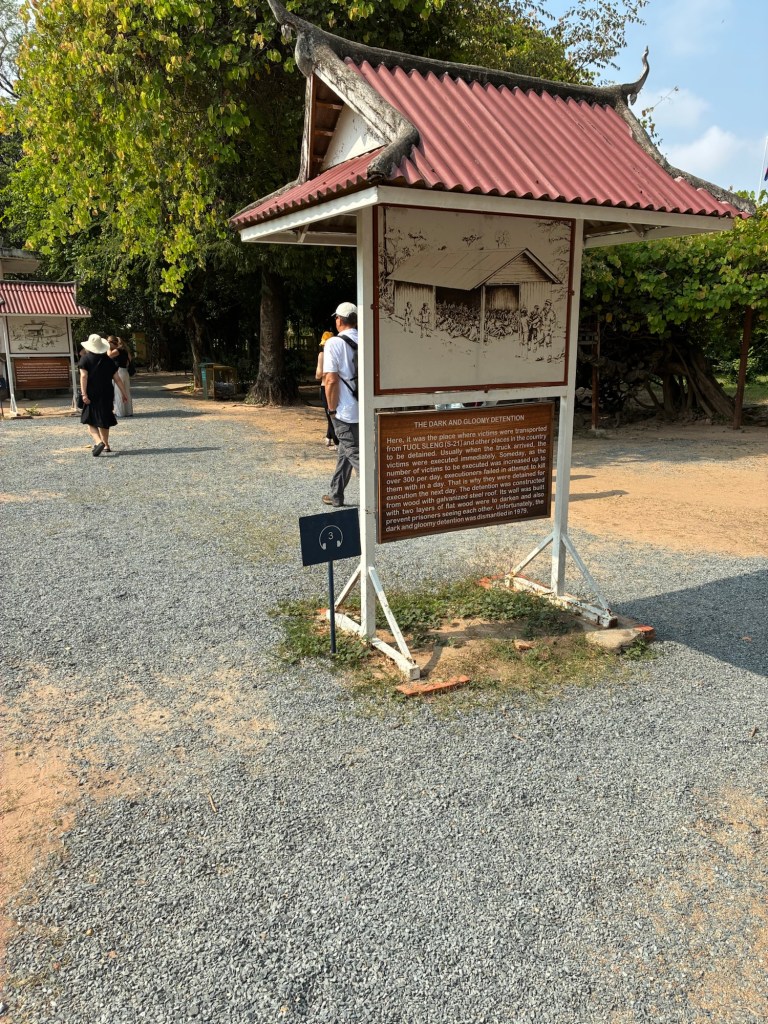
By 1979, the Vietnamese had had enough. Since they’d gotten their shit sorted out, they invaded Cambodia and toppled the government within 2 weeks. The killings stopped.
What’s incredible is what happened next. Pol Pot was not captured or killed; he fled into the jungle with his surviving forces and set up a government in exile. Because the Americans continued to be afraid of the specter of Communist Vietnam, they declared the invasion unlawful and Pol Pot the legal leader of Cambodia, reserving a seat for him at the UN.
Eventually, Pol Pot died of poor health (although there are rumors he was assassinated) and with the fear of Communism slowly fading in the West from the fall of the Iron Curtain, Cambodia started to heal.
Started.
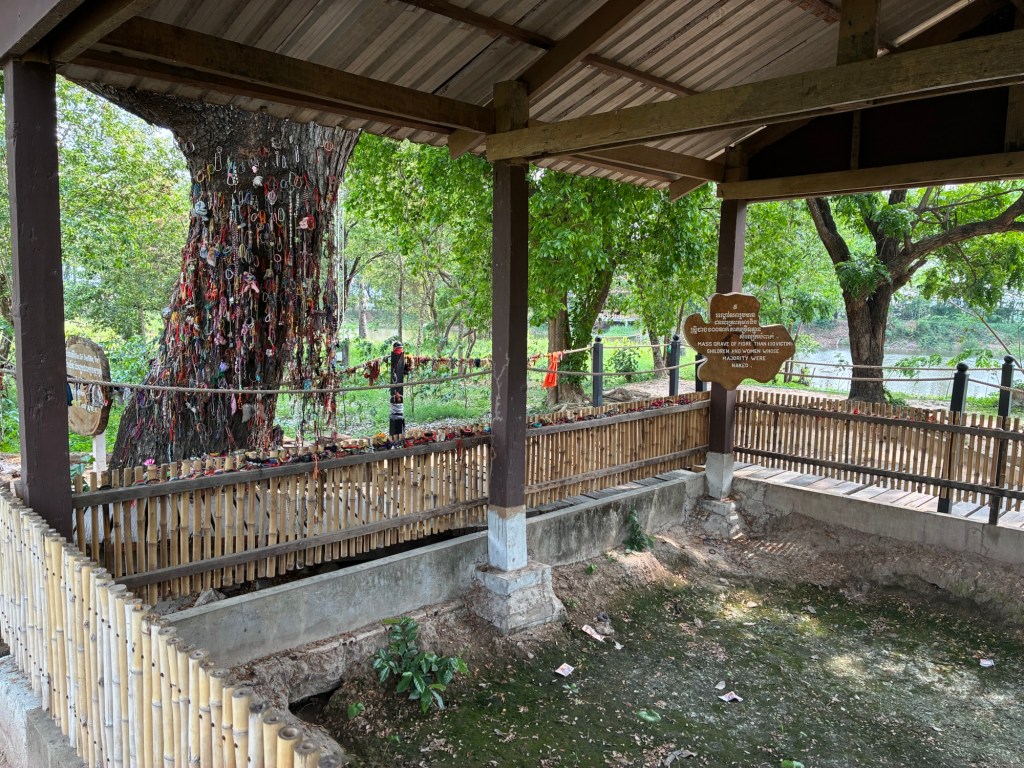
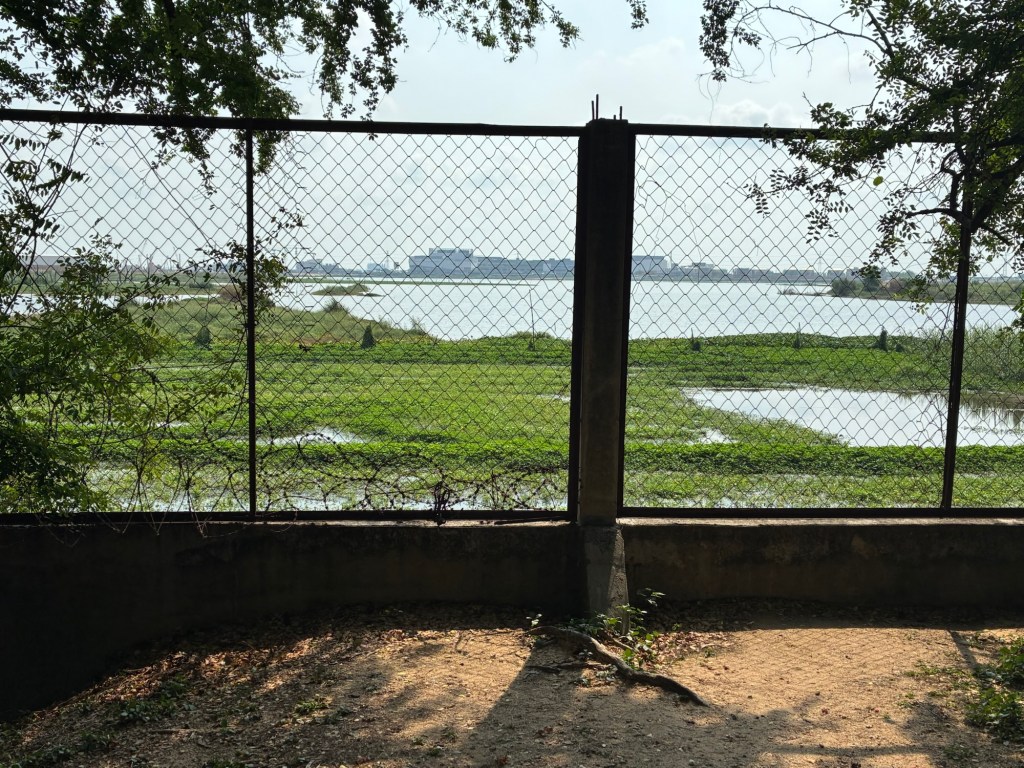
The Killing Field at Cheong Ek is interesting because before it was used for that, it was a graveyard for Chinese immigrants. Why chose a graveyard for war crimes? To pretend the bones had always been there? Because it’s secluded? A superstitious belief of keeping death in one place?
They haven’t even exhumed all the bodies. There’s a small pond on the property; they’ve decided to let the bodies under it lie. Some of the burial pits were 5 meters deep, after all.
It’s a nice walk, around the pond.
I dissolved into tears again, shaded by the palm trees. Still within living memory… and yet it’s happening again. How can we say each war is the last, and then jump into another? How can we say “never again” and then ignore more bloodshed? Ukraine, Palestine, Iran. People are dying horribly every day and we quibble about the cost in dollars, in oil.
What the dollar value of a life, hm? I’m curious.
I had a friend who did tours in Bosnia and Herzegovina (yes, he’s a little bit older than me). Matt never really came back from the war. He signed up to pay for his engineering school. They handed him a rifle at basic and told him “don’t worry, you’ll never use it”.
They were wrong.
I haven’t talked to him in a while. He was hard to get ahold of. He’d come by when he wanted to unburden himself of something. After a particularly bad day, he told me about the time his squad found a fresh mass grave. Among other things.
We talked about going to Ukraine when the war started. He would always talk about signing up again; going back to the only world that made sense to him. And I was feeling hopeless, before carpentry set me free.
Eventually I gathered enough courage to leave.
Most people go to S-21, the “genocide museum”, as well, but I had seen enough. My soul couldn’t handle more.
The tuk tuk ride back to the hostel was shorter.
Still shaken, I flung myself on my bunk and cried more.
Linna is only 45. She was born shortly after Pol Pot was deposed, then. What does she remember? How many family members did she lose?
How close was she to being one of the babies with their heads bashed open?
Eventually I was forced to peel myself from my bunk by my grumbling stomach.
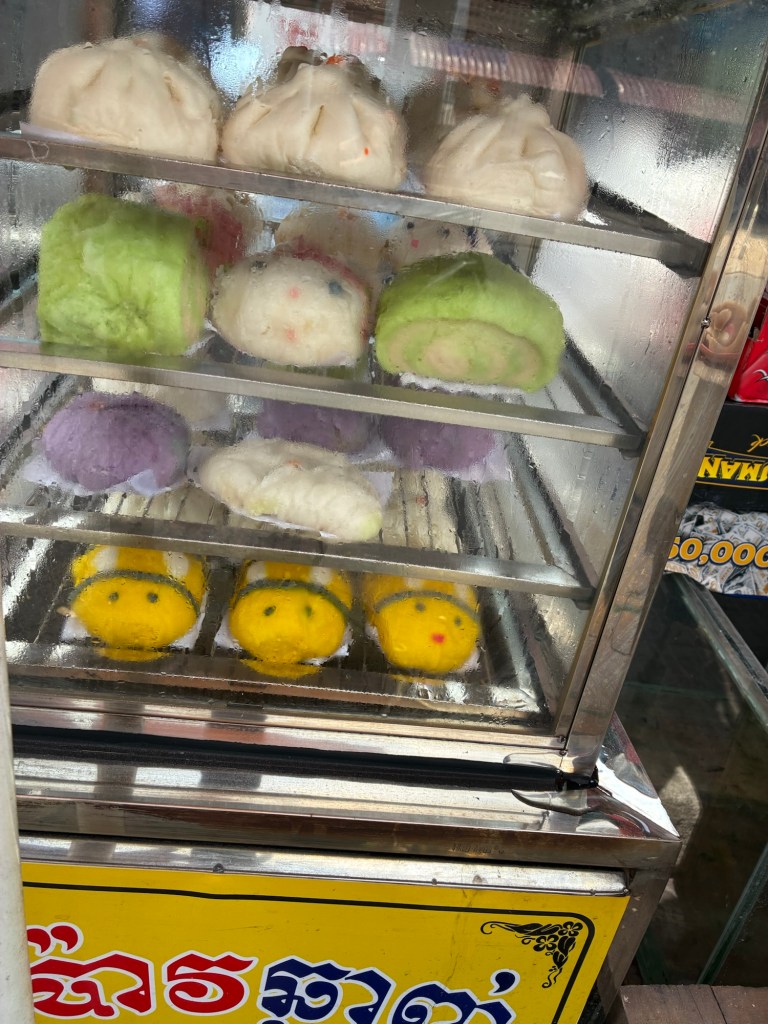
I found a vendor around the corner from the hostel selling Vietnamese bao. They looked like little bees, too. I bought two, and a bottle of Pocari. The woman selling them was very kind; I suspect she could see the skulls behind my eyes.
A pleasant surprise for the day: Vlad booked a ticket to Kota Kinabalu! I hope the place I’m working would be ok with him staying… he doesn’t mind working for his stay.
In the afternoon, I also went for a swim in the pool. It wasn’t much of a pool – for some reason, half of it is only ankle-deep – more for lounging in with a cocktail than doing laps, but I made it work.
Off to Siem Reap tomorrow.
 Wanderjahre
Leave a comment