By Lucy
Housekeeping notes: posts will be moving back to weekly for at least April. I have settled in to my place in Malaysia and I don’t imagine there will be enough going on to justify two posts a week. The wifi here is very spotty and I have no AC, so work is slow.
Additionally, I’m strongly leaning towards coming back to Canada in August. The war is changing things rapidly. The obvious change is flights; prices have tripled over the last month. That upsets me because I don’t even want to be flying as much as I am, but despite all of these countries being islands, with the introduction of cheap airfare, many of them have done away with international boats in favour of forcing everyone to fly to the main airport. In the long term, this will also force up the price of food, and the situation in several countries looks very bleak.
I woke up early for the bus.
Funnily enough, the British couple who were on my bus to Cambodia and staying at my hostel were also on the bus to Siem Reap!
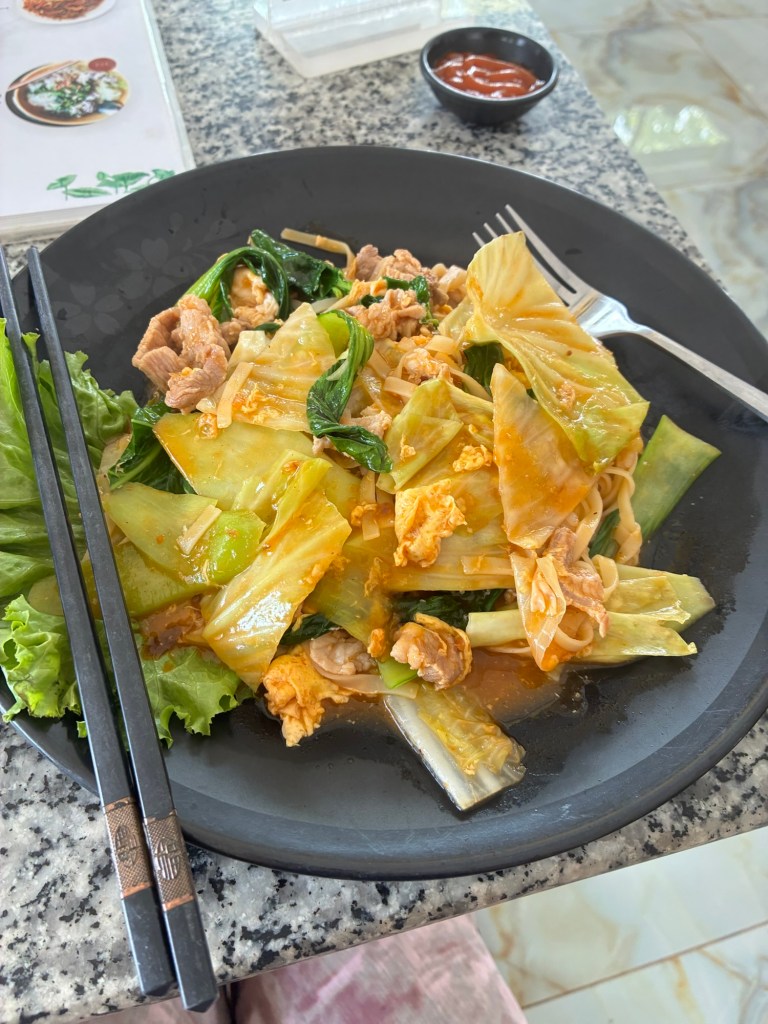
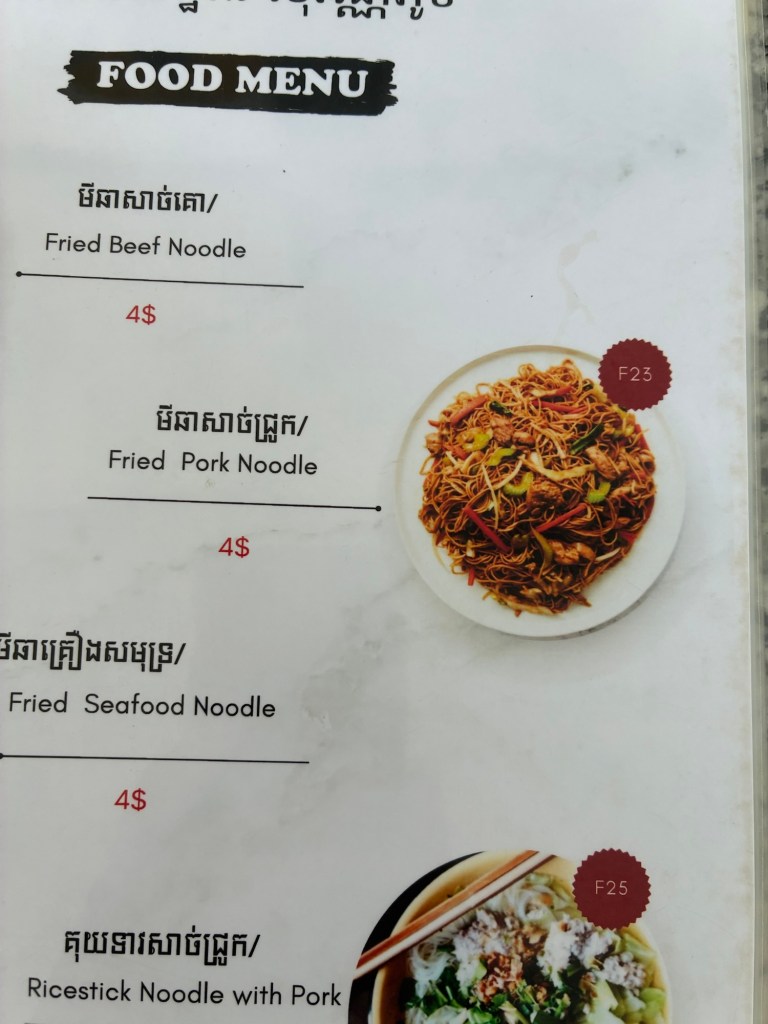
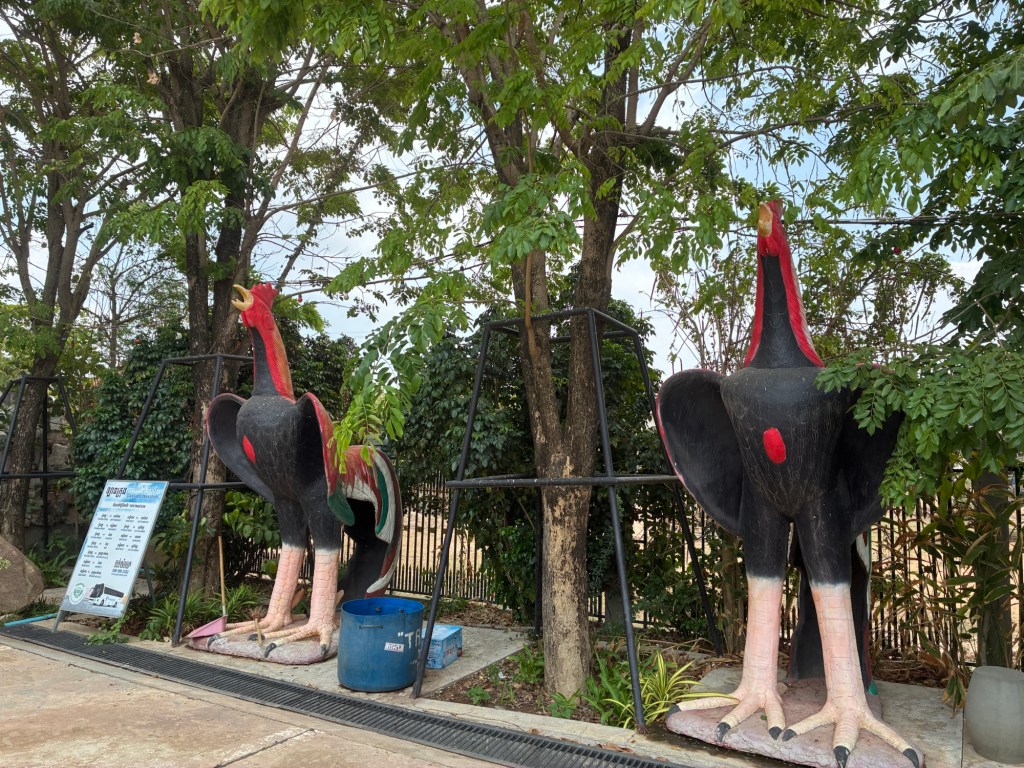
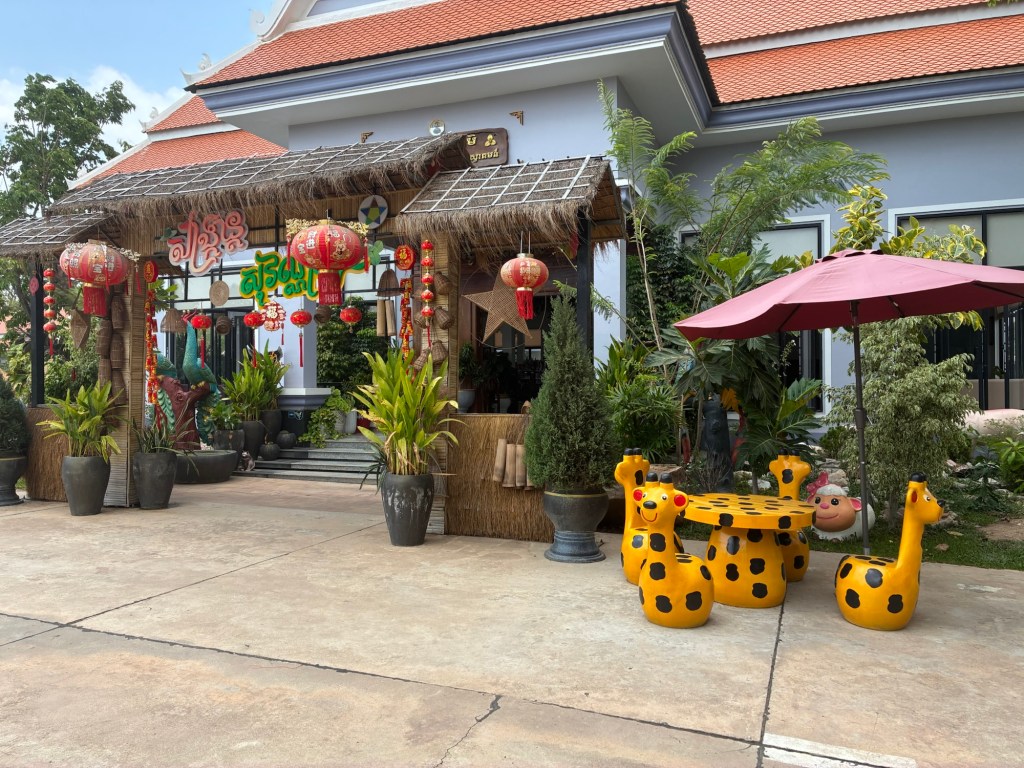
The bus ride itself was fairly boring. We stopped for lunch at a roadside cafe where the food did not match the pictures on the menu.
Janessa lost her license. She made the newspaper doing it, too. I cracked a joke about her being a true scaffolder and she said everyone keeps telling her that. I’ll spare posting the details, but I worry about her.
Siem Reap used to be a small town that’s been around about as long as Angkor has. It’s about 6-10 kilometers from Angkor, depending on where you measure from. When Angkor became a big tourist draw, it boomed, as the logical jumping off-point to visit the ancient city. Not always to its benefit; much of the expansion has been undermanaged and the temples are sinking from too much groundwater extraction.
Despite the depiction of Angkor as lost and forgotten, it was neither; there are written French records indicating people were still living there into the 1700’s. But the massive force of carvers needed to maintain the sandstone reliefs, and the gardeners to clear off the plants, were no longer there, and so the jungle swallowed it. The wooden houses rotted, leaving behind only the stone temples.
This is where the whole “ancient aliens” thing becomes so very racist. The idea that “these yellow savages” couldn’t build such a civilization lends itself to alternative thinking. Conversely, knowing that Asian civilizations were building massive cities with intricate plumbing systems while London was still a collection of mud huts forces a reconsideration of what we think people are capable of.
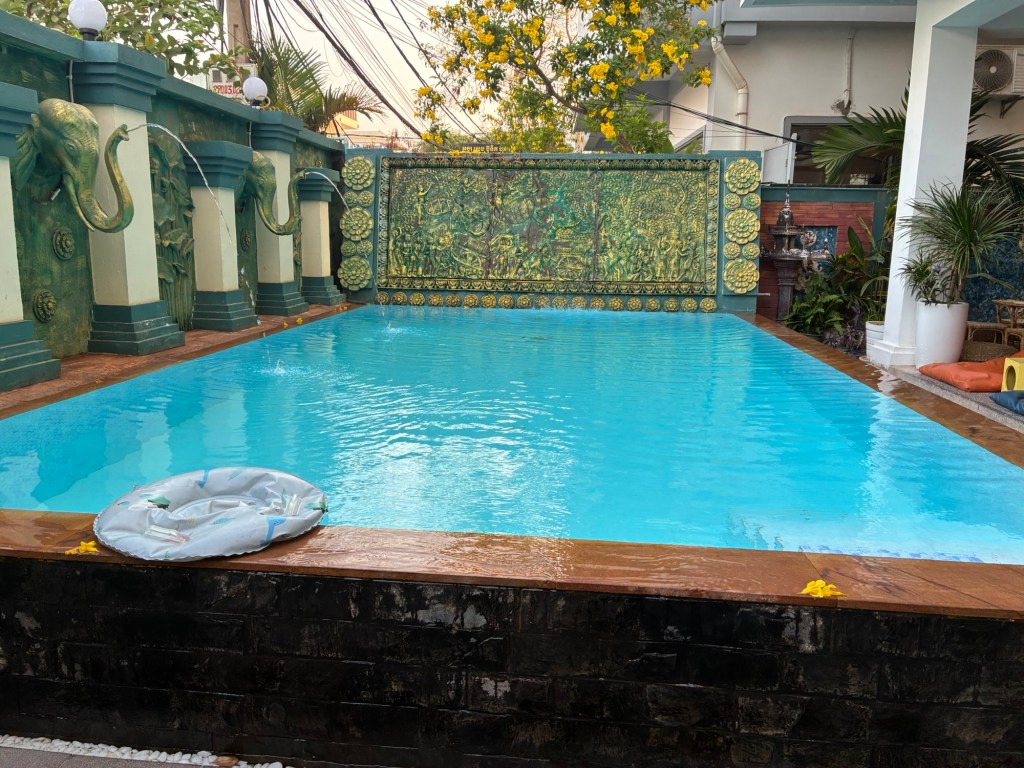
We got to Siem Reap around 3:30. I walked half an hour in the boiling sun to reach my hostel, which also had a pool, restaurant, and signs saying not to bring in outside food, although at least they didn’t have overpriced food. Actually, their food prices were comparable or slightly cheaper than some options, so I wasn’t complaining. Unlike the hostel in Phnom Penh, they turn the AC off in midday here. The pool is nicer.
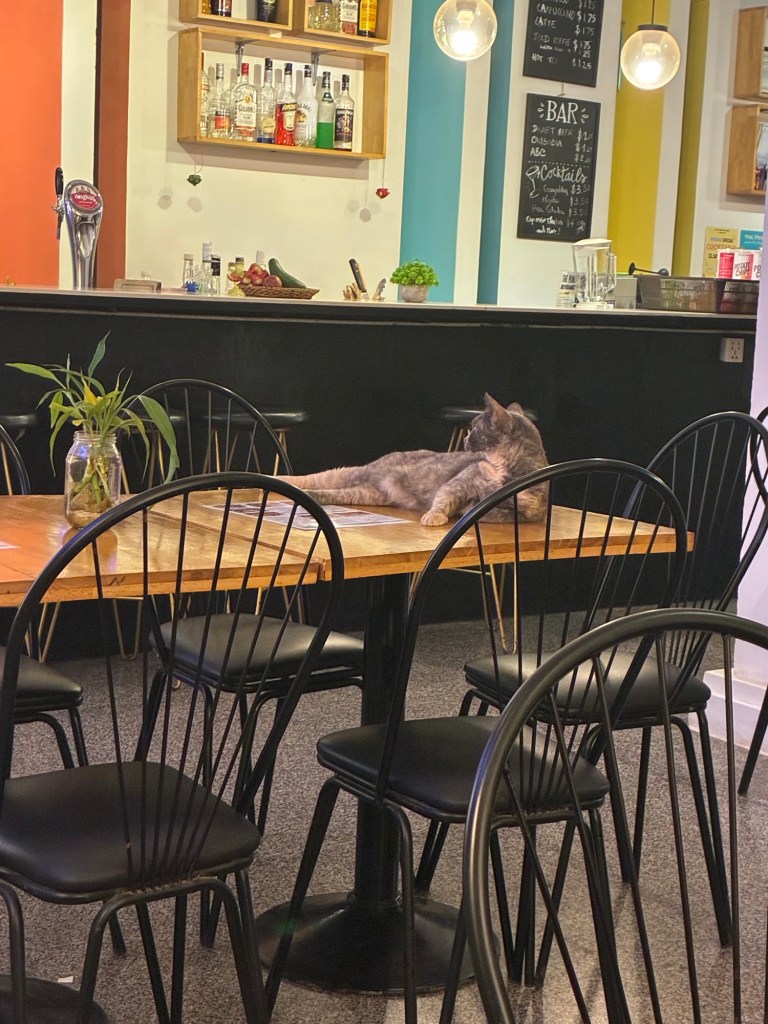
On the walk, I had smelled the most amazing smell… when I passed it, I realized it was a fried bug stall! It was too far away to go back and grab any, so I didn’t. Instead, I found a place on my street that served gar parm wings and fries with blue cheese dip. They were very good and I went back frequently enough that the server remembered my order.
I started watching season 4 of Stranger Things. It didn’t take even a minute for me to realize the soft-spoken orderly is actually Vecna, because I recognized the actor immediately; it’s the blonde guy from Sweeney Todd! I wish he was in more things… he’s really cute. I’d join himas a villain immediately. I mean, he’s also a deadly actor; he’s really good at turning from genial to sinister, on a level with Anthony Hopkins playing Hannibal Lecter. His speech in Episode 7 is chef’s kiss.
I slept alright. Despite this not being a party town or a party hostel, and the fact that Angkor is best explored as early in the morning as possible, my roommates kept being people who stayed up late into the night.
I ordered breakfast at the hostel and then a tuk tuk to the gates of Angkor. The tuk tuk drivers can be annoying here; the city is big, even by modern standards, and a lot of the drivers try to angle for you to pay them to be on standby. Which, to be fair, probably makes a lot of sense to the average middle-aged, well-funded traveler, but not me. And I prefer to walk.
The annoyances continued. I’d held off on buying a ticket online because it requires you to create an account and I didn’t want to do that. But they don’t accept cards at the gate, they just direct you to use the website (maybe they would accept cash, but I didn’t have enough). The tickets are 1 day, 3 days, or 7 days, but a lot of people don’t notice the fine print says the days do not have to be one after the other. The three day pass is good for a week, so what I should have done (and, to be fair, what I planned to do before I was sidetracked by Phnom Penh), was book in for a week and take a day off between adventures.
The boulevard was also relentless. Touts stood around, offering to be paid guides (the official guides have a shirt and a badge, don’t be hustled). I started hanging close enough to a group with a guide to be mistaken as part of them, so they’d stop hassling me.
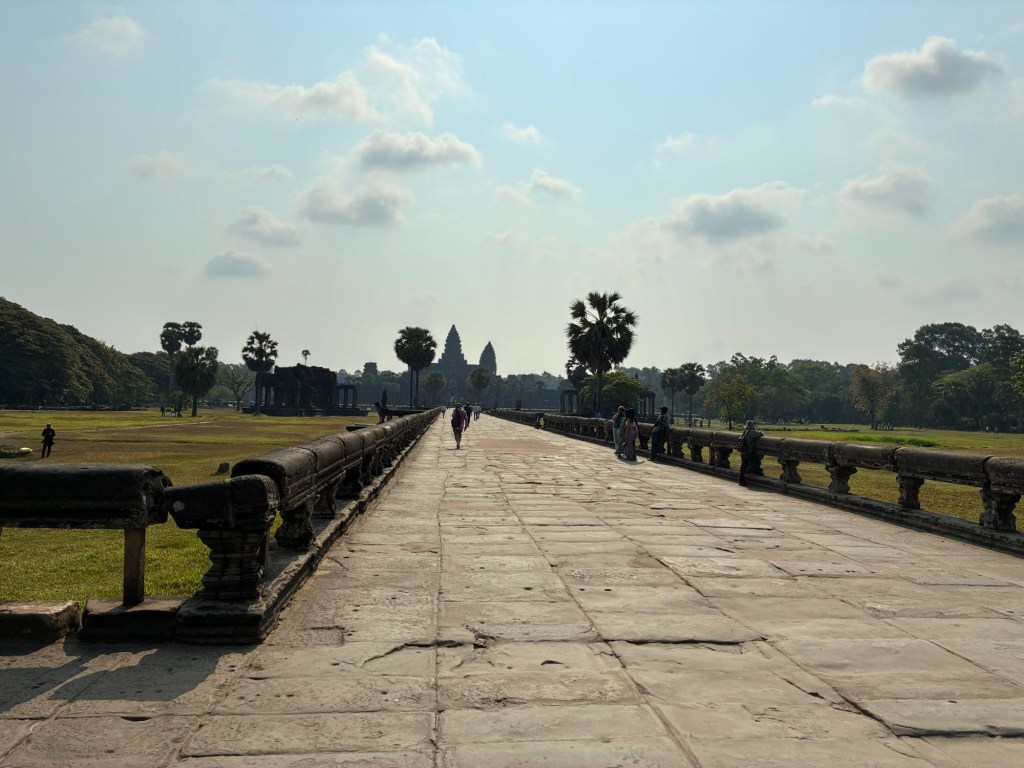
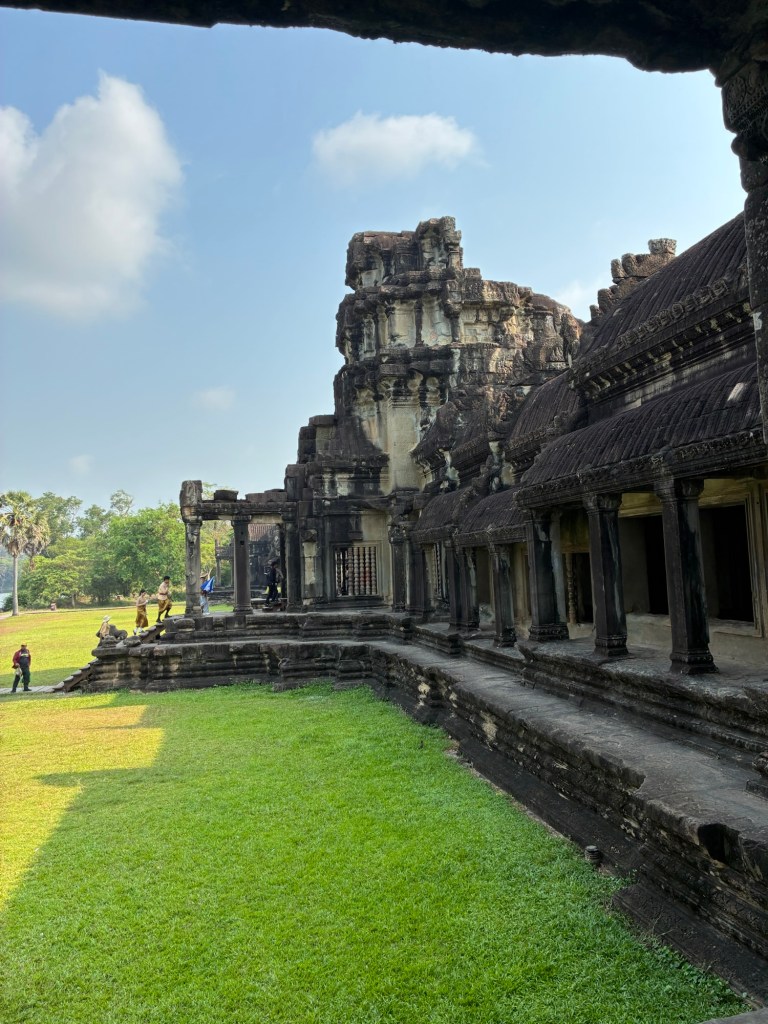
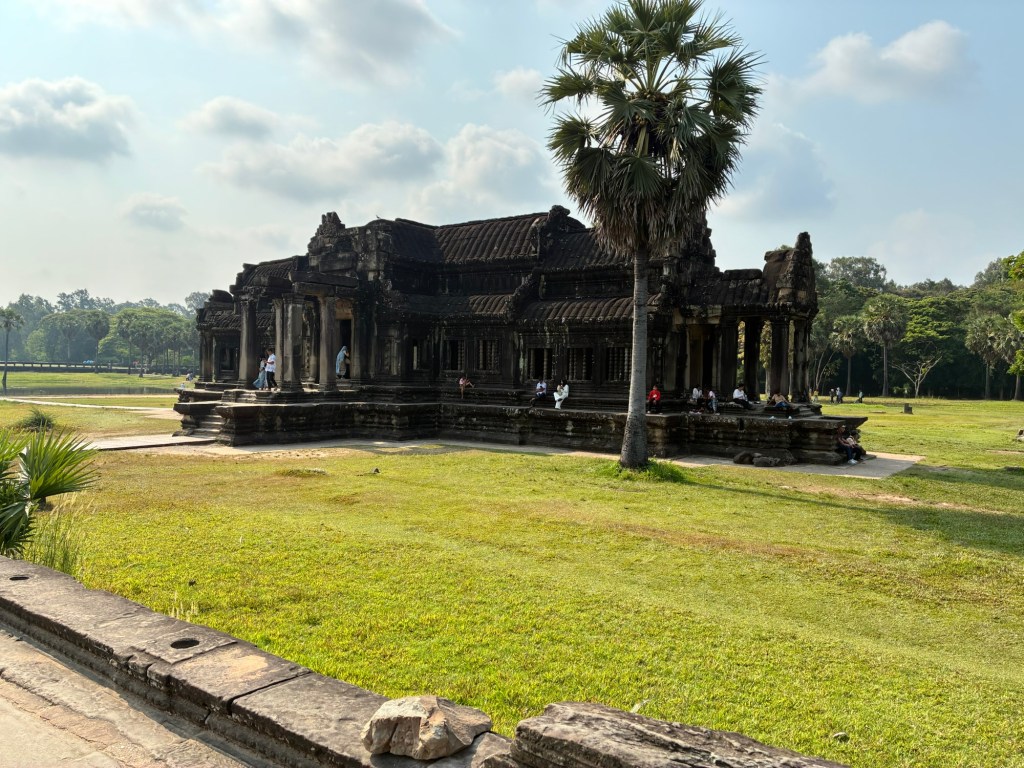
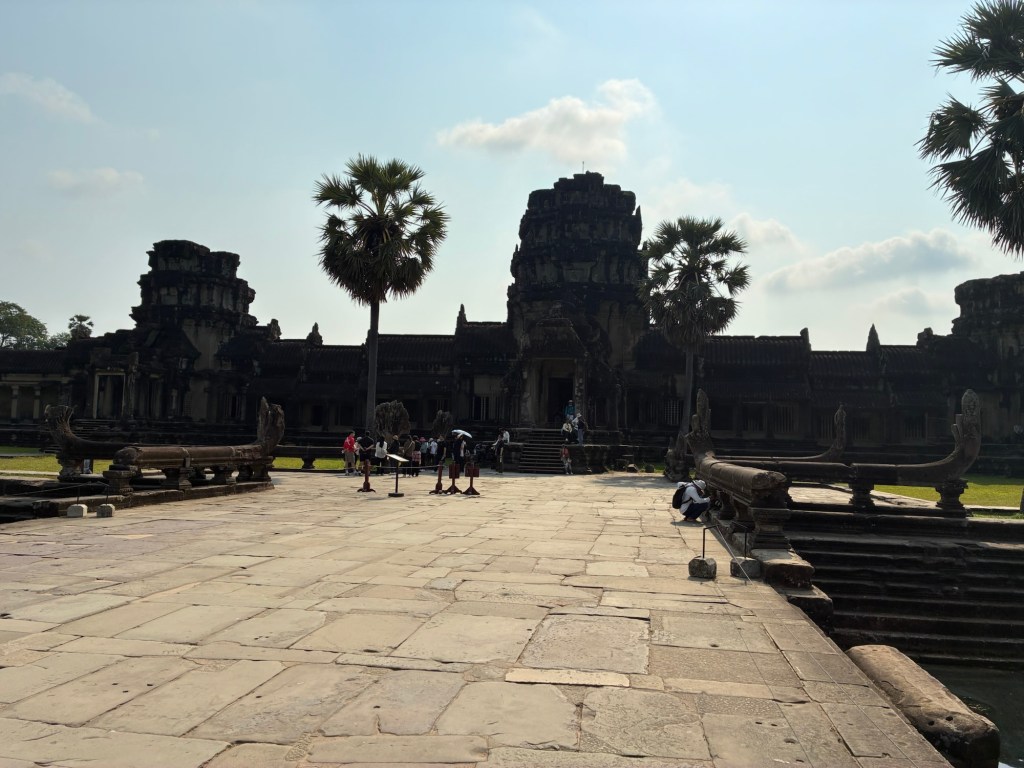
And then I’d made it. Angkor Wat, one of the wonders of the ancient world.
At 8 AM, it was already unbearably hot. What the photos don’t sell you is that it is a long walk up the boulevard, and across the bridge (all in direct sun), then, on the other side of the gate, another long, unshaded walk across the main courtyard. Presumably as an effort to stop touts from harassing tourists, there aren’t any along the main strip, but there is a small market to the north, so you can’t even stop for a cold drink.
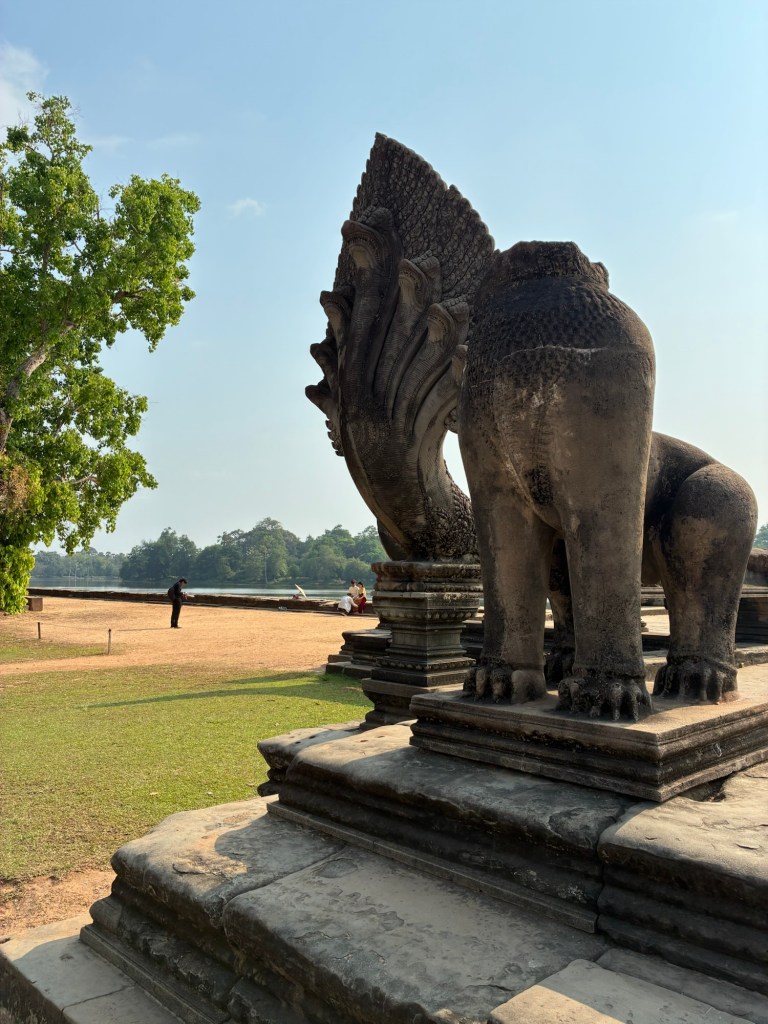
But wow!
Angkor Wat, meaning the City’s Temple, was built in the 11th century. The sandstone was quarried from Mount Kulen, about 30 kilometers away, and transported across a system of canals built for that purpose. The complex itself is built to align with the spring and fall equinoxes – I just missed the vernal equinox. Originally it was Hindu – as were many temples in the city – before being converted to Buddhism. It’s still being rebuilt to this day, not helped by earlier attempts to preserve it, such as water-repellent coatings that trapped water in the sandstone and degraded them faster.
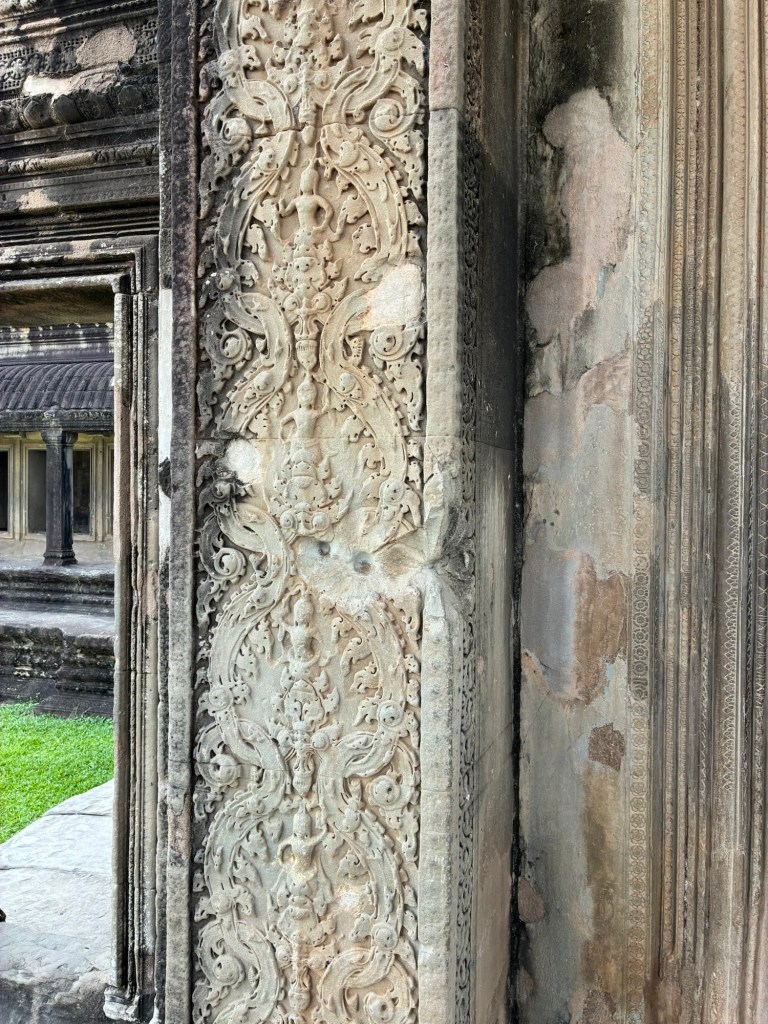
Every flat surface – minus the floors – are covered in carvings. The obvious ones are the reliefs, covered in figures of Vishnu, Naga, Garuda and Varana, and apsaras – female demigods – elephants, wars and celebrations. But there were other things; pillars covered in Khmer scripture; ceilings resplendent with lotus blossoms. The famous spiky cupolas that define the skyline are spiky because, in centuries past, they were covered in Nagas, now worn down to simple wedges of sandstone.
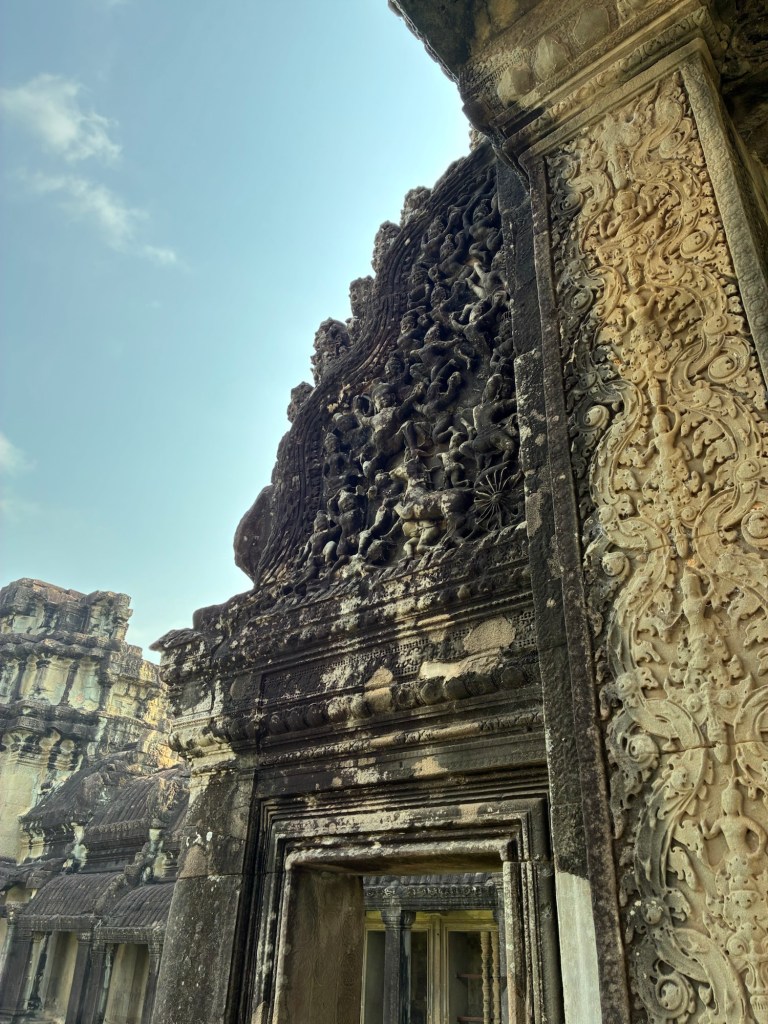
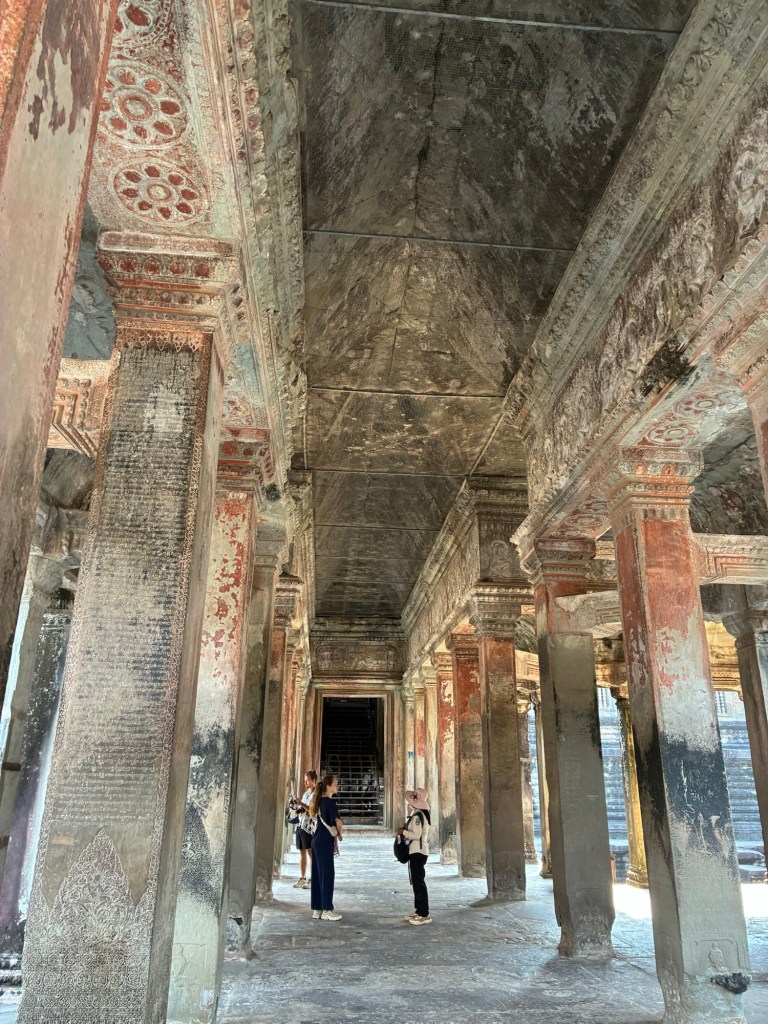
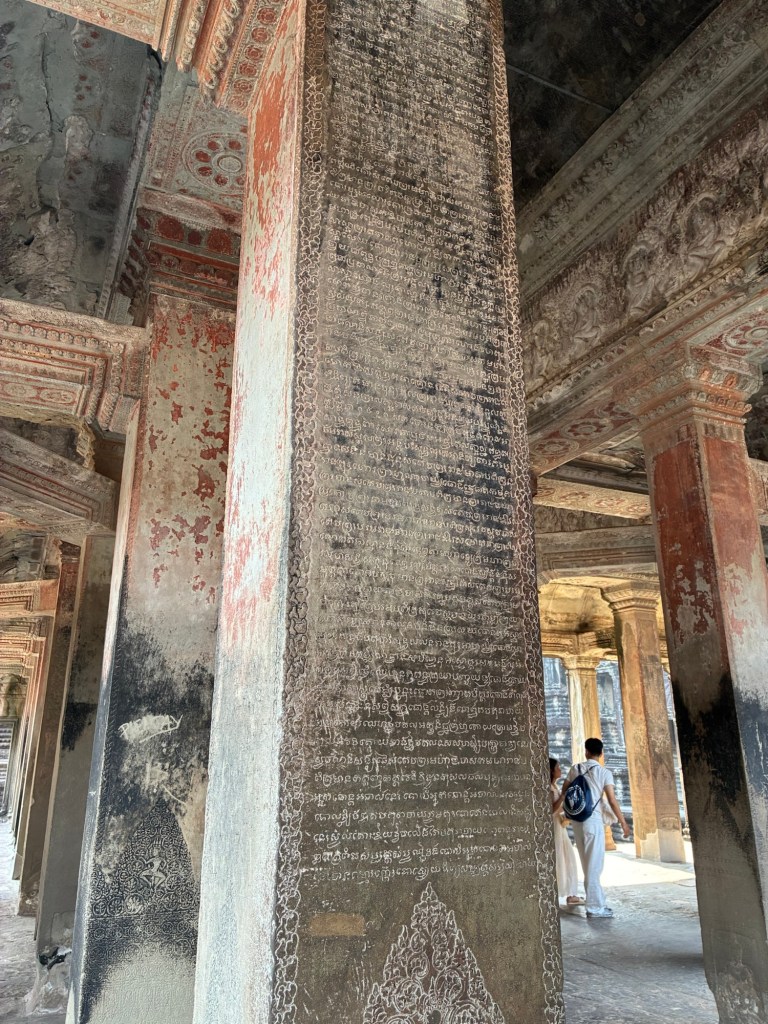
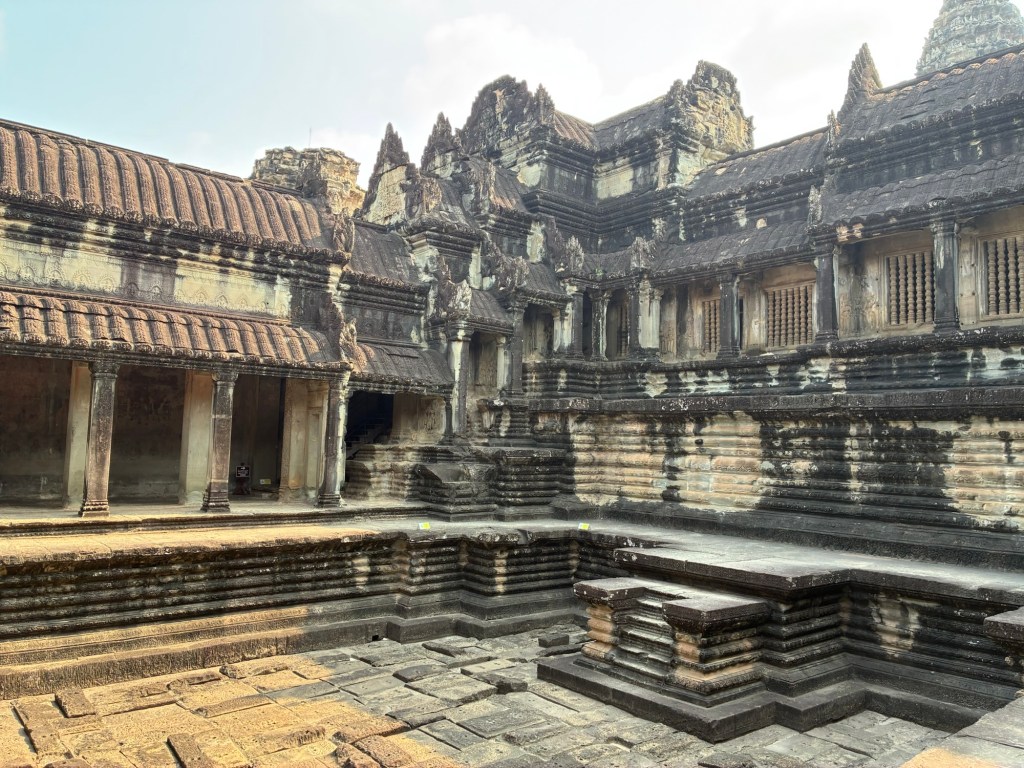
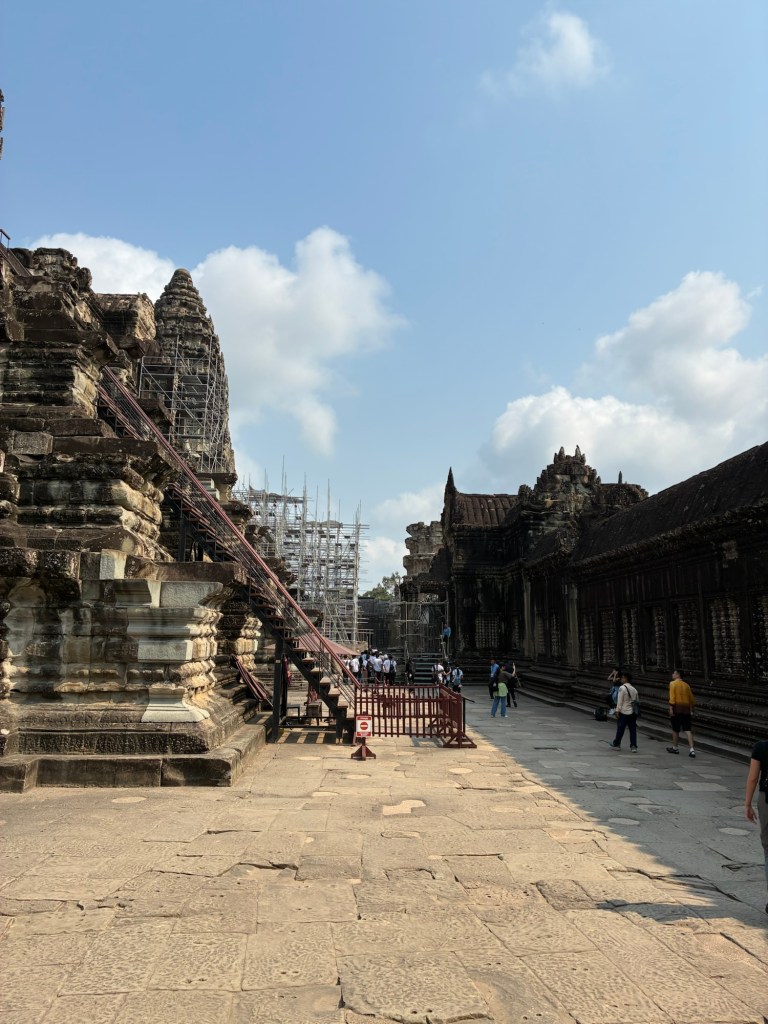
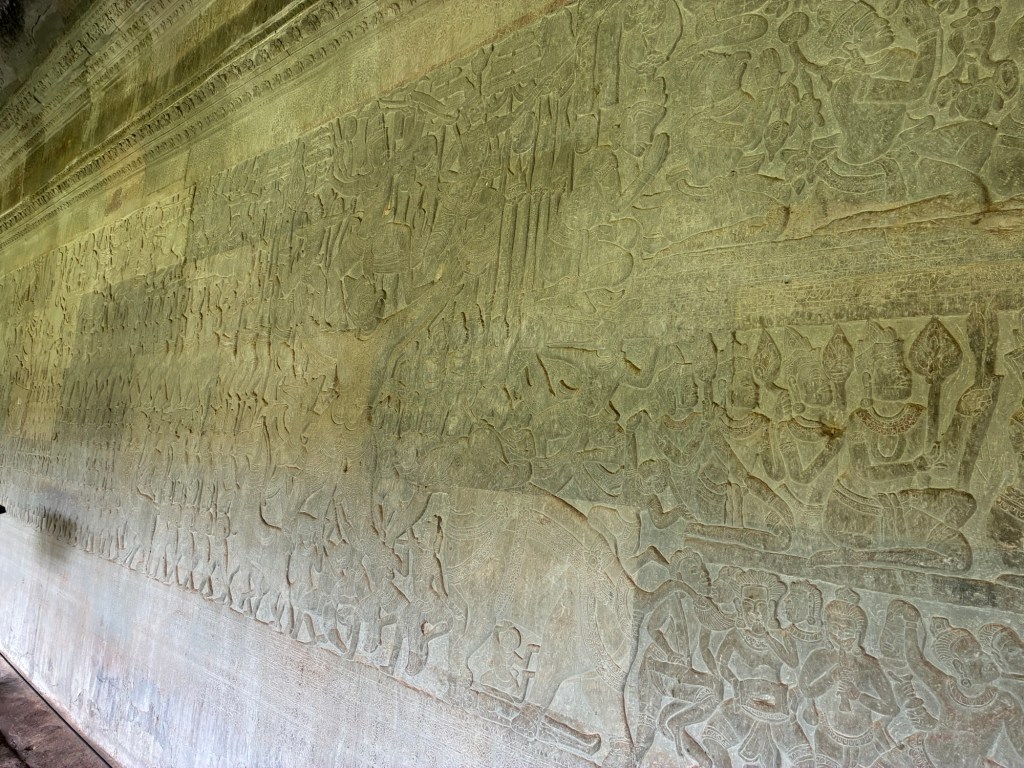
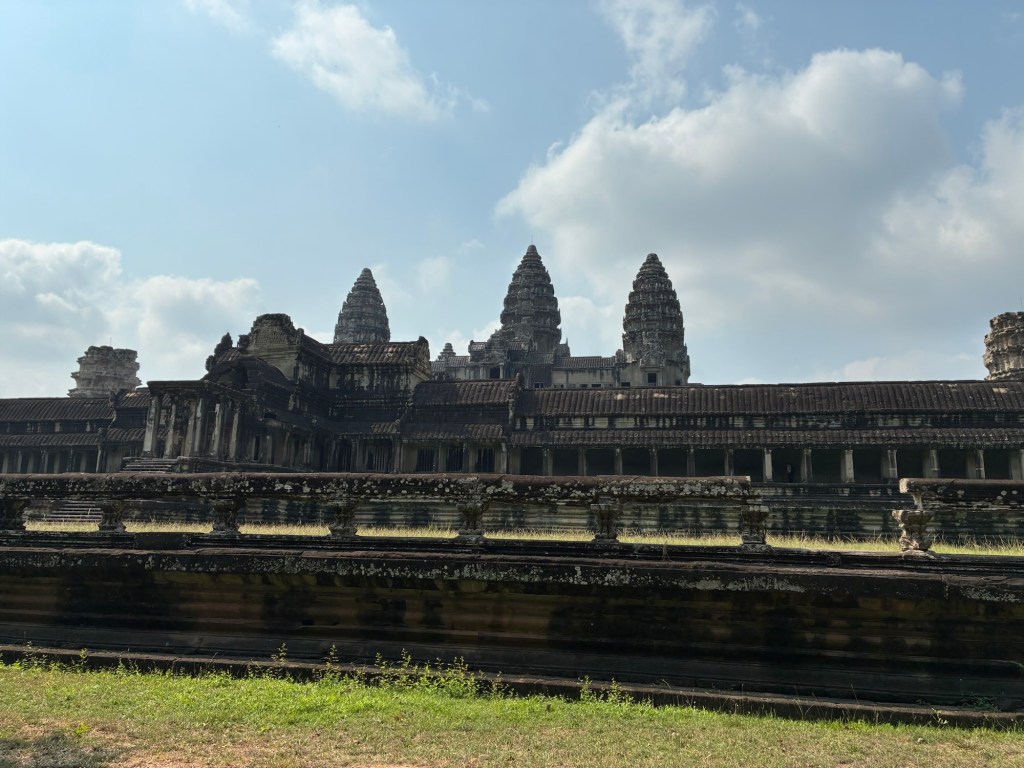
When I finally reached the inner sanctum, I discovered my second mistake; it was closed for a Buddhist holiday. What holiday, you ask? I have no idea. Best I can tell, it was closed because the moon was a quarter (Buddhists celebrate the full and new moon).
Around 10, I called it. You could walk around taking pictures of the reliefs for 7 days and still not see it all, but it does get a bit samey after a while, and the heat was apocalyptic. It was supposed to reach 40 Celsius, and a UV index of 14 – the max.
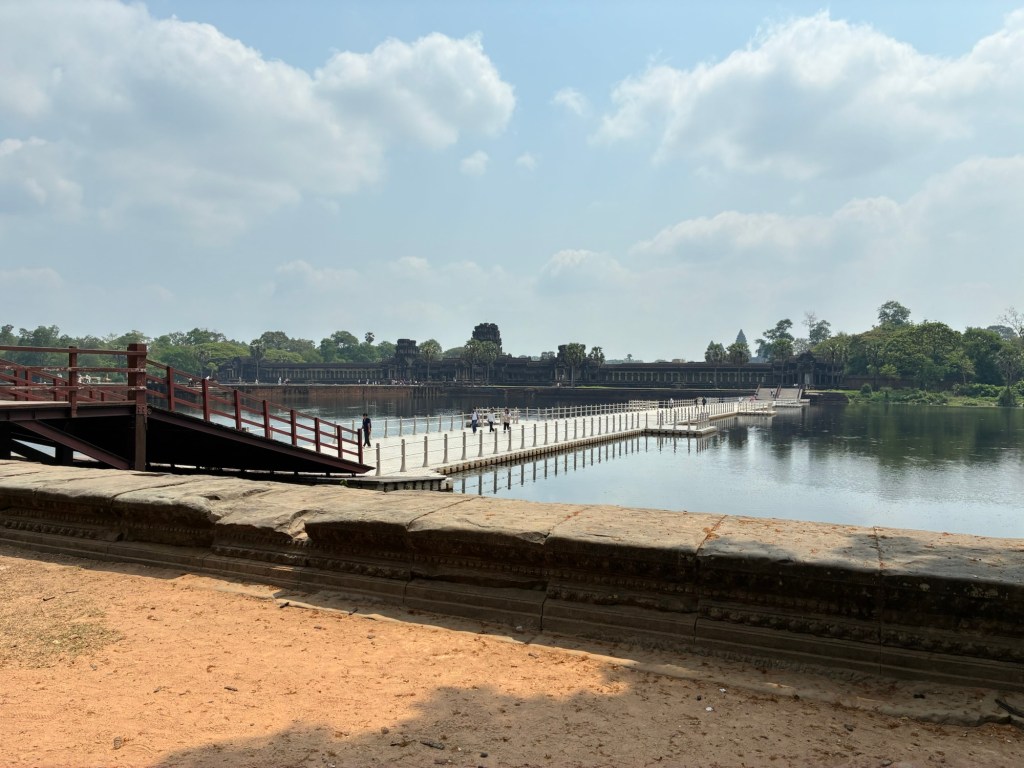
The exit bridge is a floating bridge. It wobbles with each step and is bright white, for some reason, which hurt my eyes.
I walked back to the gate and was harassed by touts again. One of them was rather smug when my Grab request came to him, but I’d still rather order a ride on Grab.
I had a drink and a bite to eat at the hostel, then I changed into my swimsuit and hopped into the pool to cool off. Then I settled in to the common area to watch more Stranger things.
Around noon, a constant Buddhist chant started up, and for the next 3 days continued from dawn to dusk. It was from a loudspeaker set up on the road, and it was so loud it defied even my noise-cancelling headphones. I found out later it was a funeral… something something, the louder you can make the speaker, the more likely the deceased is accepted into heaven? (Yes, there is Buddhist heaven) Whatever, to my Western ears, it was insane and hard to get away from.
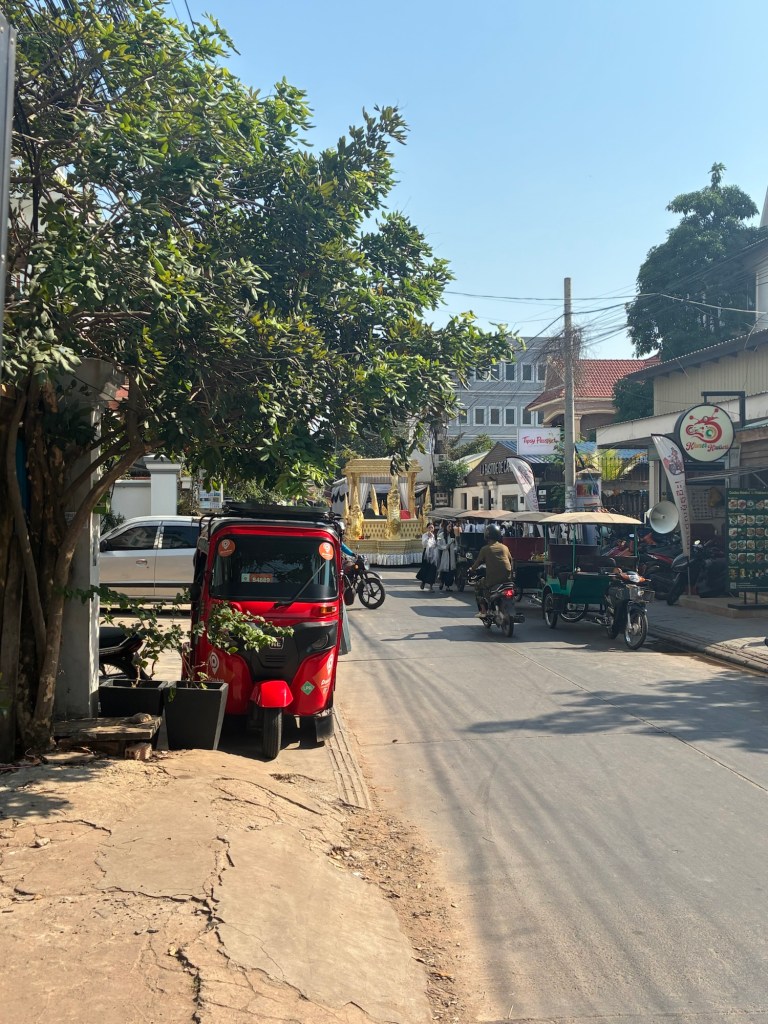
For lunch, I had a local dish called Amok fish. It’s fish curry with rice, I enjoyed it quite a bit.
I discovered the hostel offers a “sunrise box”, a to-go breakfast, which suits me just fine. I ordered one for the morning.
I got up for 5. There’s a lot of debates about when to get up – and you can get into distinctions like “civil twilight” – but I think, for most people, getting there for 6 is adequate. Around 6 is when the sun breaks the horizon, but the temple is so tall the sun doesn’t hit the top until 6:30. That being said, meditating on the colours in the sky shifting from deep blue to pastel pink to orange was pleasant. Except I was wasting the pleasant early morning chill.
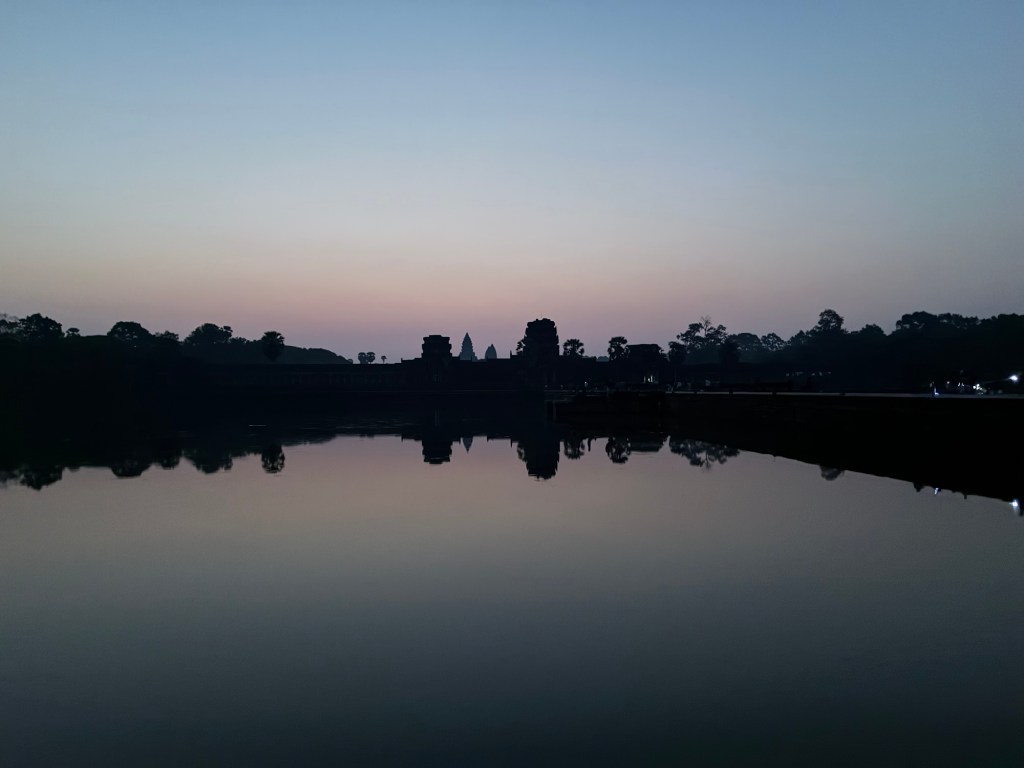
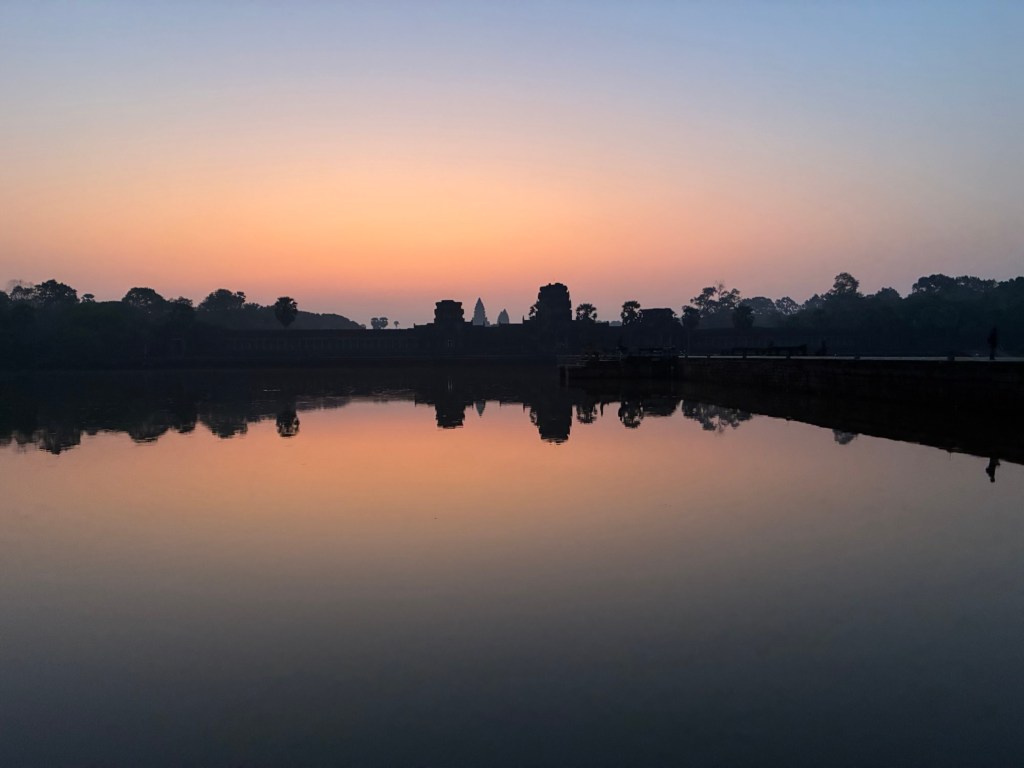
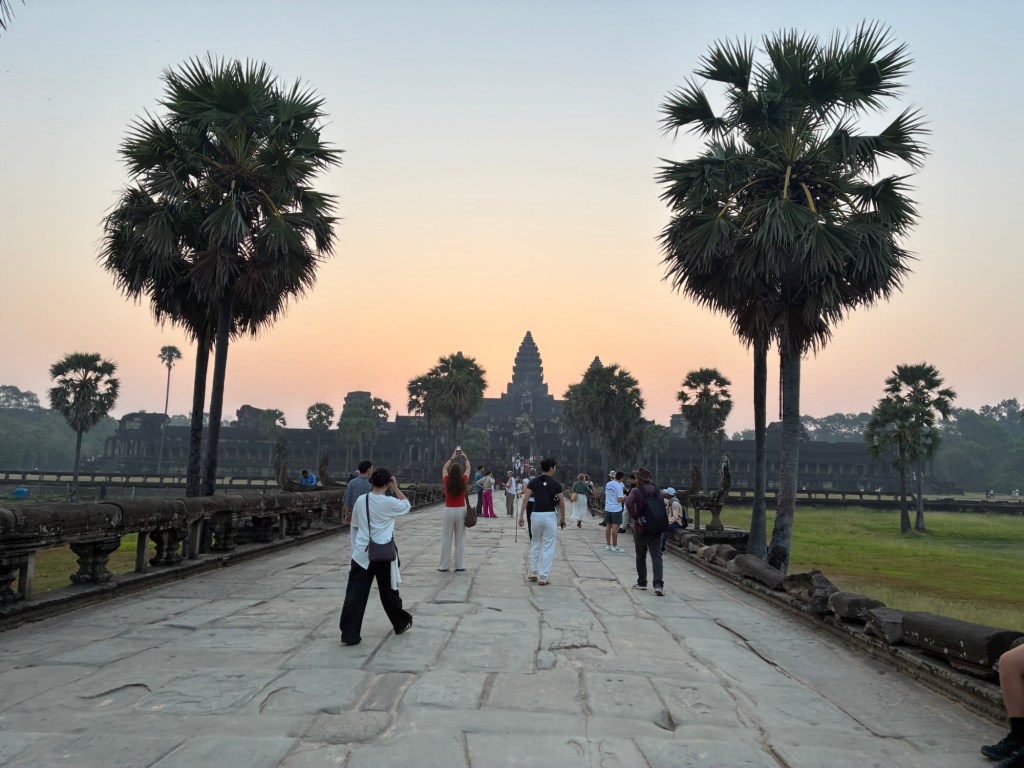
I wouldn’t even have come back to Angkor Wat, except that I couldn’t scale the inner sanctum the day before! I made a bee-line across the temple and was the second person in line to ascend. It only took me 20 minutes to walk, which was a waste because it doesn’t open ’til 6:30.
The inner sanctum is really cool at first blush. It wears off, though, when you realize it’s a lot of the same as the ground level. Still, I can now point to the top in a picture and say “I’ve been there!” It’s also how I got close enough to notice the spiky bits are Naga, and that the gate at every cardinal direction has a different carving over it.
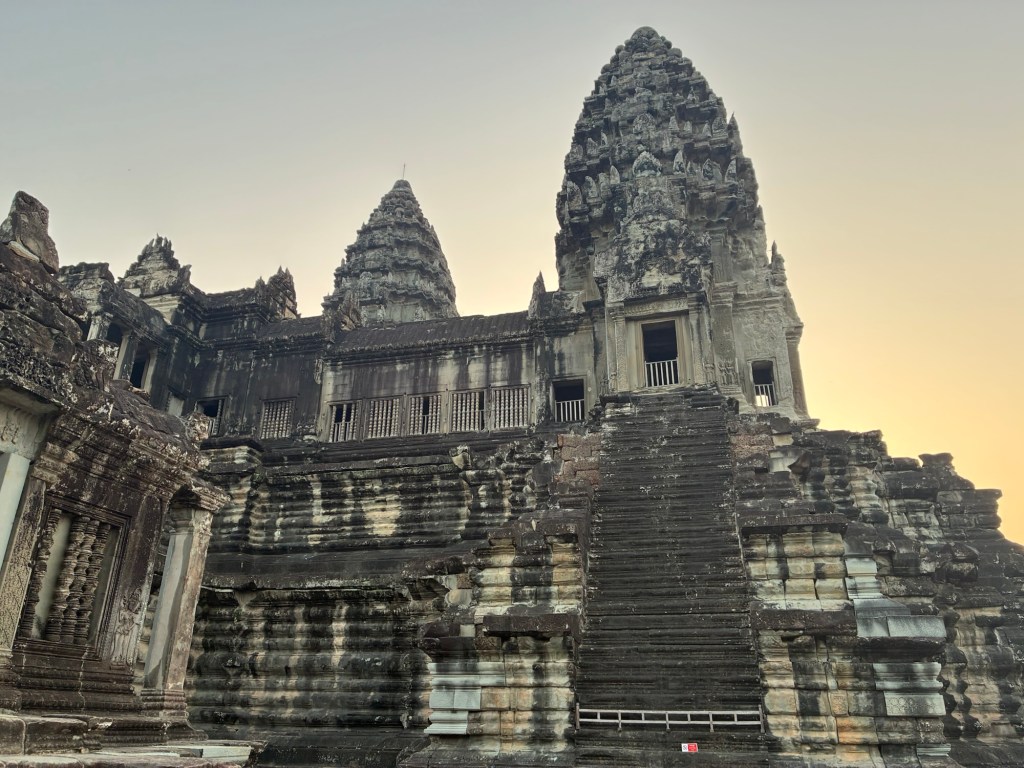
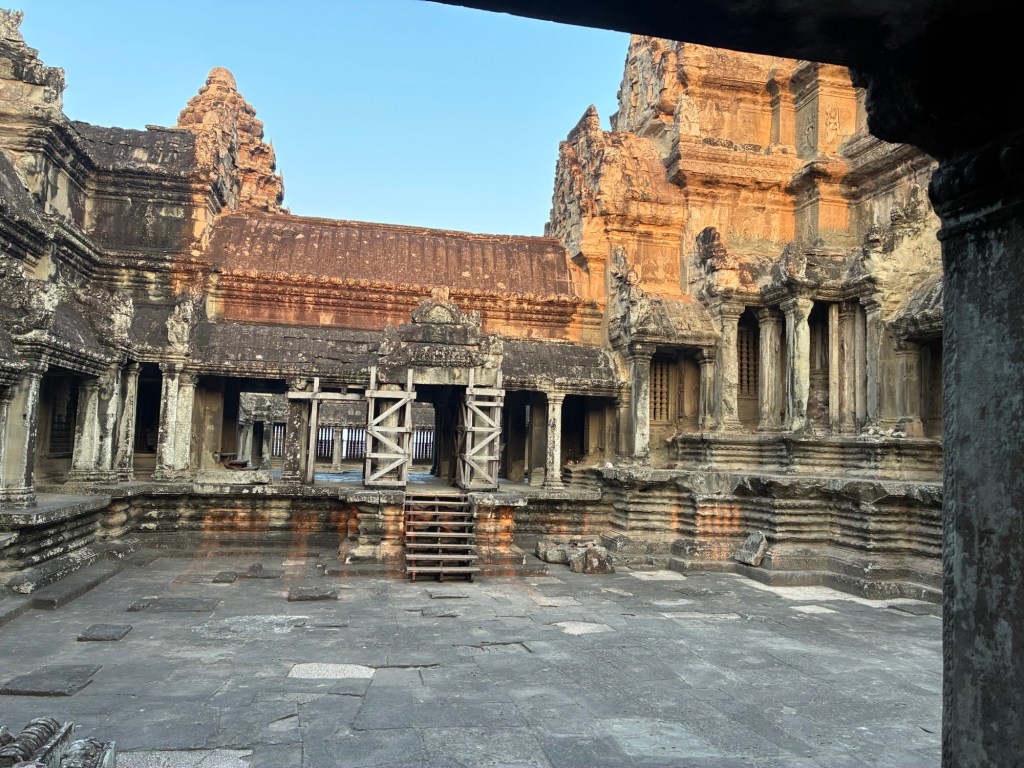
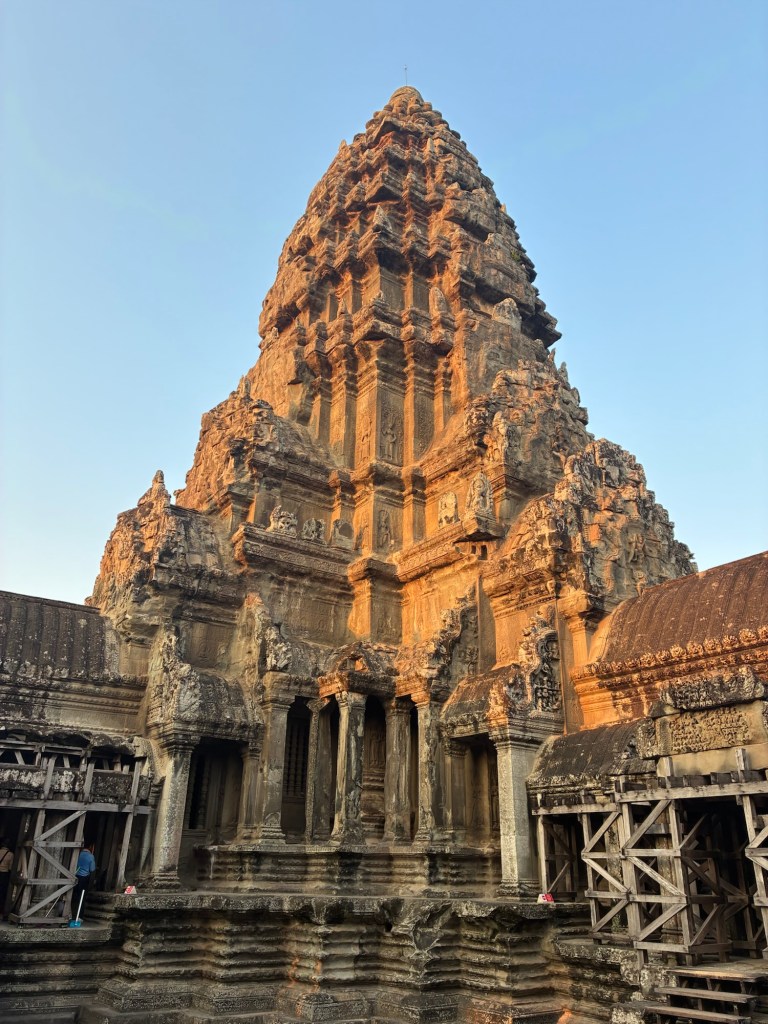
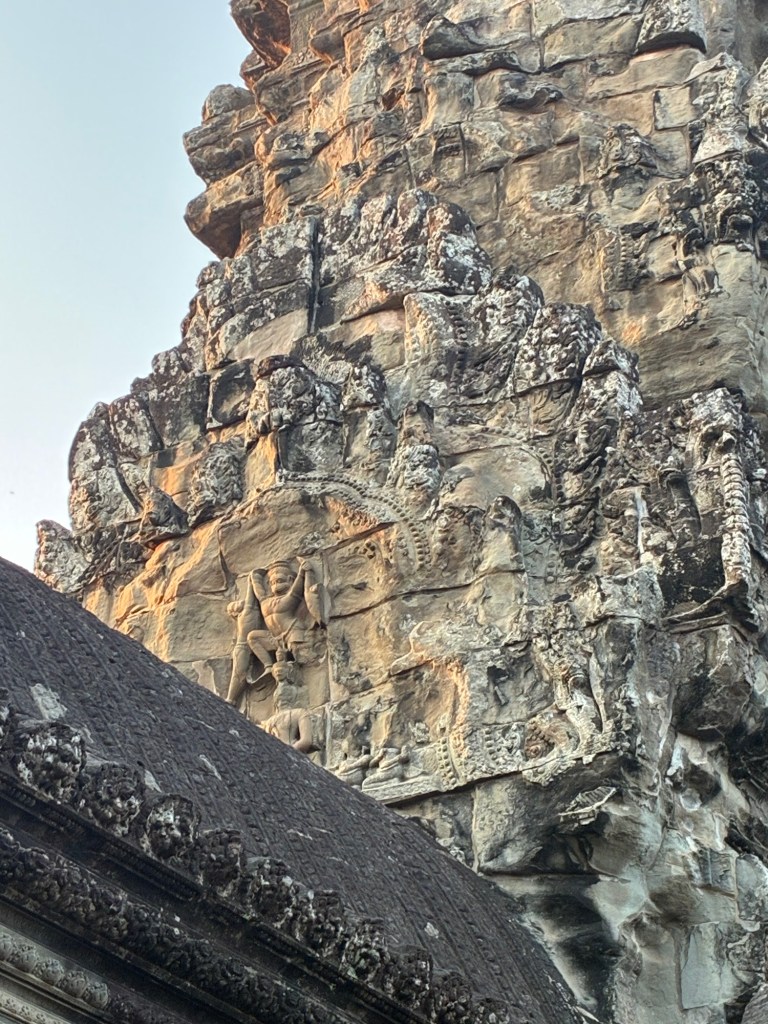
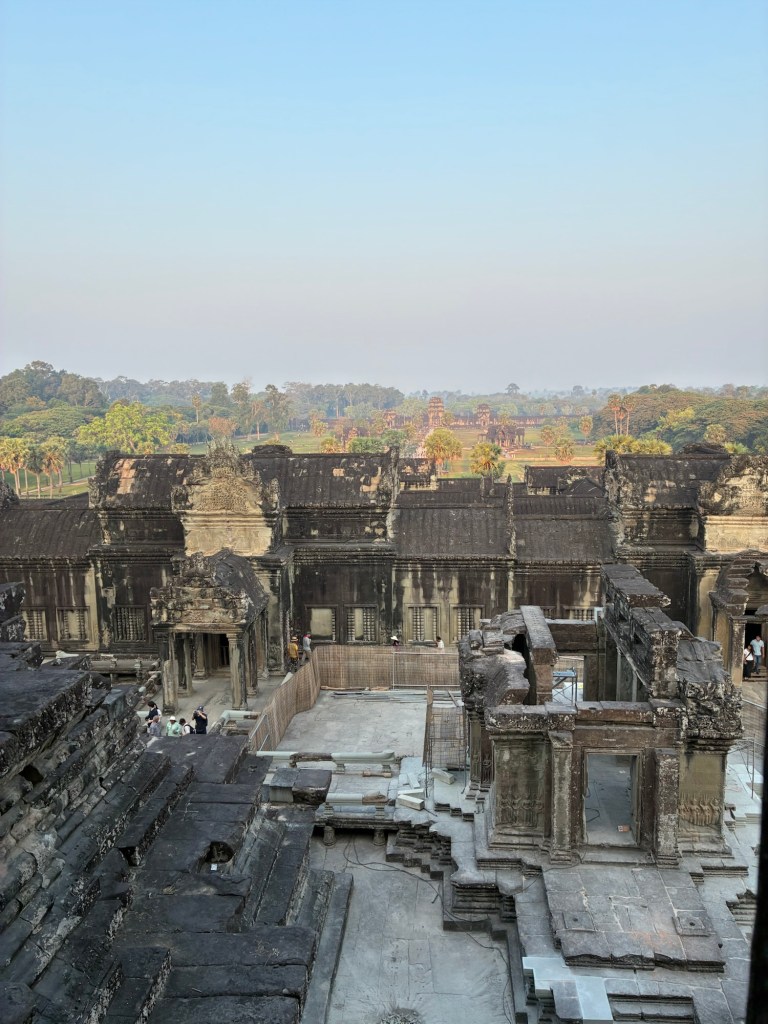
By 7:30, I was back at the main gate. Then I discovered my second mistake; I’d walked too far. To walk to the rest of the city, I should have turned right at the end of the bridge. Backtrack a go-go.
Once I’d waved away the rest of the tuk tuk drivers, the walk was nice. This part of the road was nicely shaded, and it was fun to imagine the ancient civilization that used to exist; vendors hawking wares, monks walking between temples.
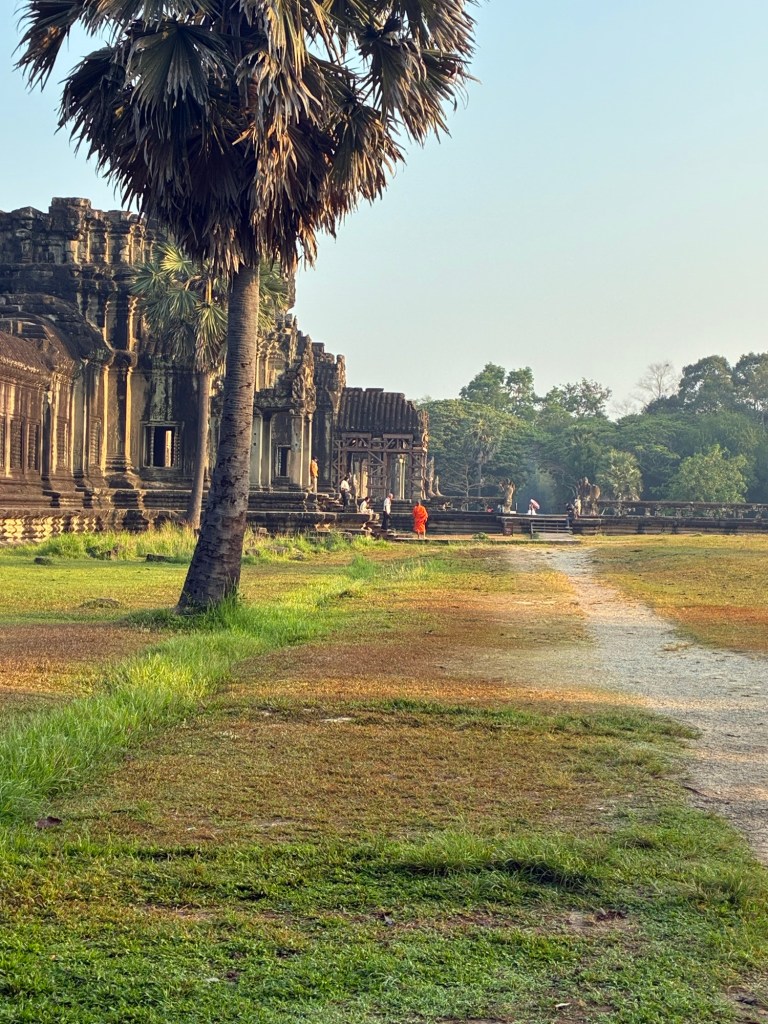
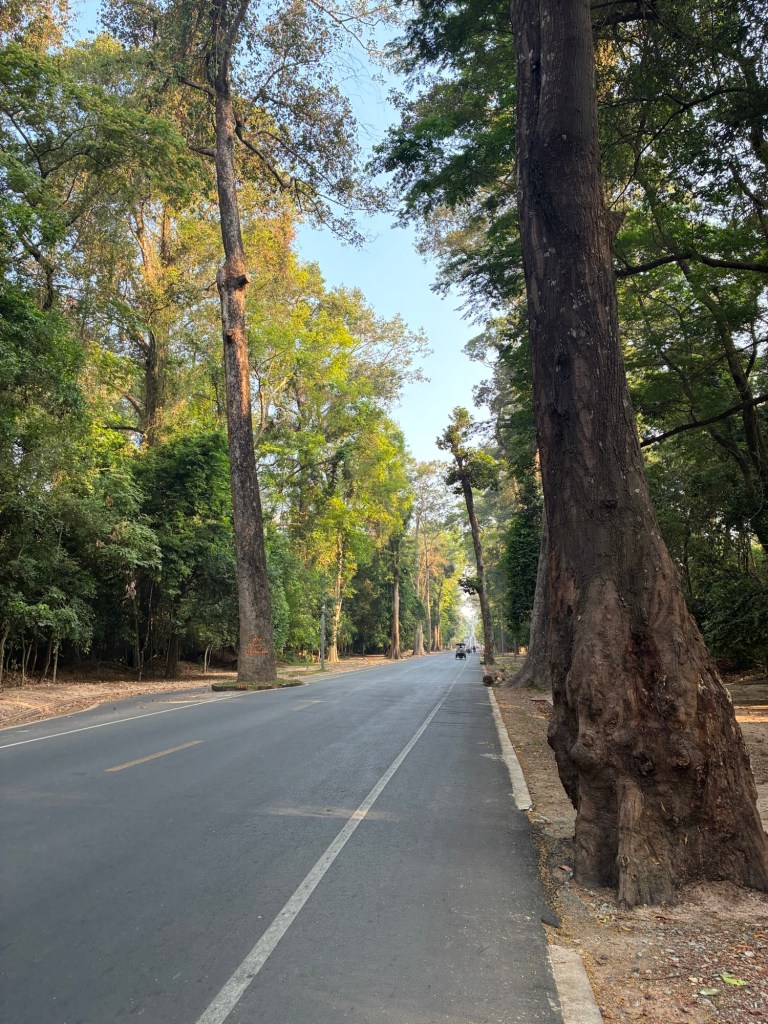
It took me about 20 minutes to reach my next destination, the criminally under-appreciated Phnom Bakheng. In no small part, because it’s a bit of a hike up a hill to reach.
There was a guard posted at the road here who wanted to scan my ticket again. This was the only way in to the main city, so it makes sense.
I climbed up the hill, stopping occasionally to admire the view. This mountain is the highest point for miles around, taller than even Angkor Wat. This temple is the oldest one in the area, and the one that’s most obviously Hindu. It was absolutely butchered in the attempt to convert it.
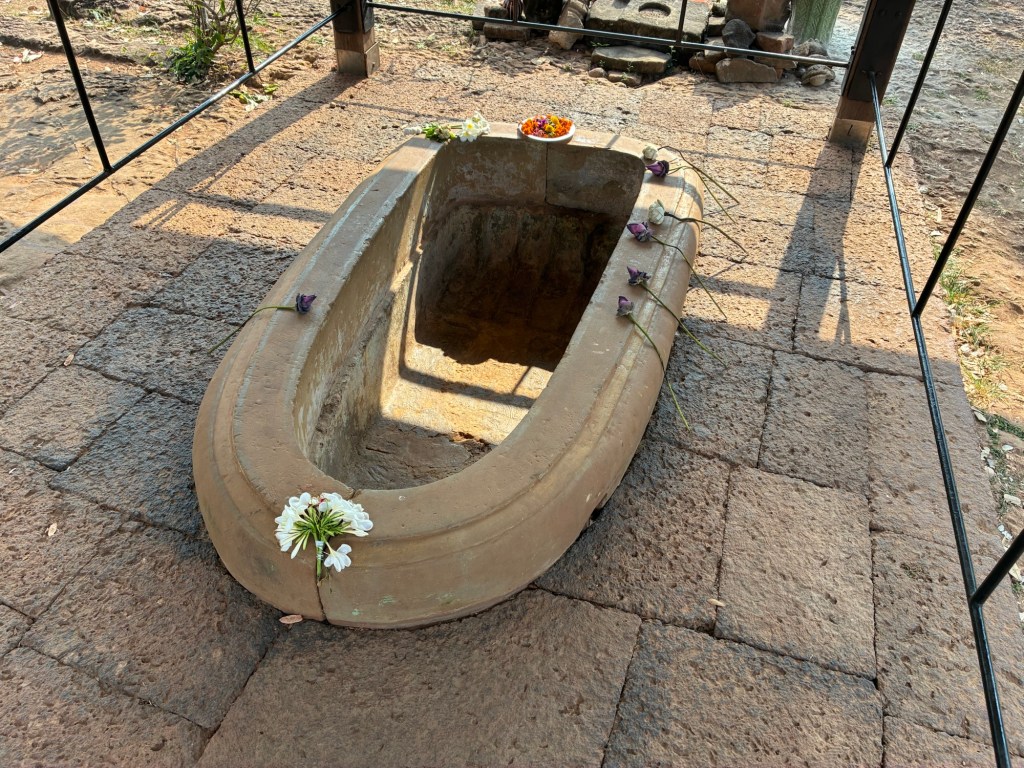
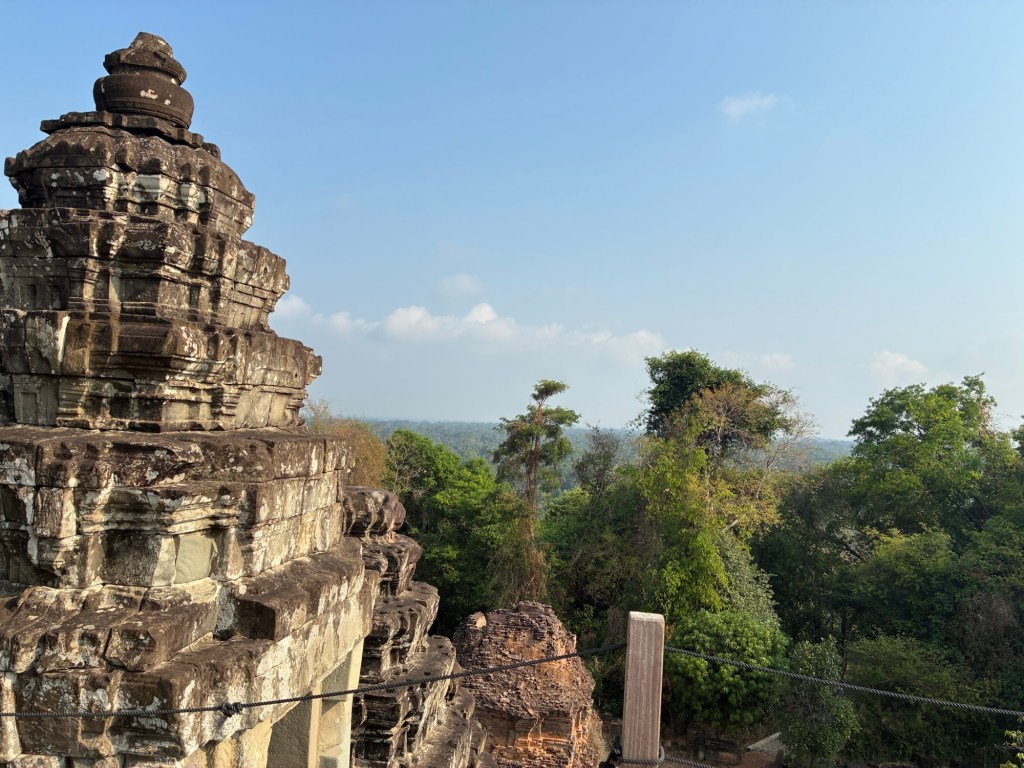
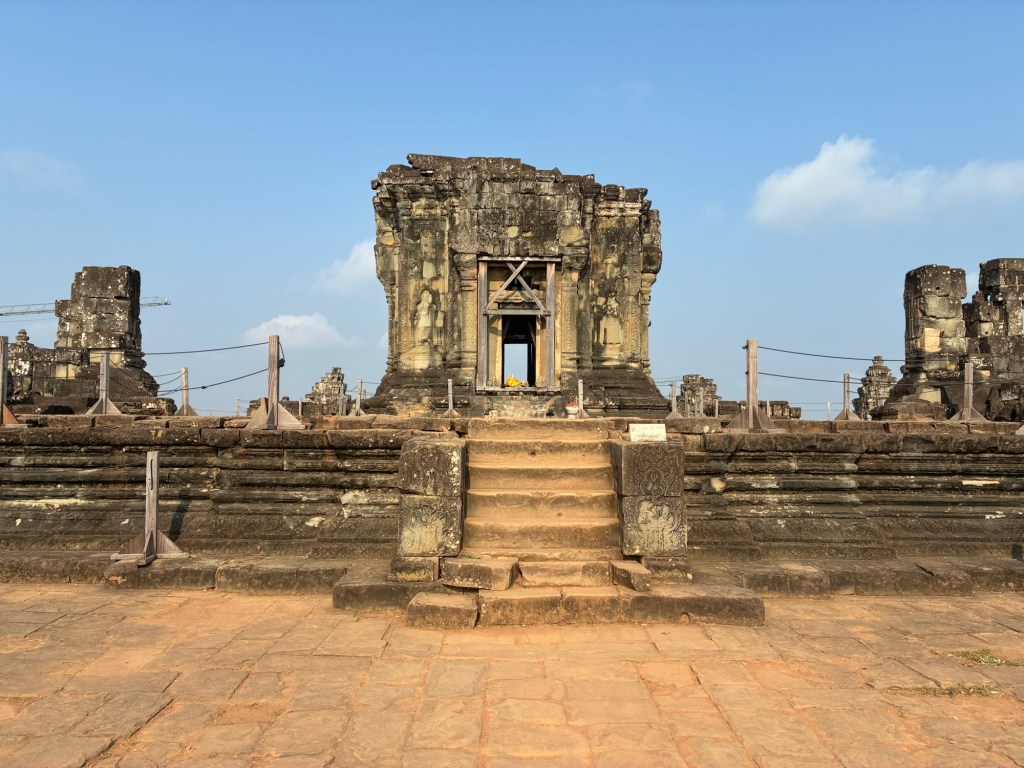
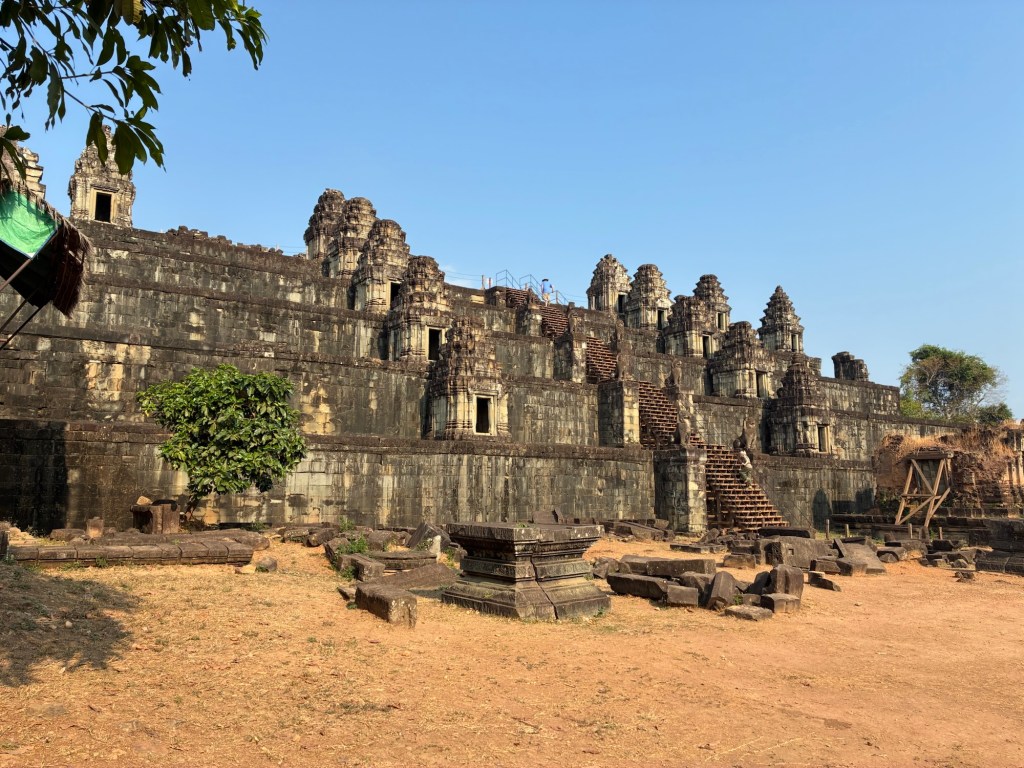
The whole East flank is currently being rebuilt. Most of the temples in the area were filled in with sand, with the stones acting as a retaining wall, which is why any shifting can be catastrophic.
There’s also a wonderful view of Angkor Wat from the south corner.
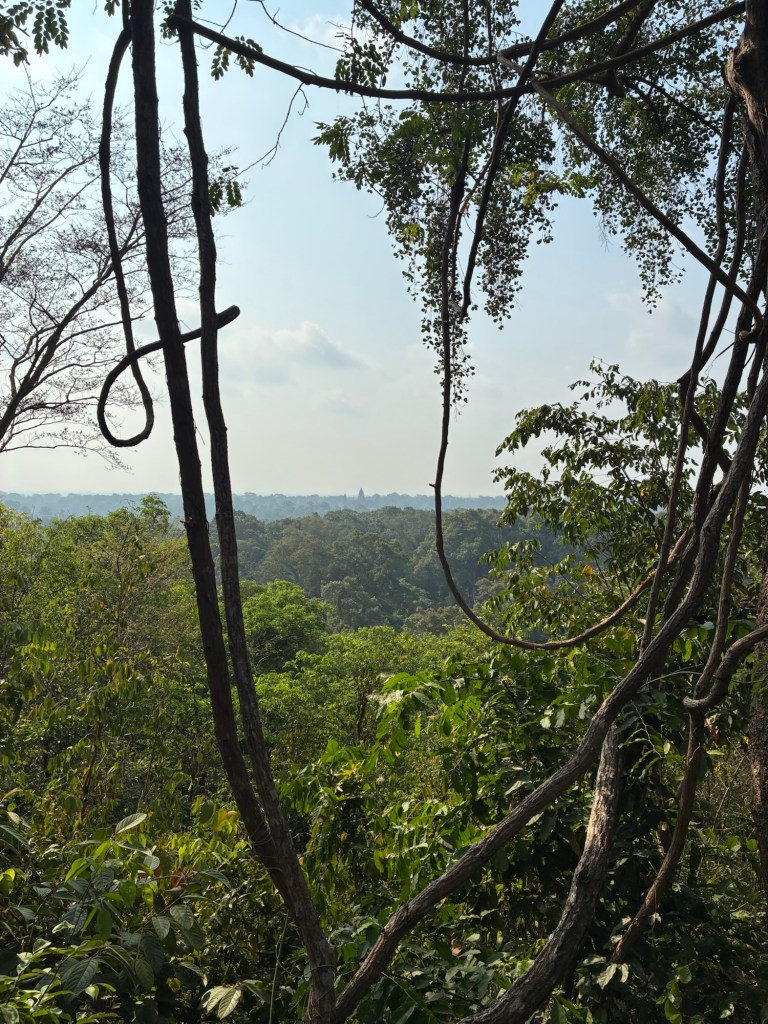
At the top of the temple, I struck up a conversation with an elderly couple who turned out to be Texan. They don’t like Trump, though, so we spent a good amount of time ragging on him. A plaque at the base of the temple proudly touts the American funding for the reconstruction. How much of that has dried up?
I decided to finish off my breakfast here as well. Is it sacreligious to eat on a temple? Probably.
Back down we go.
The next stop was barely 300 meters down the road; the famous Tonle Om gate, south of the city.
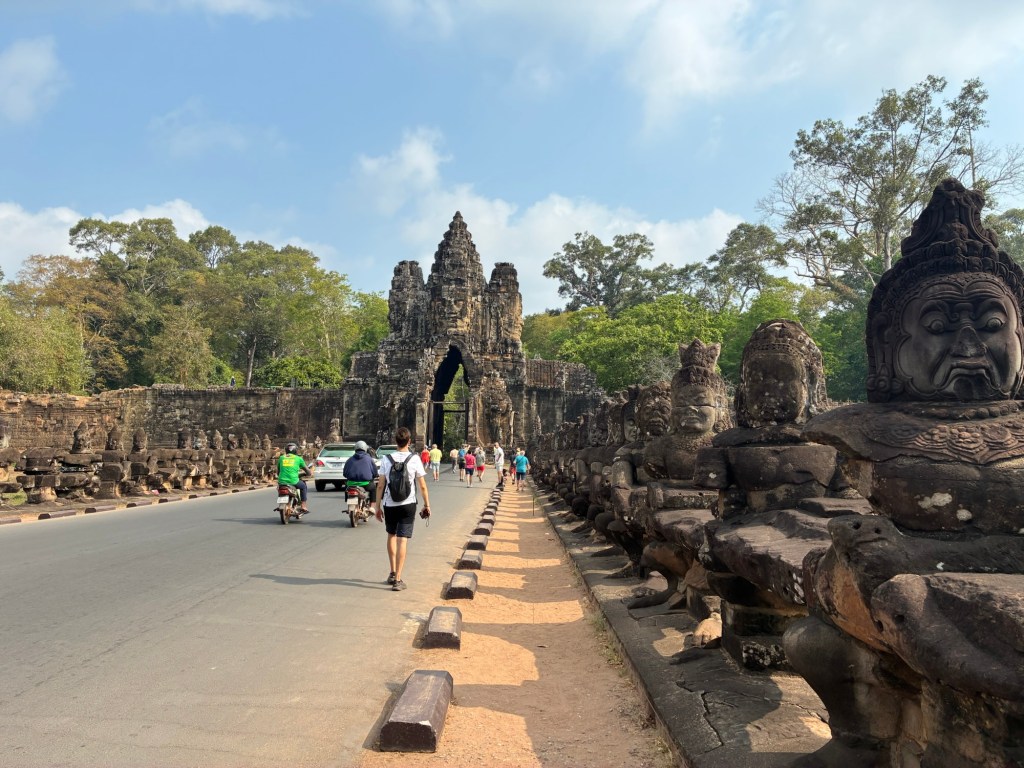
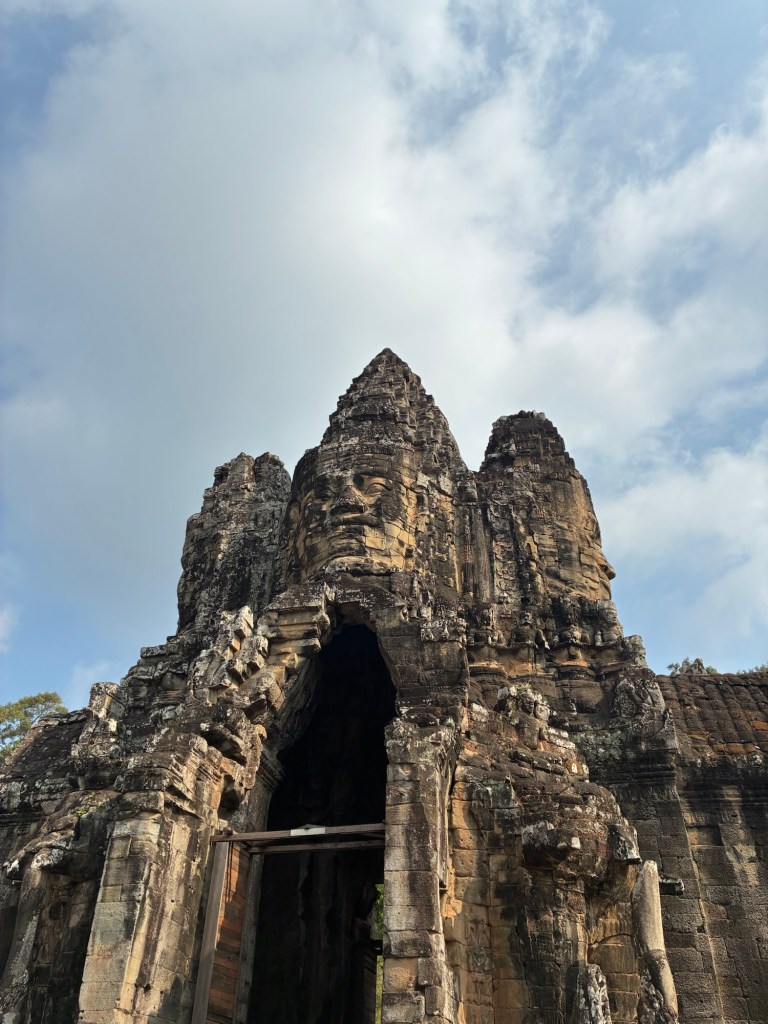
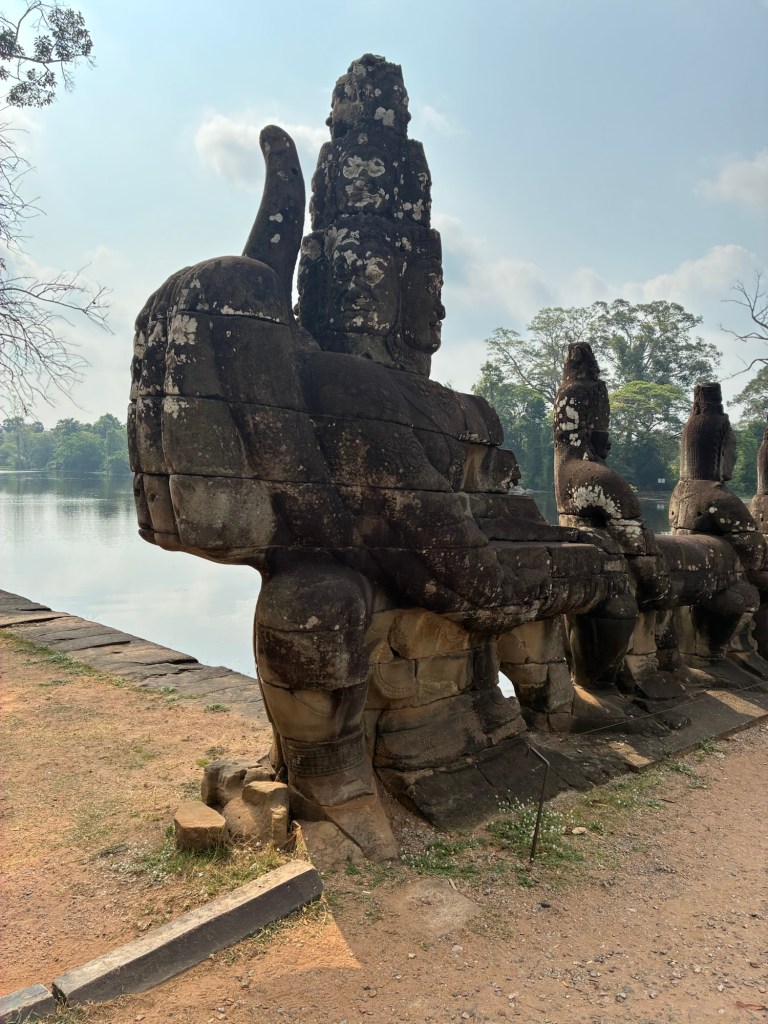
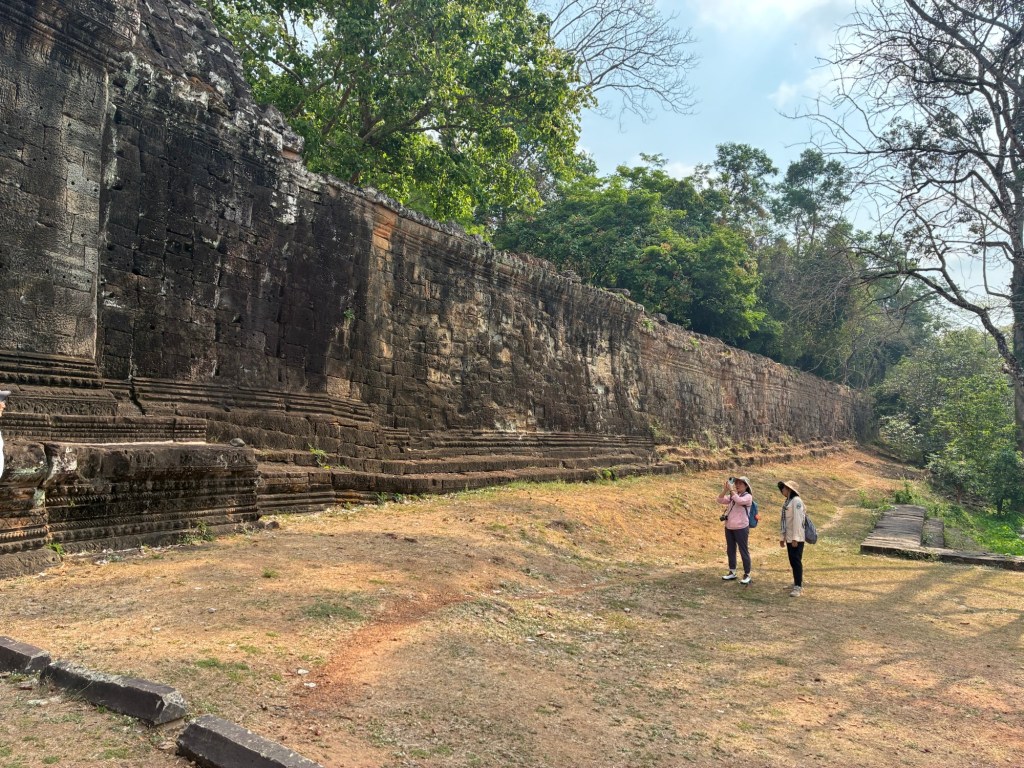
I found this one interesting because no one’s quit sure what the iconography means. The figures making up the railing are probably devatas – probably best translated to demigod, but I think Maiar would be more apt – and asuras, but why do they appear to be holding the tail of a Naga? Are they restraining an attacker? An avenger? Is it defensive? The heads are popularly believed to be Avalokitesvara, the male version of Guan Yin, symbolizing compassion.
The walls are 26 feet high, 3 kilometers long, and built of laterite.
Tuk tuks have a habit of dropping off their charges at the beginning of the bridge so they can walk through the gate, then driving through and waiting for them there.
Another wide, shady boulevard here. A water truck was also driving up the road, wetting the soft shoulder to keep the dust down.
I stopped once I reached my destination and had a sit down. There’s lots of sandstone graveyards around; fields of stones extracted from the temples, stained black from smog, like London. I wonder what they’ll do with them?
I also think about Herman Hesse. When he visited South East Asia, none of this infrastructure was here. Did he visit Angkor? Did he see the destroyed temples, choked with greenery? Certainly he disdained of the French occupation.
The next temple is at the centre of the city. It’s called Bayon, but it’s worth knowing that Bayon doesn’t actually mean anything in Khmer or Pali; it’s a mishearing of the word for the prangs.
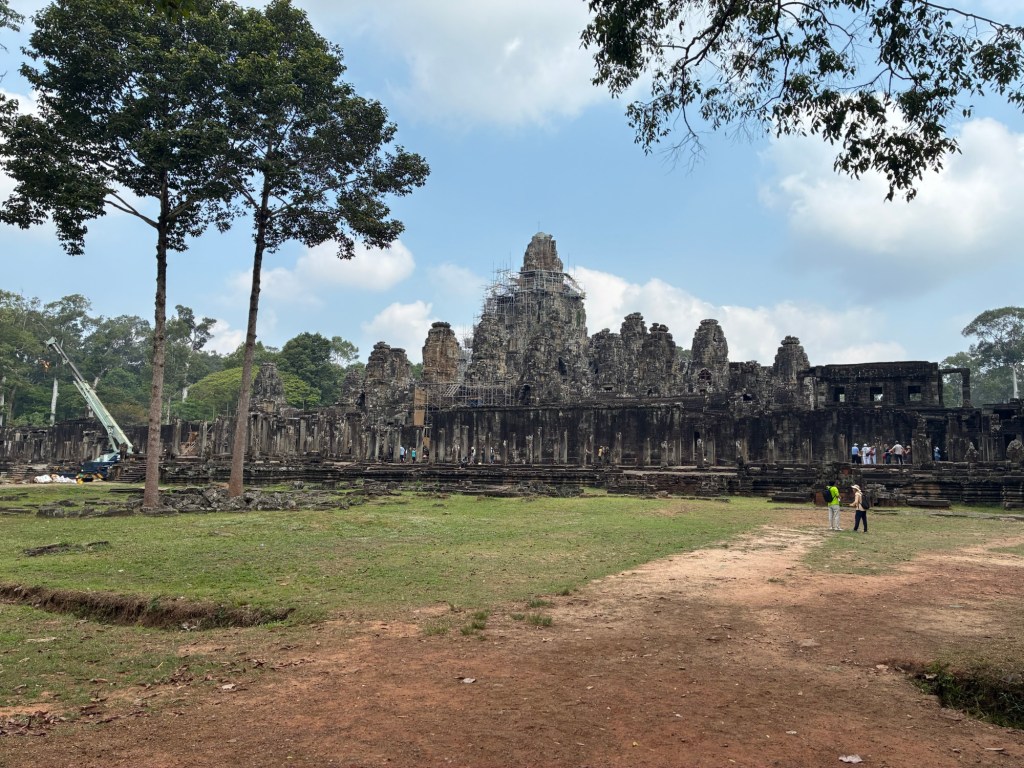
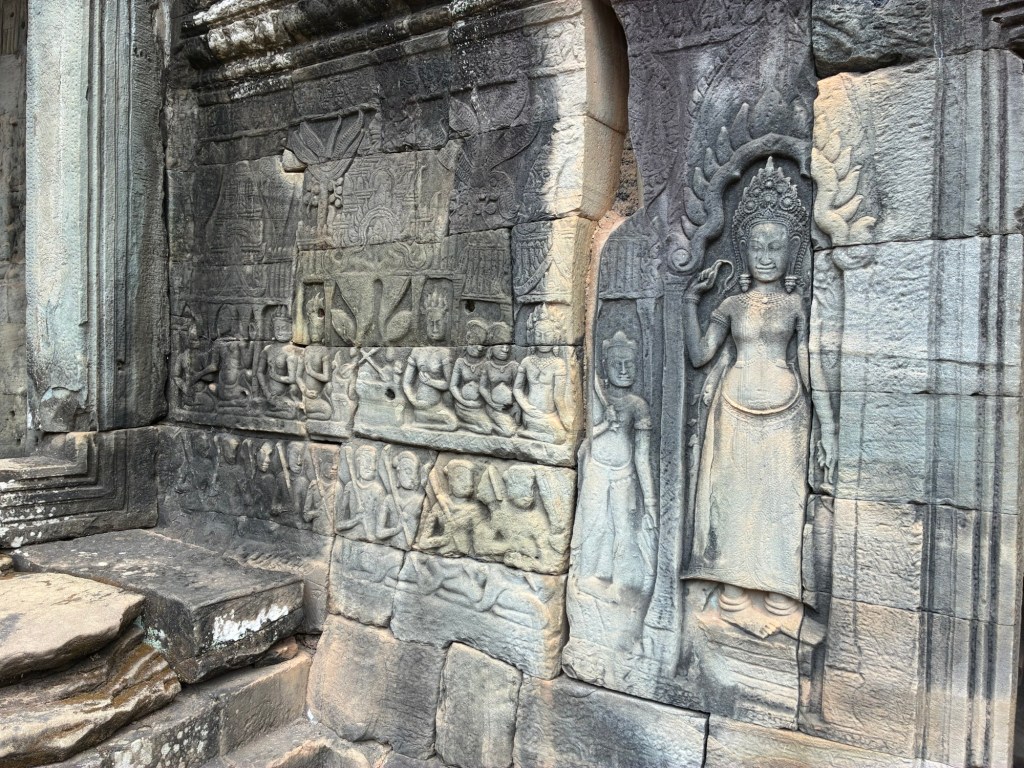
Bayon, like Angkor Wat, is covered head to toe in carvings and reliefs, in somewhat better shape. The king who built it was Mahayana Buddhist (yes, there are different kinds of Buddhism) and the structure is designed like a mandala, which everyone loves to rag on about (I learned about mandalas from The Last Mimzy). The reliefs are more varied; local people going about their day; Shiva; also scenes from the “Churning of the Sea of Milk”, Samudra Manthana, a Hindu myth about the devatas fighting the asuras for immortality (basically). The prangs are all designed to look like the king as Avalokitesvara.
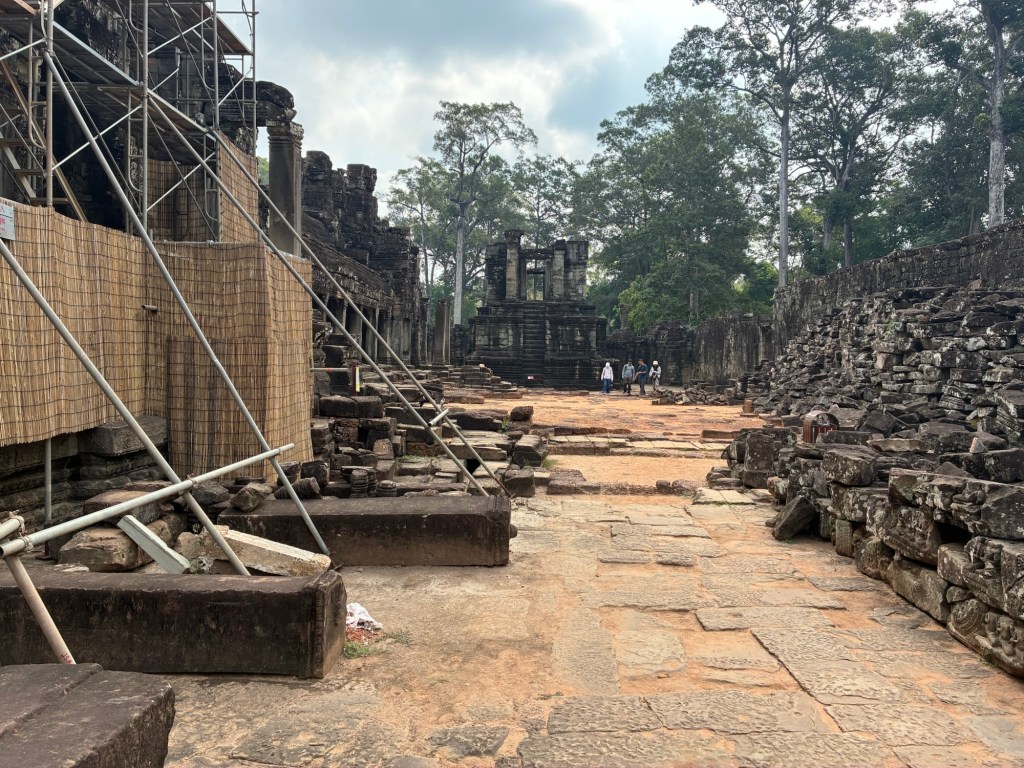
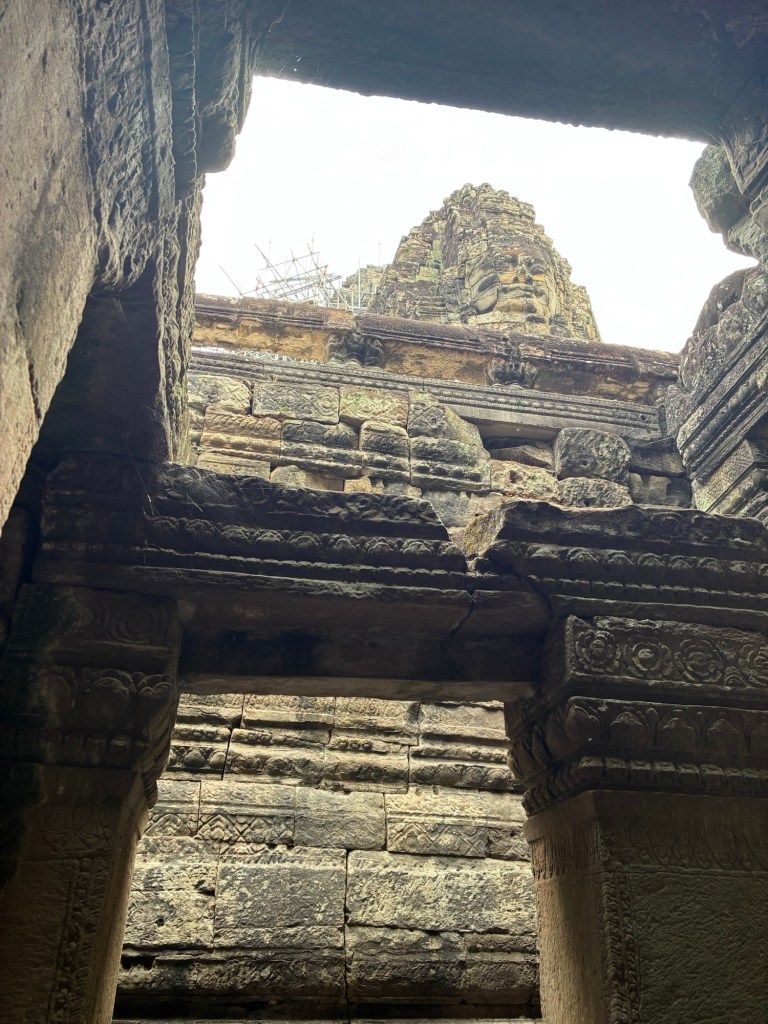
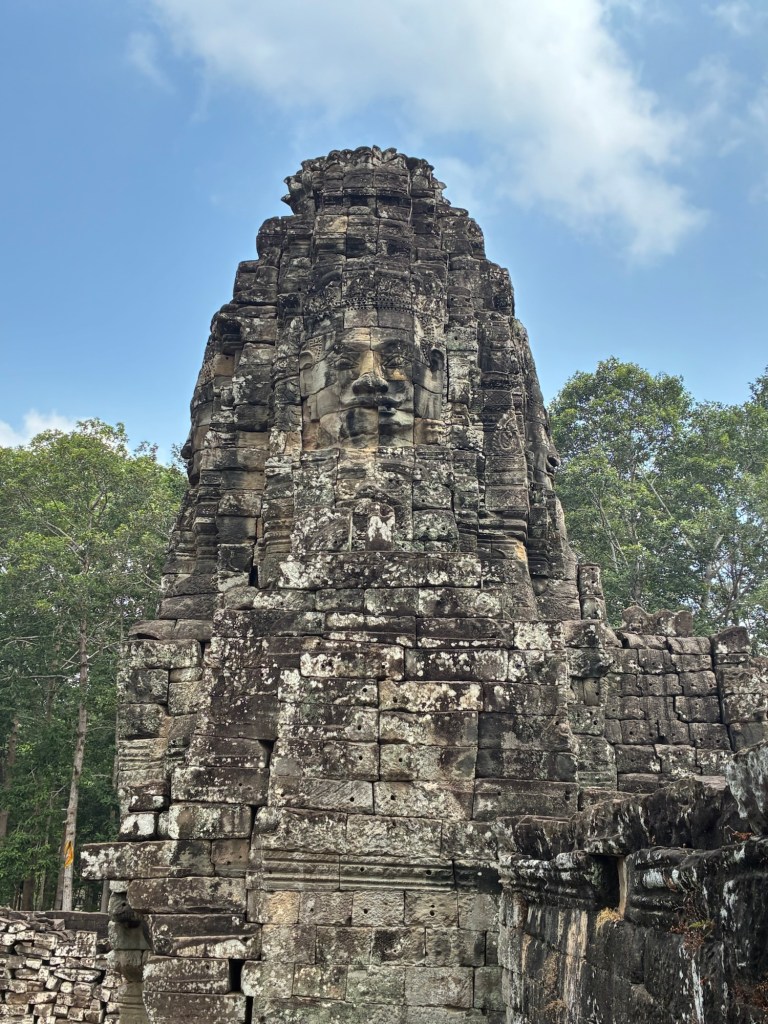
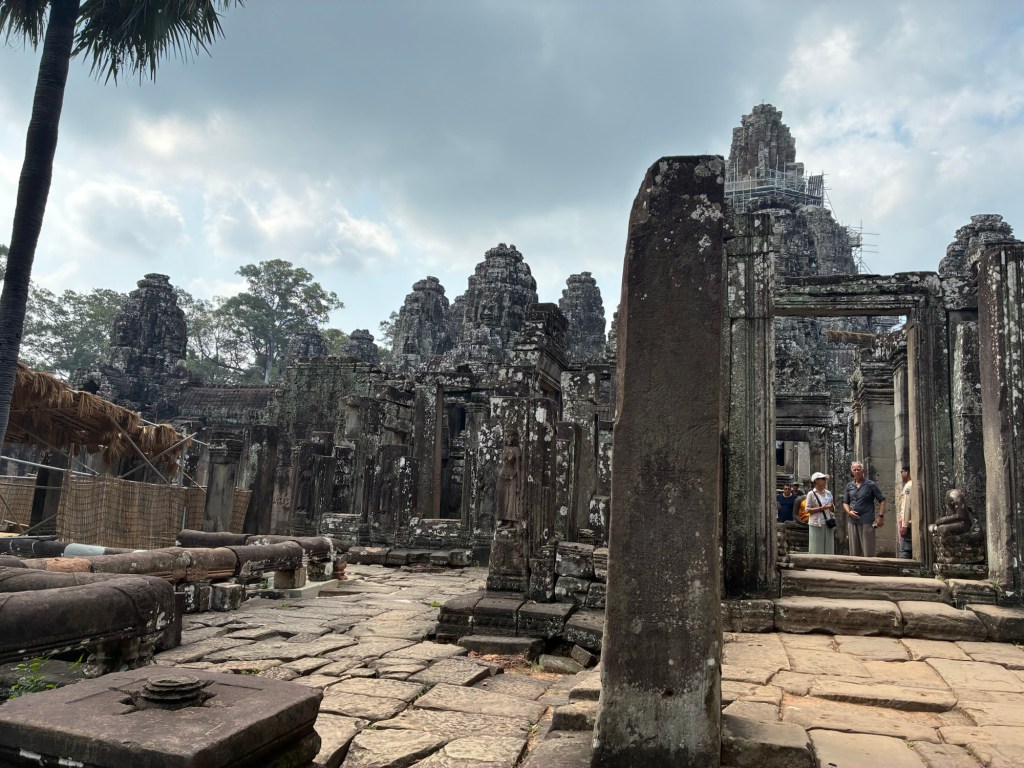
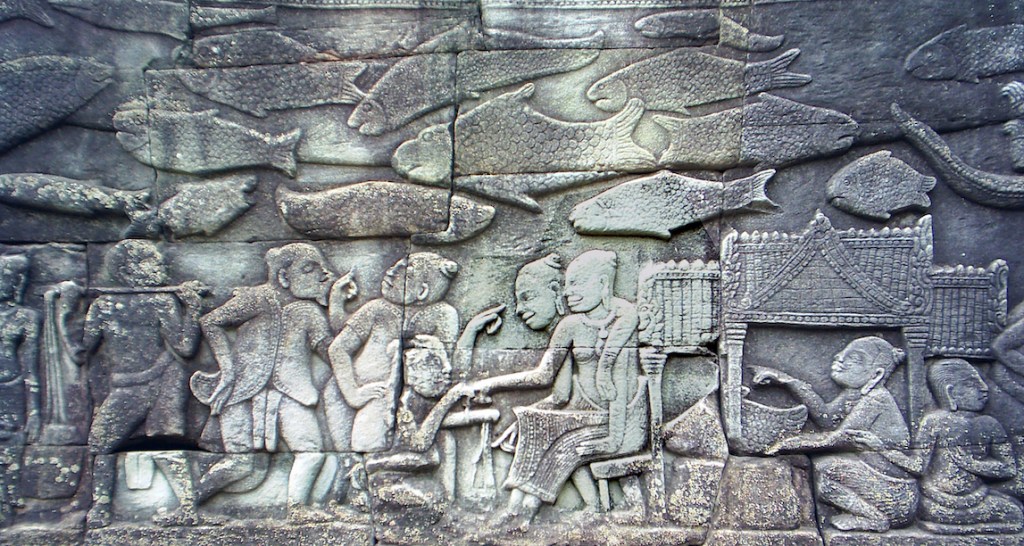
This temple is the most like “Tomb Raider”; fully enclosed, claustrophobic hallways; tight corners. Plus bats.
Across the way from Bayon is Baphuon temple, the king’s personal temple, next to his palace. Opposite it is the grand parade and the Victory gate, where the king would enter and exit the city so as not to mix with the riff-raff.
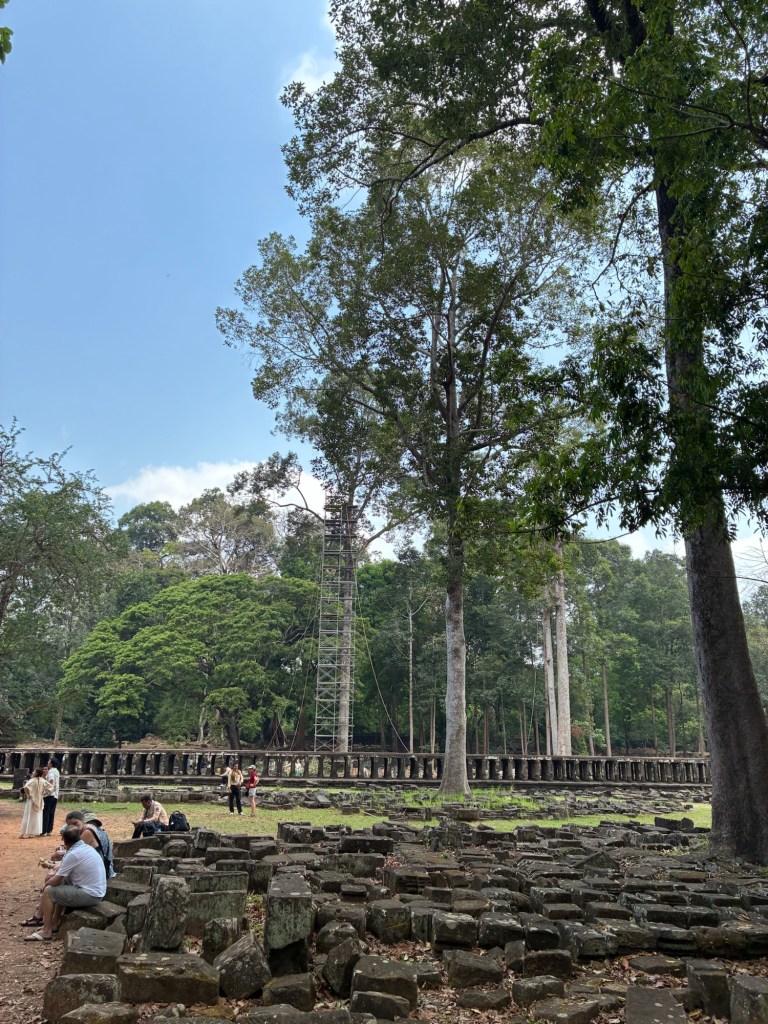
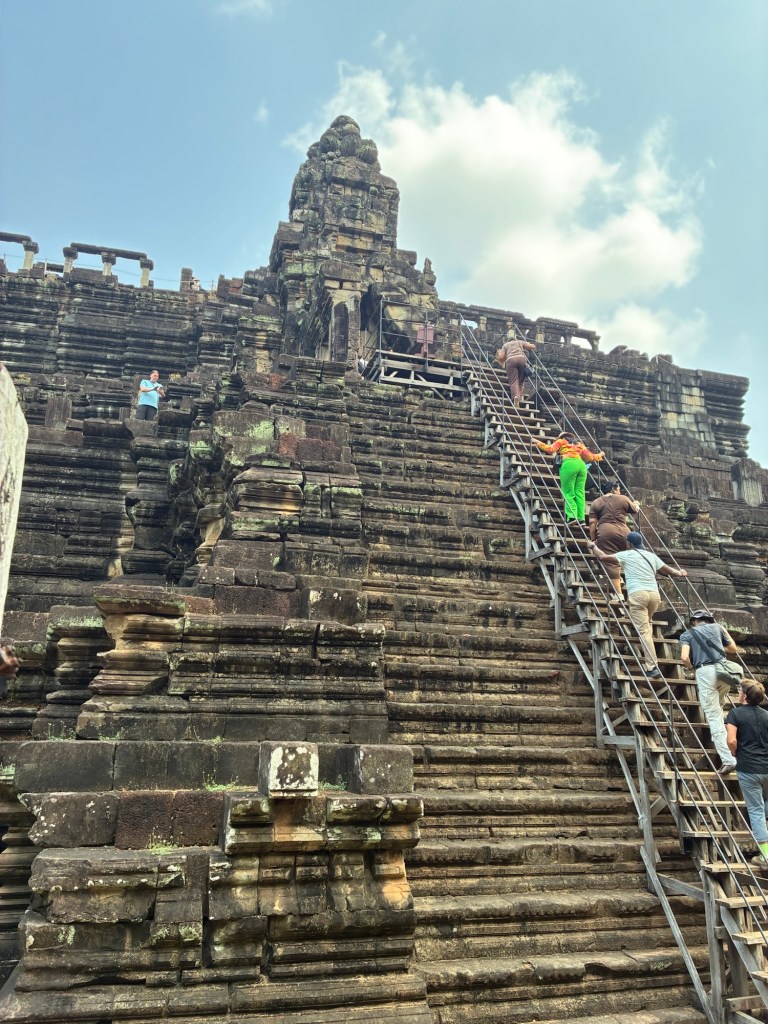
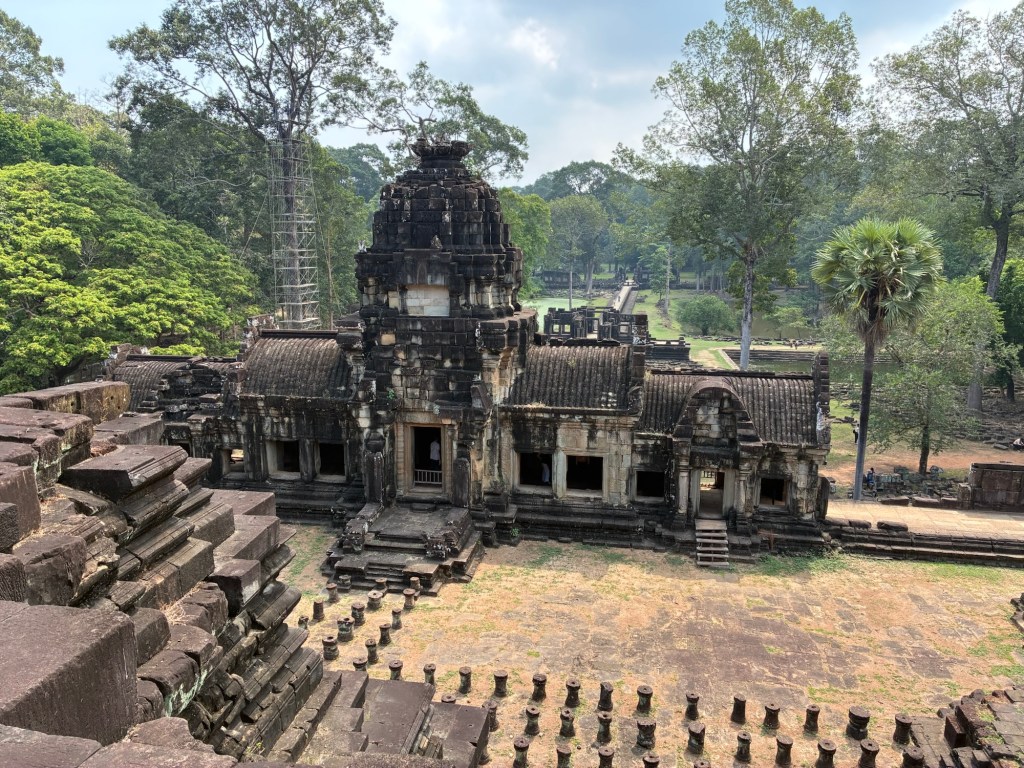
There’s an option to climb to the top here that I did not take, because my legs were screaming. I went to the second tier and around.
Following along from the grand parade, to the north, is the Terrace of the Elephants. It was basically the front porch for the palace, from which the king would make declarations and such. The palace itself was made of wood and has long since rotted away.
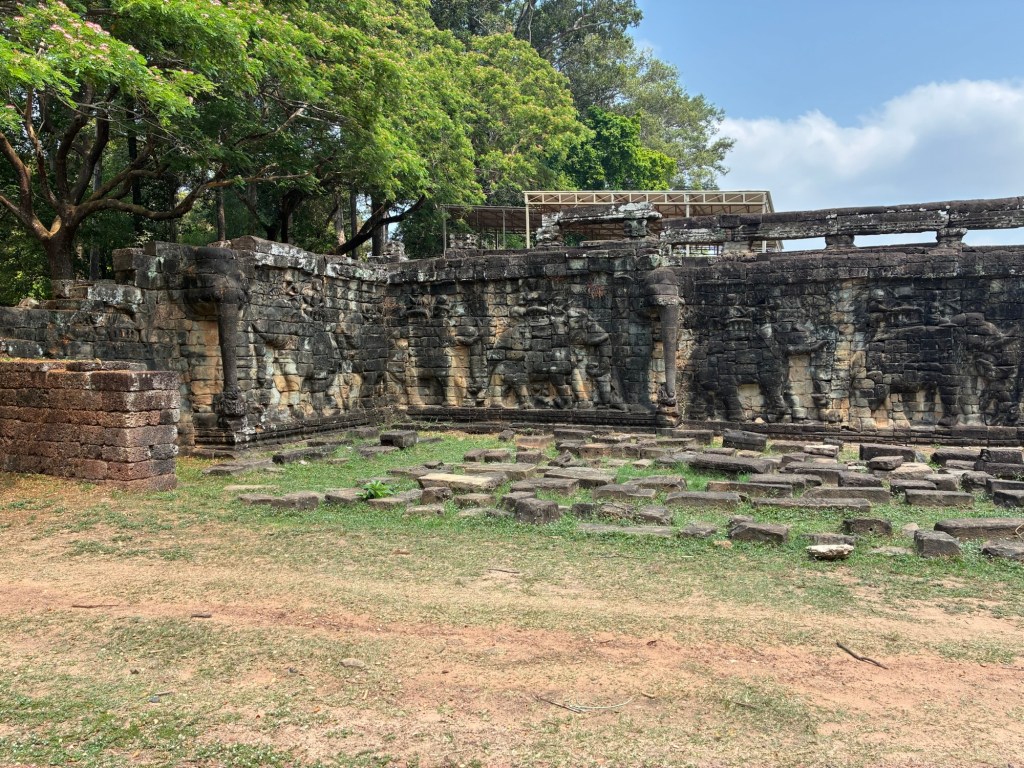
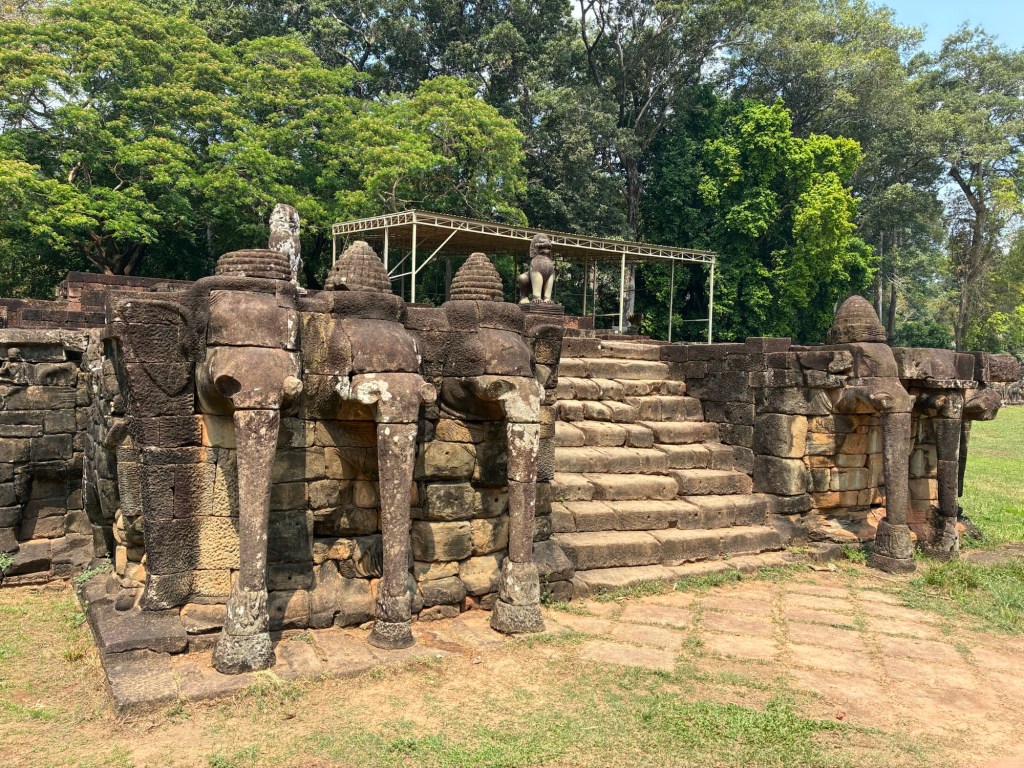
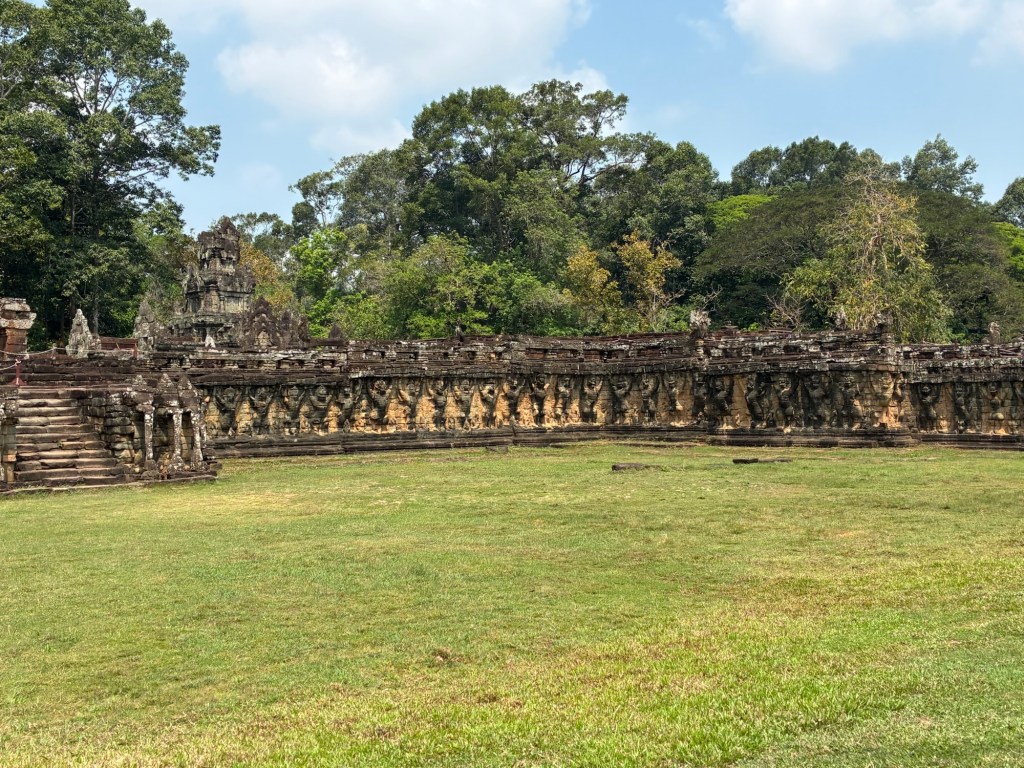
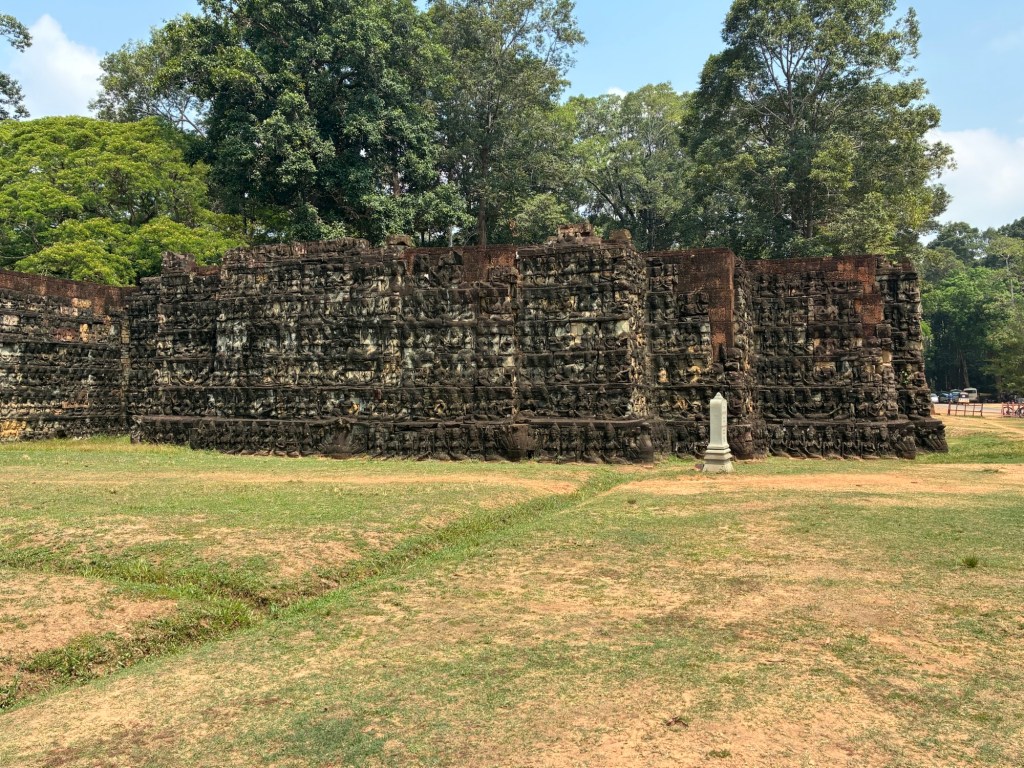
It was nearly 11 and the heat was unbearable again. I sheltered under the shade of a large tree and called a Grab back to the hostel. Then I hopped in the pool to cool off.
Had lunch at the hostel. Tried the Lok beef, which I didn’t like.
Had a tough choice to make! I’d originally planned to go out the next day – there were still more things I hadn’t seen, like Ta Prohm, the temple where Tomb Raider was filmed – but I was getting pretty tired. With Paul’s blessing, I decided to let it go. No more exploring.
In the afternoon, I went to a bakery up the road. They had good value for their food; you could get half a loaf of bread, or 6 cookies, for a dollar! I got a couple different things and sat in a spot in the hallway, under the camera, so no one could would notice I brought in outside food.
The Buddhist chanting started at 5AM this time.
I did have some housekeeping things to do the next day. I still had to send my postcards. I also wanted to take out enough American cash to pay Vlad back, and maybe also get a haircut.
Went for a nice walk around town. Stopped at Mixue for a drink. I am going to miss them when I go back to Canada!
Dropped my laundry off at a laundry place. The cheapest price is 24 hours, woops. I should have dropped it off yesterday. Oh well.
After lunch, I went up the road for a haircut. Since it’s the slow season, there’s all kinds of deal. A hostel up the road called “The Funky Village” also has a spa inside; haircuts for 7 dollars, waxing for 3. Pedicures for 2. I asked for a haircut – just a trim – and a wax.
The haircut went reasonably well. They have this table you lay down on to get your hair washed, which takes a bit of adjusting. She spent a long time washing my hair, but then it wouldn’t surprise me if I had layers of build-up from using free hostel shampoo (I’ve managed to stretch my 100ml bottle of shampoo across 2 entire months). She also noted that I had face framing layers and asked if I wanted them touched up, which I give her kudos for.
The waxing did not go well.
She had this set up for this sugaring style wax that cools and you pull it off. It works better for fine hair, not my thick German pelt, which even the aestheticians in Canada struggle with, so this did not bode well. I gave her the option to back out, but she was determined, even to the point of debilitating my underarms with tweezers. We were both in tears by the end, and I tipped her two dollars for the effort.
Then I went back to the hostel and finished Stranger Things. One of the stray cats in the area hopped up on my laugh and made itself home.
Good finale. I can see why it upset people, though. I’m all for killing main characters in service of the story, myself. But there is a trend of killing traumatized characters that people claim implies someone who is traumatized is too “broken” to be healed or fit in to society, to which I say… duh! With the American health care system, how broken ODSP and welfare is, the cost of living and the lack of affordable housing, every single day we are telling people with mental health problems that they don’t deserve to live. Build a society that will be supportive and healing for them, and maybe we won’t have to kill them at the end of each franchise.
I hate the cop-out. Kill her or don’t, don’t leave it ambiguous.
Away to bed, up early in the morning. My flight to Malaysia is today, Sunday.
I thought I’d just take a Grab to the airport, but turns out, the Siem Reap Airport is 40 clicks outside of town. Instead, there is a bus from the centre of town, although it can be busy because the Cambodians who work at the airport take it as well.
I ran to the bus stop without stopping for breakfast. The bus left at 7 and arrived around 7:40. I had checked in online and got my E boarding pass, but I missed the blurb on the boarding pass that says “You can’t board the plane with this and need a physical pass from the gate” (why does it exist, then?!) and I ended up at the back of the line. There was a large Portuguese family who did not have themselves sorted out at the front of the line, unpacking and moving belongings between their bags before they could check them.
Whatever!
I finally got my boarding pass and got through customs, found a coffee shop, and settled down for my very belated breakfast.
The gate was located at the very back of the terminal. 18 and 19 are right next to each other, so it’s hard to tell that there is two gates – I think it’s for shuttling people back and forth from Kuala Lumpur. An Australian family who showed up just as we were boarding decided we were a different gate and wandered off, despite my attempts to wave them down and tell them they were at the right gate. They were boarded last, presumably after being paged.
And then we were ready to go.
Goodbye, Cambodia.

 Wanderjahre
Leave a reply to abacaphotographer Cancel reply