By Lucy
Ready for chaos week?
I should have just posted “Not doing a post this week” instead of running myself ragged for a post I ultimately couldn’t finish in time, but hindsight is 20/20.
I had stupidly booked myself in to a different city almost every night, with one sight to see apiece, which I don’t usually do because I hate that kind of “ticking boxes” tourism, but that was the choice I had been forced to make. This is why I had wanted to do 5 weeks in the Philippines.
I wasn’t seated in the waiting area of the airport for long before I heard, “Lucy?”
I glanced up from my book of word searches. It was Rose!
“Oh, hey you!” I forgot she was flying to Manila as well. Her partner smiles at me. I can never remember his name; he’s a man of few words, but he seems genuinely happy to see me as well.
They sit with me. We chat for a few minutes before they abandon their luggage with me, although they come back with a couple of donuts for me as thanks. Rose hasn’t been to Baguio yet but she hopes to go next year.
I was somewhat leaving the travelled road behind. There’s a lot of tourism into north Luzon… from other Filipinos. Officially, Baguio is the City of Pines, but unofficially, it’s called the summer capital of the Philippines, because it’s where all the Filipinos go to beat the heat. The city itself is at a height of 1’500 meters, and the towns beyond at 2’000 or higher.
Me and Rose didn’t end up sitting near each other. I was seated almost at the back of the plane. The flight was short and unexciting.
I have noticed that all the flights into Manila play Wonderwall, for whatever reason. It’s impossible for me not to wonder how Rich is doing, especially since he posted on Instagram for the first time in more than a year. It’s tempting to reach out, but every time I consider it, I run it past Damocles, who always tells me not to. Rich is the one who owes me an apology and is the one who cut contact, after all.
I run into Rose one last time as I walk past the luggage carousel. She wishes me well on the journey.
I debated if I should try to grab food here before heading to the bus station, but there’s not much around and the touts set upon me right away. I summon a Grab – it’s a 40 minute ride to the bus station, although I have plenty of time. I ordered food on the way there. The Grab driver was a little chatty and recommended I try the ube jam made by a nunnery once I get to Baguio.
The bus station was a lot. Many bus companies have departures from there, but there’s no real waiting area. It’s in a grimy, industrial part of town, and although no one gives me any real trouble, it’s hard to feel safe.
Eventually my bus arrives for us to board. I had a mental plan to grab out a second layer of clothes and my towel to keep me warm on the journey, as the bus blasts the AC, but I was too frazzled and didn’t. I was seated next to another woman, and we were in front of the toilet, which was curiously located in the middle of the bus.
I actually managed to get some decent sleep at the beginning of the journey. The first 4-5 hours of the journey is across the mostly flat plains between Manila and the mountains. After we entered the mountains, however, all bets were off. The switchbacks were so severe and constant, and the bus’s acceleration/ deceleration so abrupt, we were tossed back and forth constantly. I nodded off only to be awoken by a sharp turn or braking. I was freezing in just my one layer of clothes and jacket. I tucked my pants into my socks.
Around 5AM, the sun rose and that was the end of trying to sleep.
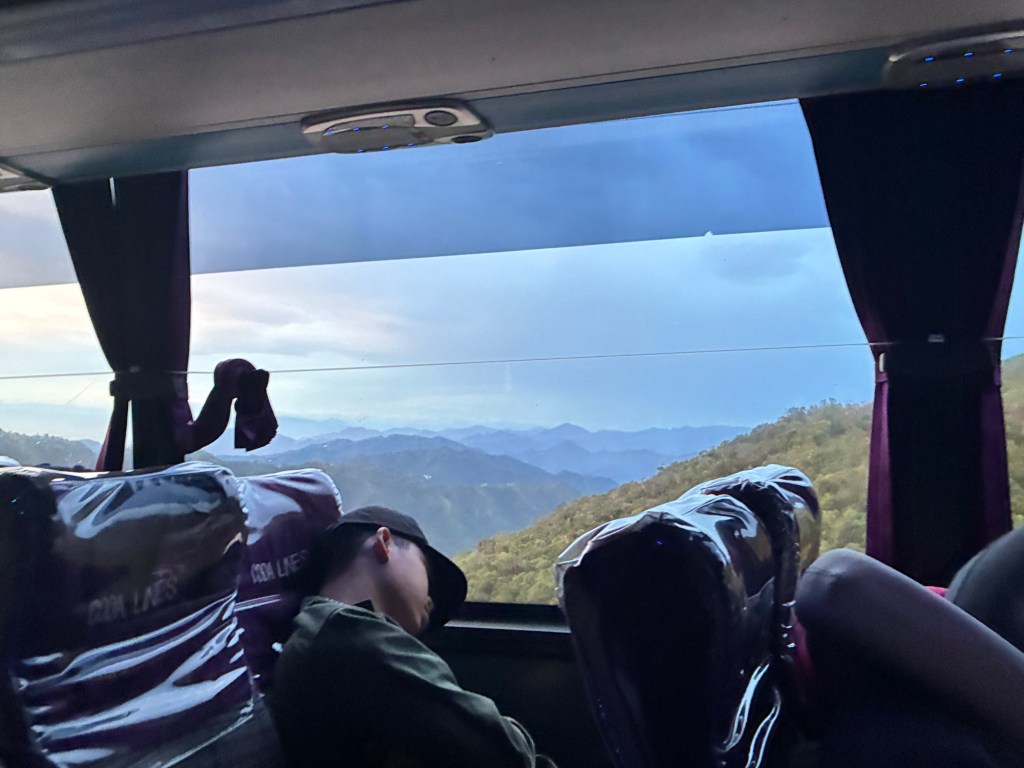
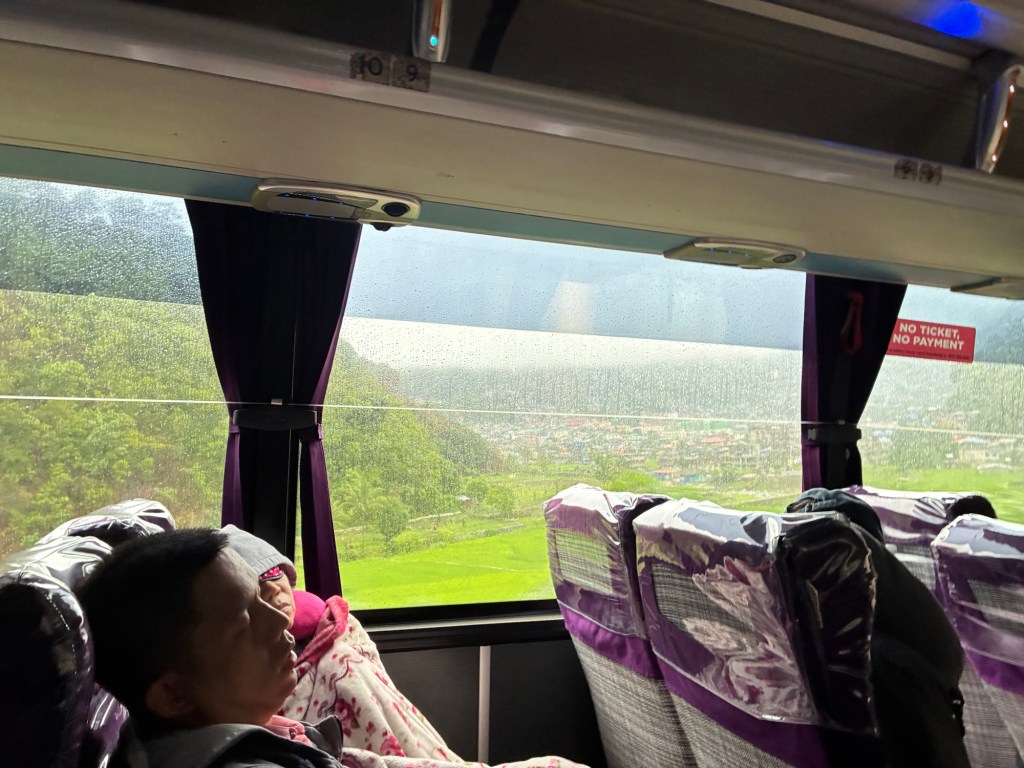
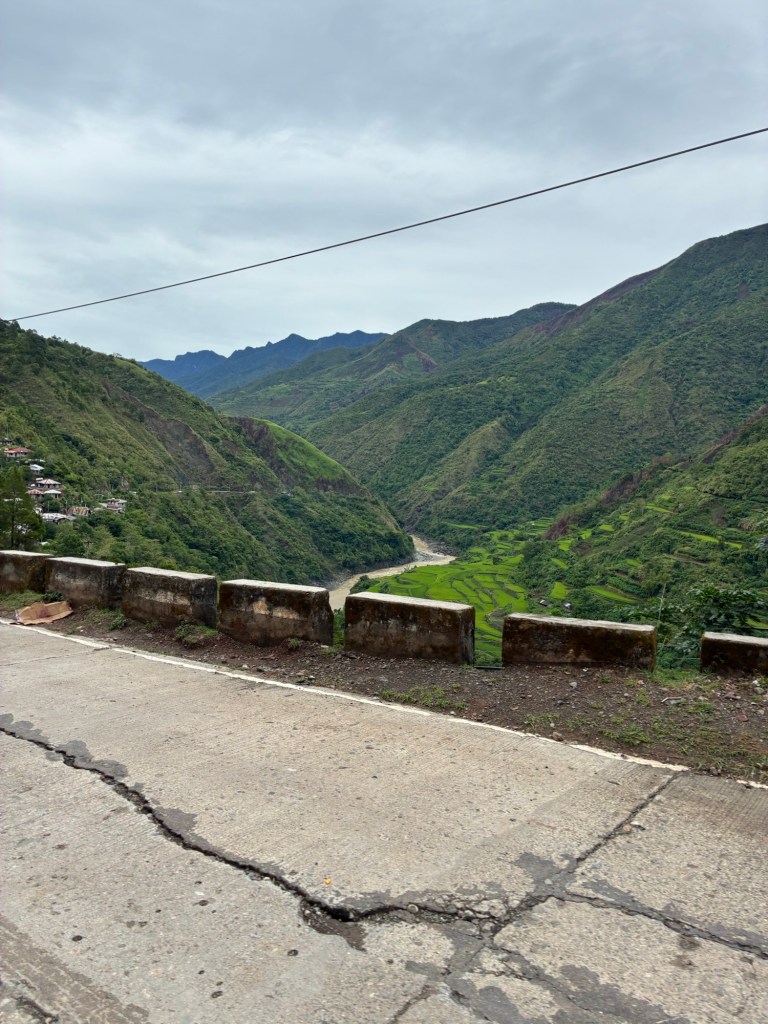
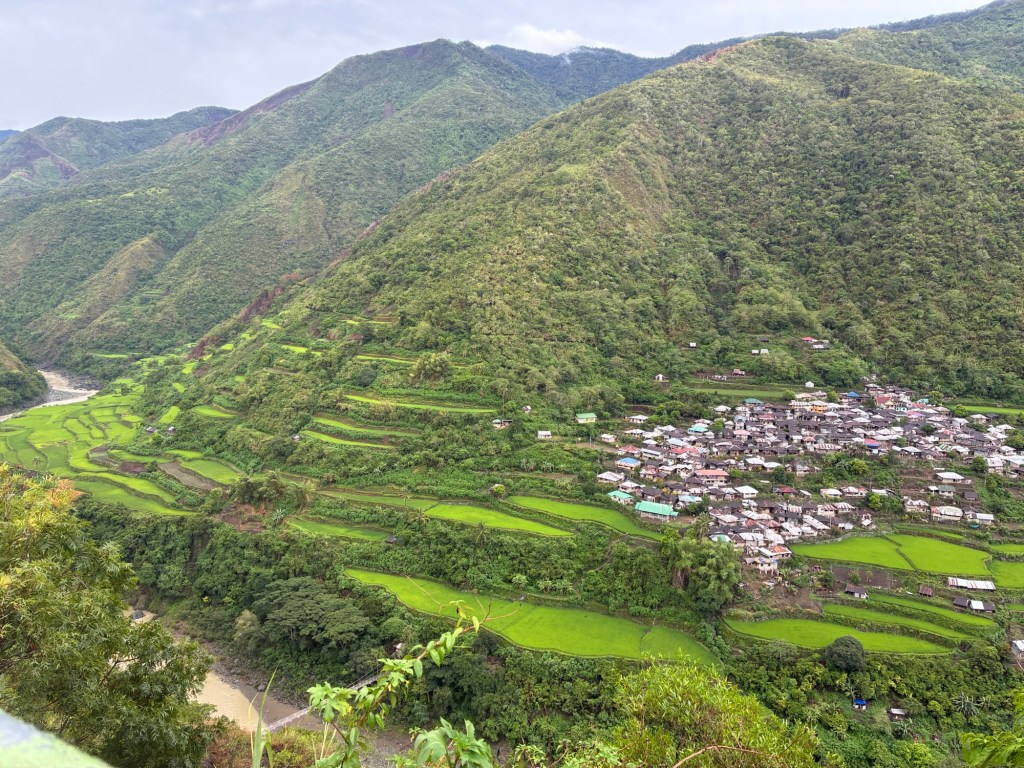
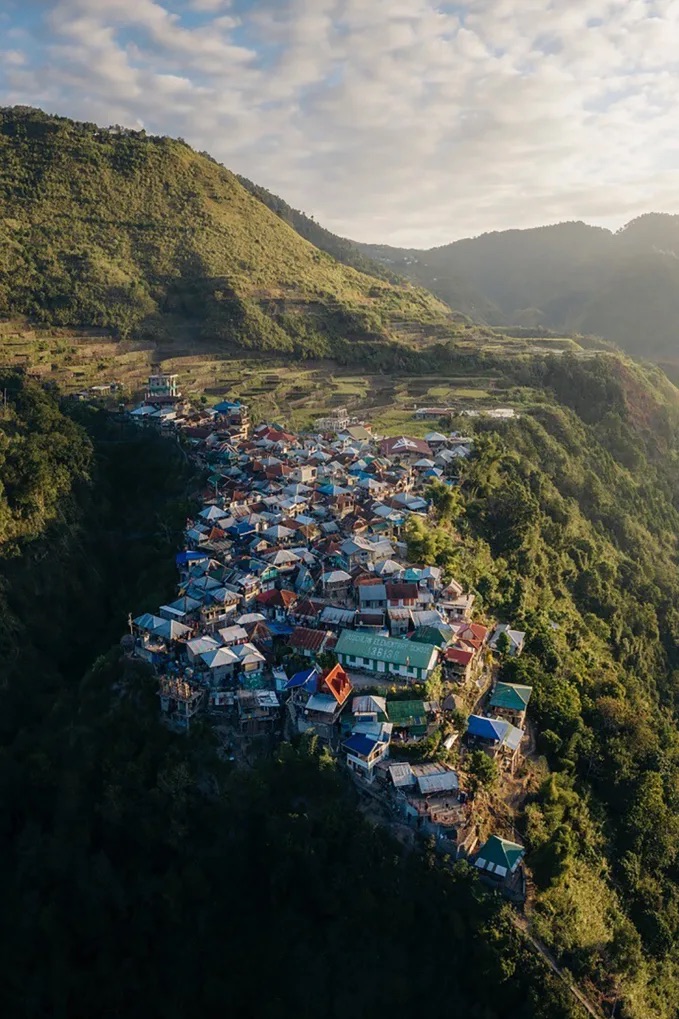
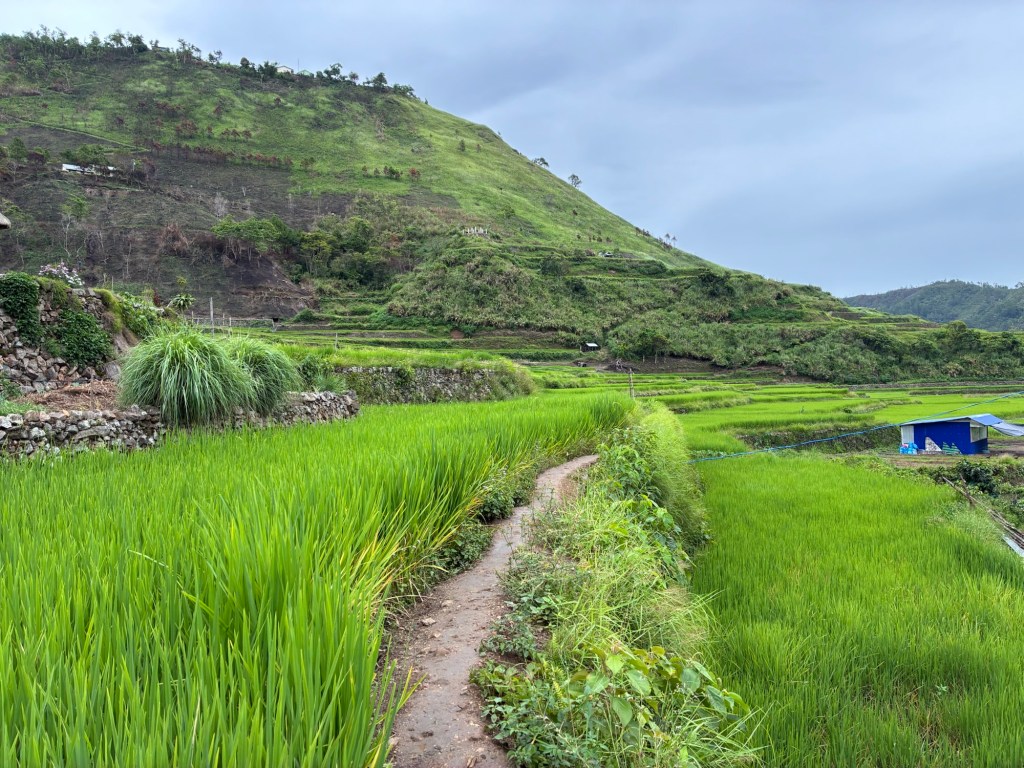
As the sun rose, I was captivated by the natural beauty of the Cordillera mountains. I’d hazard to say it was more beautiful than New Zealand. Large stretches of ancient mossy and montane forest are broken up only by the ribbon of the road, the occasional village, and vibrantly green rice terraces.
The Spanish didn’t really try to get into the mountains too much, so the people here are as close to uncolonized as you can get. Most of the people don’t even speak Tagalog, just their local language and increasingly English. Until the 1950’s, the villages were insular; headhunting was such an integral part of the culture the tribes didn’t communicate or trade with each other until American missionaries made them stop.
Of course, the pivot from “you have to bring a head from another tribe to be married” to “highland vacation destination” happened almost cartoonishly abruptly, over a period of like 30 years. Apo lived through basically all of it; the reason why she’s the last mambabatok is because she’s the only one still alive from when headhunting was ‘legal’. Others can do the tattoos, but they can’t bring back heads to undergo the rituals, so it doesn’t “count”.
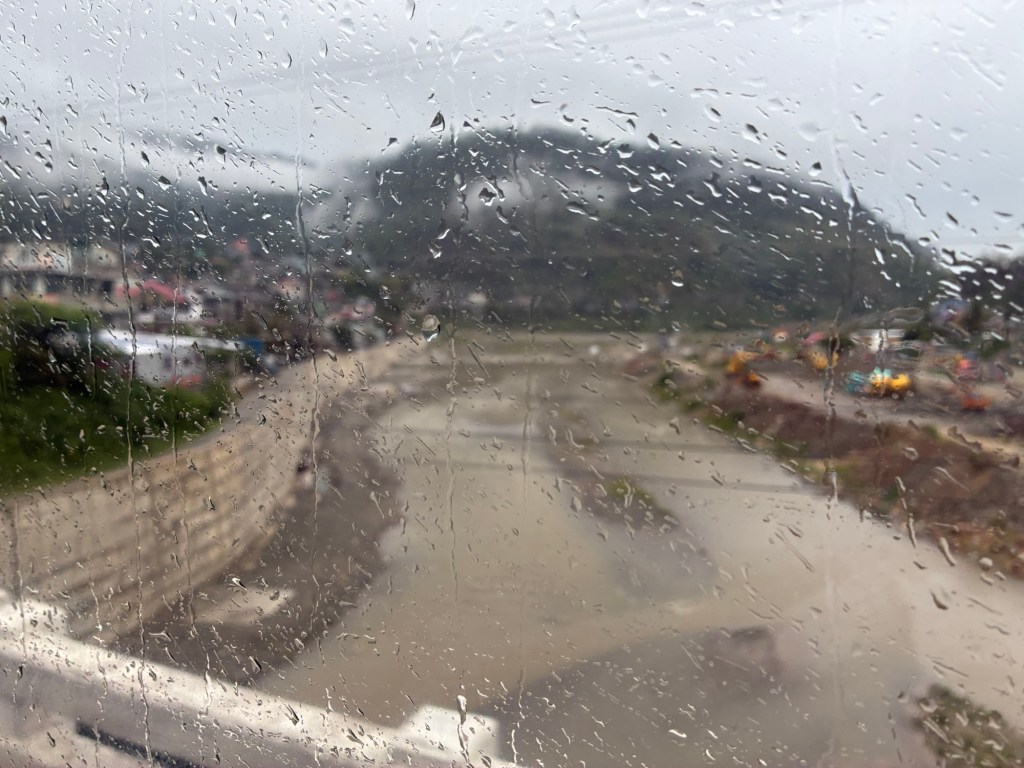
Around 6:30, we pulled into what passes for a bus stop in Bontoc, a small city in the middle of the mountains. They decanted us and the bus left. Everyone else scattered, leaving the white girl alone and lost in the rain.
Fortunately, my data was working here, so I searched it up online. The Jeepney ‘stations’ are marked on Google maps, so I zipped my backpack into my raincoat and trudged down the road in the rain. The Jeepney was open but unmanned, only a few locals inside, so I loaded myself inside. According to Google, it was supposed to leave at 7:30, but we ended up leaving at 7:20 because the jeepney was already so full people had clambered onto the roof for a ride.
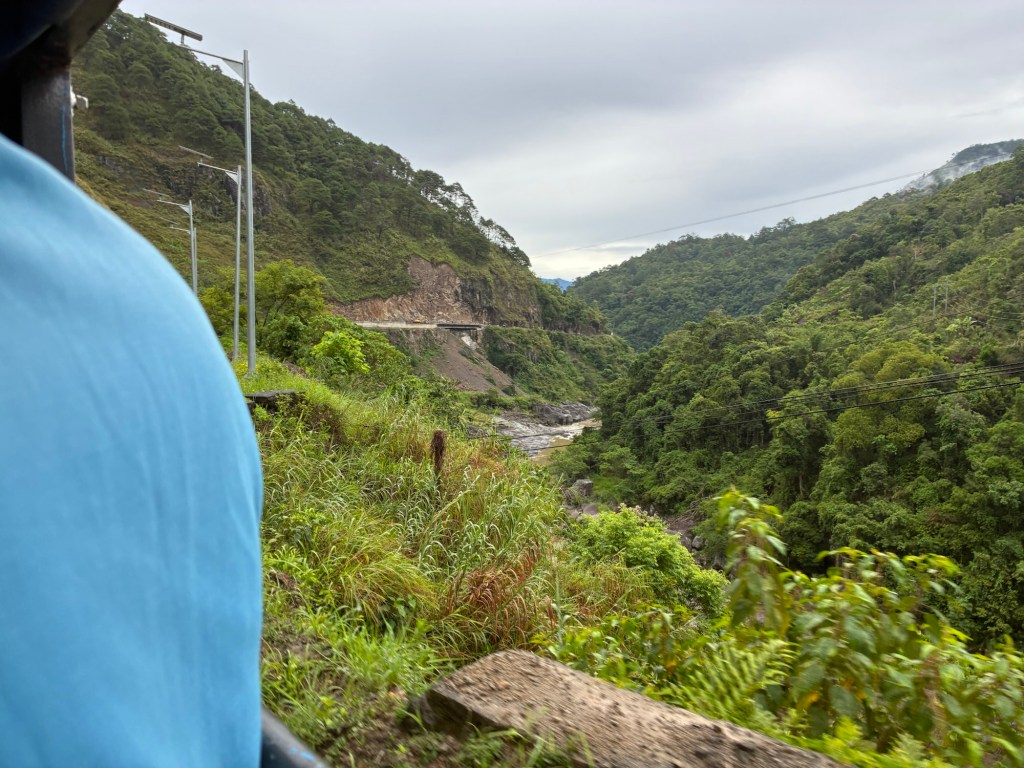
It’s only about 30 kilometers as the crow flies to Buscalan, but we were crawling along at a snails pace, the road weaving along the mountains. Up and up and up, the river getting smaller and smaller below us as we passed 2’000 meters. I was a little nervous; the rain never let up and we kept passing the scars of landslides, and places where the road had obviously washed away and been patched. The ground here is vulnerable to slips; the rock is very volcanic, mostly andesite and basalt and tuff.
I also knew, logically, the oxygen up here is less – 16% – but with the effect of the night of poor sleep, it was hard to tell how much of an effect it was having. I had no coffee and only a bag of baked goods I’d thrown into my backpack before I left Palawan, but I didn’t feel hungry. Just numb with determination. We stopped at some kind of market for 20 minutes, and almost everyone got out, but I didn’t bother trying to buy anything. I did shuffle all my stuff down to the entrance of the Jeepney, just so I wasn’t hitting people in the face with my bags as I tried to exit at my stop.
The way you stop a Jeepney is by knocking on the ceiling. As we pulled up to where the stop is, I wrapped on it with my knuckles, and everyone in the Jeepney glanced at me in surprise.
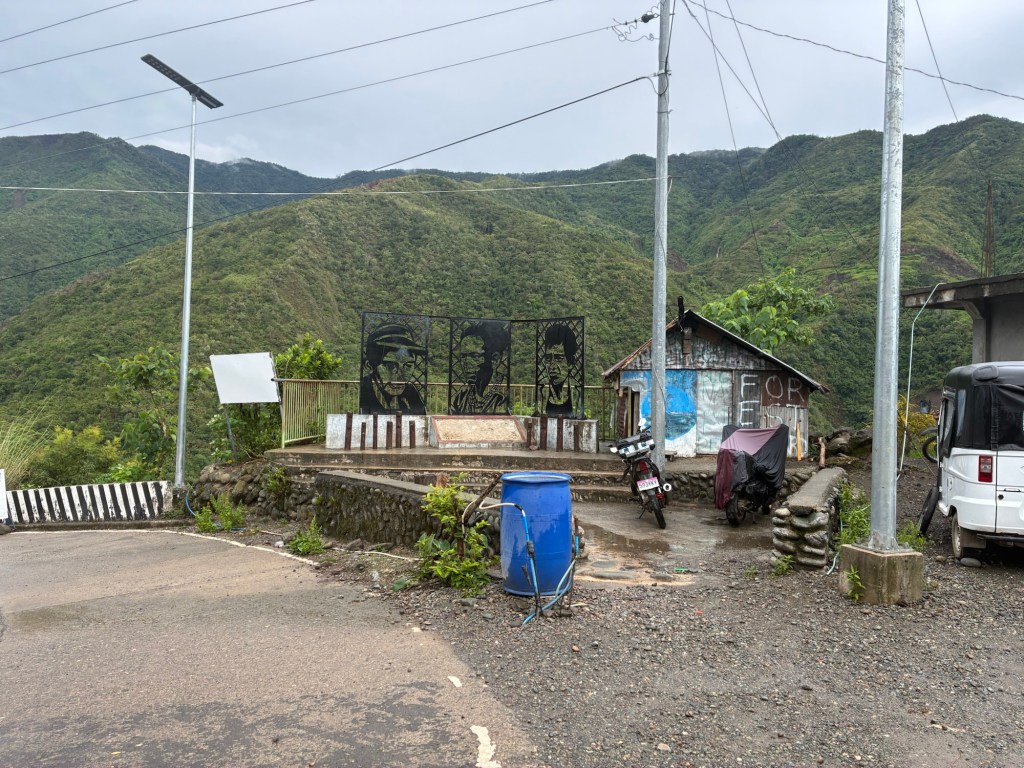
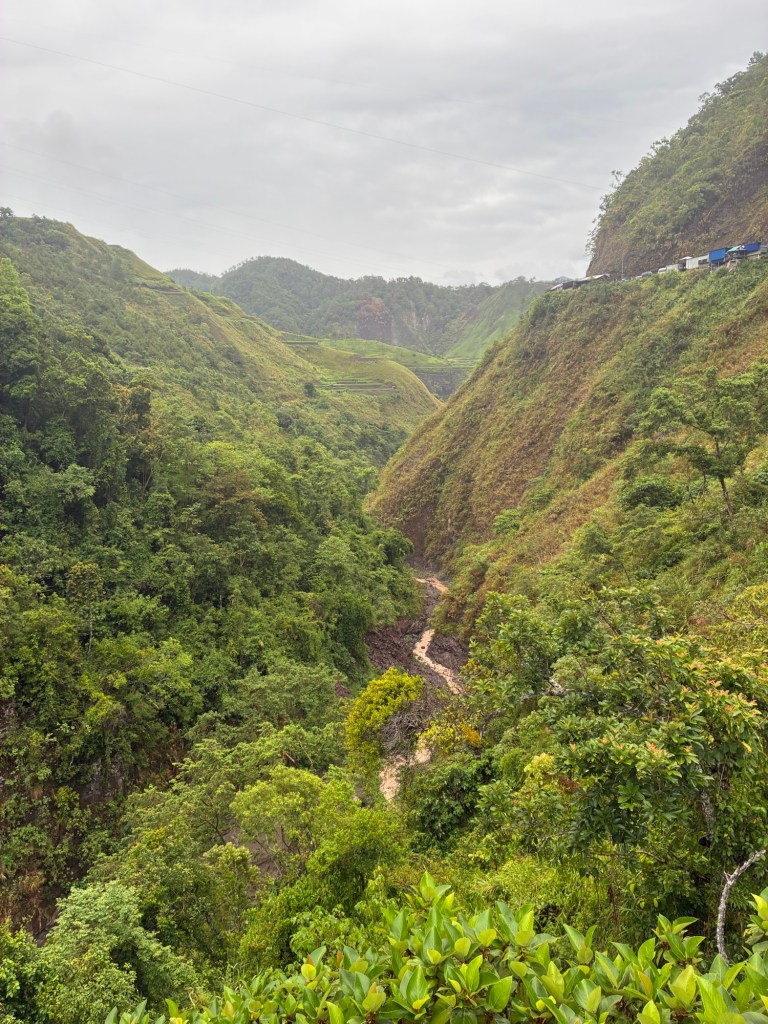
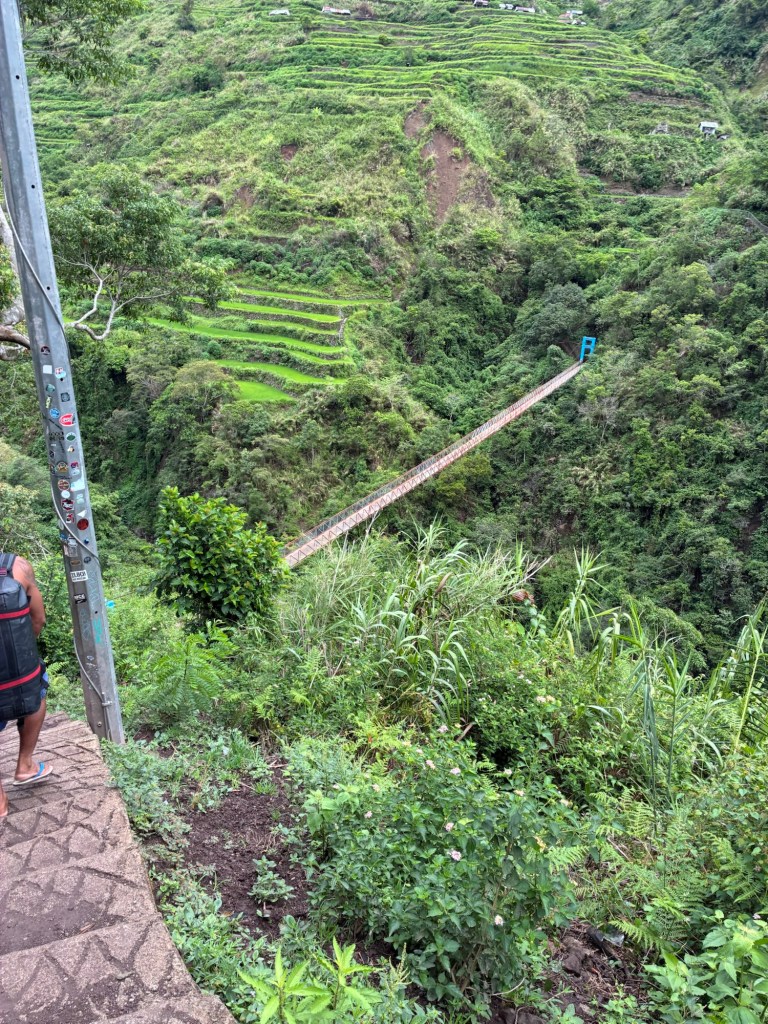
I’ve read a few blogs about getting to Buscalan, but the details change so frequently as to be useless. Even 2 years ago, people were writing that there was no road or wifi, but neither is true anymore. As of June 2026, there’s a police station by the road, and you have to sign into their logbook. There’s a few tuktuks waiting at the corner store there. A local was about to head up the mountain, and she kindly asked her tuktuk to wait for me. I noticed that she didn’t appear to have paid him, but then that makes a certain kind of sense; let the tourists pay the wages.
It was 200 peso for the tuktuk. They dropped me off at another station, where I had to sign another logbook. Someone explained to me the price of everything, but I barely heard them. I’d hashed out the rough price from summaries on blogs, and brought a couple thousand extra, just in case. I just agreed to everything and was introduced to my guide, Paul.
Actually, in hindsight, I regretted a lot of the journey. I’d planned so well and gotten there so early, and the tattoo process was so smooth, I could have gotten the Jeepney back to Bontoc and made it to Sagada for the night, which I enjoyed more. I didn’t enjoy the night in Buscalan. But I was just going along with what everyone else did, and most people don’t make it there before 10 or even later.
Also, I dunno if it’s just the price or luck of the draw, but I’d read a lot of other blogs had chatty guides who talked about the village and history. Paul’s English was good but he was not chatty – he often mumbled so I had to ask him to repeat himself – and despite having done this since at least 2019, he didn’t seem to enjoy it and always had a vibe of wanting to get away from me as soon as possible.
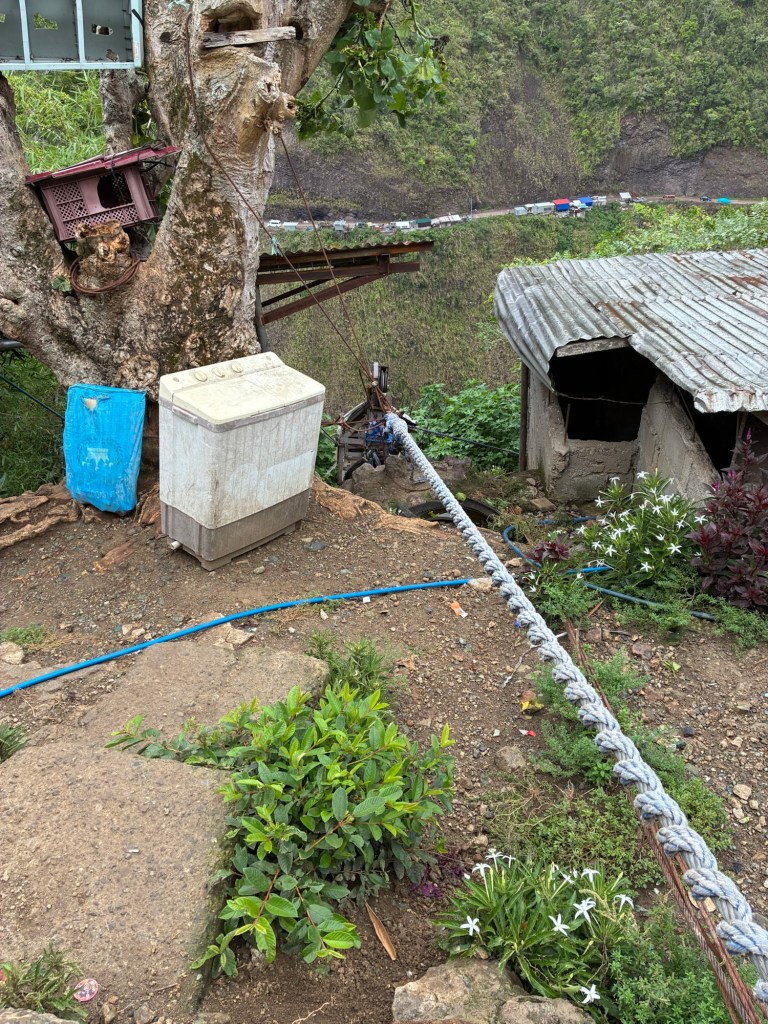
The last leg, at time of writing, is still a hike, but I did notice they are building a road the last 500 meters to the village. There’s also cargo ziplines for quickly transporting supplies across the canyon.
Paul gallantly offered to take my luggage and off we went. The guides aren’t really supposed to carry your bags, and I start to see why taking a tour with a private van makes sense – leave the heavy bags in the car. A few times, he offered me a break that was clearly him requiring a breather.
“You can get big tattoo today, but not Apo tattoo. Because the baby died.” Paul says, mumbling.
A baby died? Who’s? Is she not doing them because of a proscribed mourning period? Well, I wasn’t really sure I wanted the signature Apo tattoo anyway, to be honest. I shrug. “That’s ok.”
“You can do Apo picture today.” He offers.
“Alright.” I do want that.
Halfway up the path, the strap on my backpack snapped from where the dog had been chewing on it. Thanks, Tudy.
The place I was staying was on the other side of the village. These villages are not designed for visitors, which is part of the reason why you need to pay for a guide; before the Americans “civilized” them, no one visited the villages, so you had no need for roads or signs. You grew up here and it was all you knew. Apo doesn’t speak English or even Tagalog, just the village dialect.
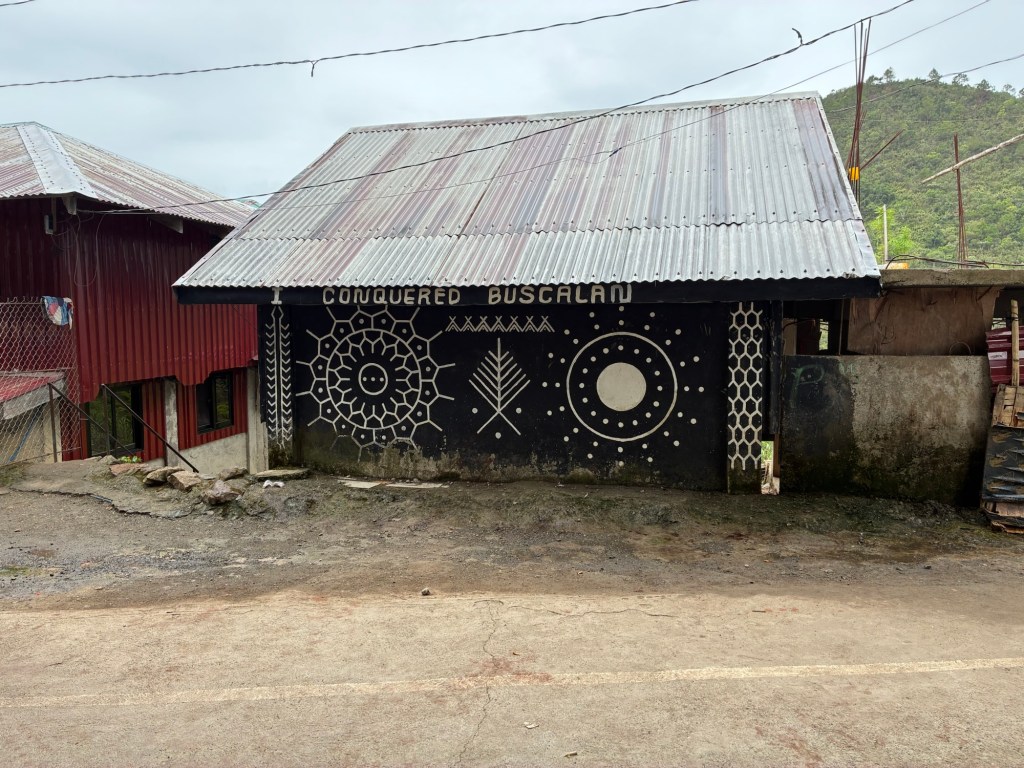
We wove our way through the rickety, narrow streets between the houses. There were a few carinderias, and stores selling Apo merch – she appears to be big into cannabis – and giant murals painted with her image on the sides of buildings.
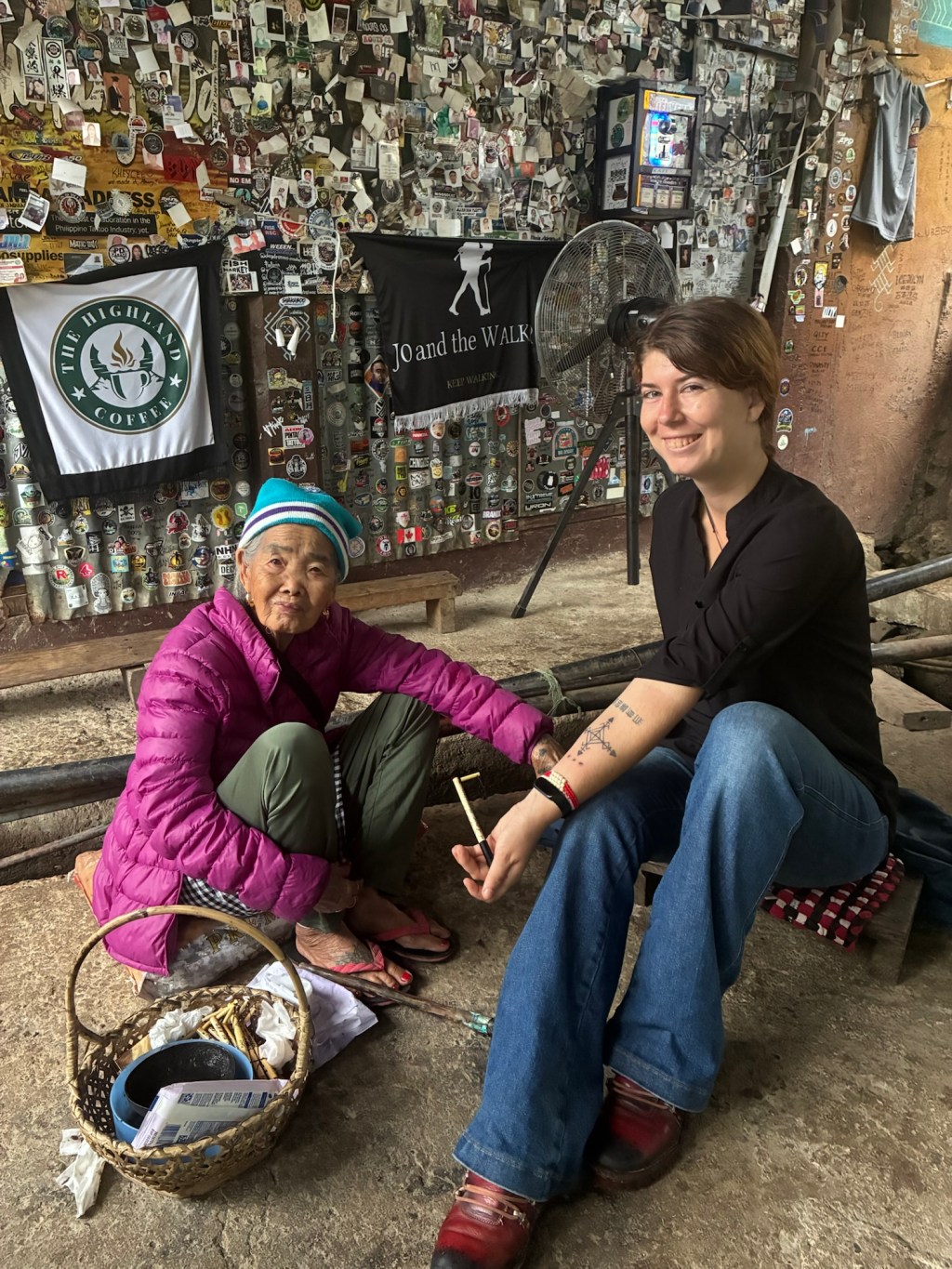
We found the legend herself sitting in an alley, on a bag of rice. Worth noting, to my understanding, that Apo isn’t ‘actually’ her name; her name is Maria. Apo is a term of respect, like “grandmother”. She patted the bag of rice next to her and Paul told me to sit with her for a picture.
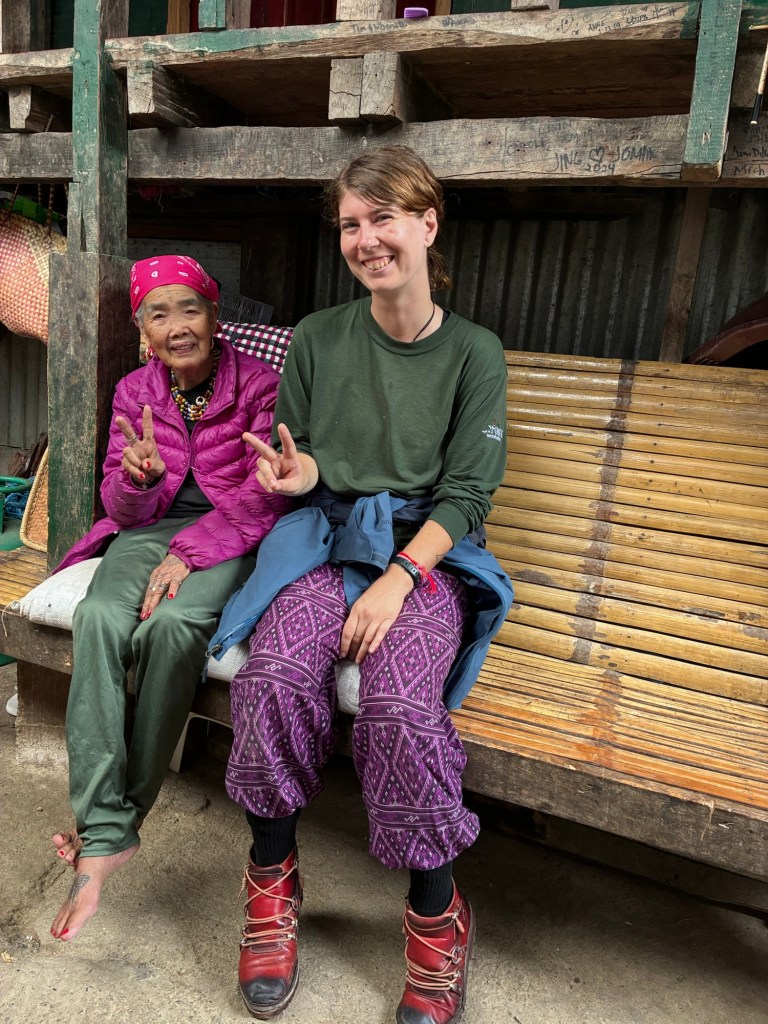
I wished she spoke something I could understand. I have so many questions. Did she know about the Spanish occupation? Did she hear the bombs being dropped on Manila? (And later, as I found out, Sagada and Baguio) What does she think of all the foreigners? She smiles and poses readily for photos, so she’s clearly ‘ok’ with it, but does she see the money as good for her village, or does she enjoy the attention? Does she worry about what will happen to the village when she’s gone? Does she think this is progress?
According to articles written about her, she had a profound love when she was young, but she wasn’t allowed to marry him. He later died and she’s had partners but never married or had kids. I find it interesting, since the rituals for the various Igorot peoples requires you to consult a oracle before someone can be married, so presumably the oracle said it was a bad idea. Considering the maternal mortality rate for a village so isolated as this, and how much she has changed the culture of the village, one could wonder if fate barred their marriage and killed him to affect this change. Before her, there wasn’t any female mambabatok, and now the only apprentices she will take are female. In the course of 90 years, she’s flipped the patriarchy on its head, and made a bunch of money doing so.
I mean, if that’s not Soroptimism, what is?
In any case, I couldn’t mention any of this to her, so I paid her for the photo – 50 peso – and me and Paul kept walking. The homestay I was to stay at was on the other side of the village.
The house was some wooden structure constructed between two existing concrete structures, which the carpenter in me struggled to make sense of. I asked Paul if it was his house and he said yes, but later on he clearly didn’t live there, so I don’t know why he said yes.
He wanted to hustle me along on the hike to the waterfall – another 300 peso – but I was tuckered out and I honestly didn’t want to explore the village much. I like being rural a bit, but not this. It’s not even the lack of cell service, it’s the lack of running water. They showed me the toilet – here it’s called a comfort room – and it was a squat potty, without even toilet paper, just… the ladle. I made a half-hearted attempt to use the ladle and gave up, deciding instead to restrict how much I ate and drank, to minimize how much I’d have to relieve myself. It really doesn’t help that my frequent bowel movements aren’t solid; if I just had to pee, it probably wouldn’t be too bad. Or if I wasn’t on my period and bleeding through pads every hour. I stupidly didn’t bring toilet paper with me – no one else mentioned this, am I the only one who ended up at the homestay without a proper toilet? – but I did bring wet wipes, and that was fine.
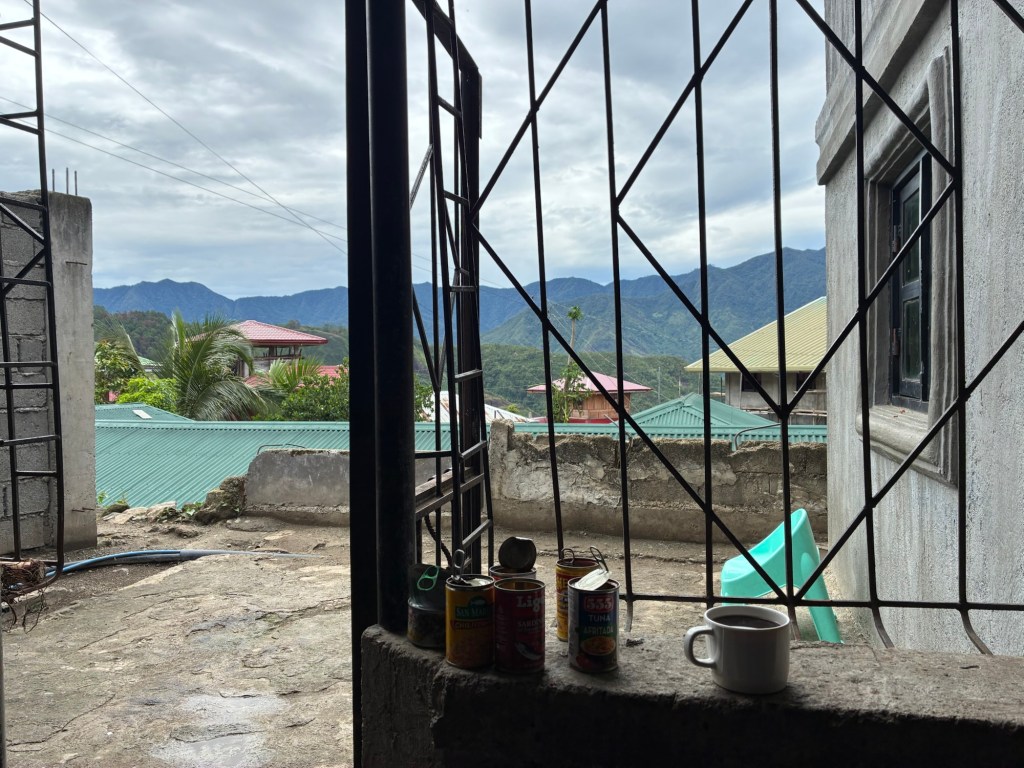
Eventually Paul gave up trying to convince me to go on a tour of the town and showed me my room. It wasn’t much, but I liked it; a room all to myself! When I came back downstairs, he handed me a laminated paper with the designs on it – no custom designs here – and a cup of coffee. They are coffee-mad here, which makes me laugh. Who brought coffee here? Not the Spanish, surely. And they can’t grow it here. This whole tattooing thing must be to ensure a steady supply of their smack habit. No one drinks water, just coffee. Vlad would love it.
I sat down in the hallway/entryway/lounge and waited. I dunno if it was the tiredness or what, but it took me far too long to clue in that the woman standing around the room with me was meant to be my tattoo artist. Once we were all on the same page, she showed me the twig for mutilating tattooing me and introduced herself as Josie.
I showed her the design I had picked out and where I wanted it, and she approved. She was the chattiest person in the village, that I met. “The traveler for the traveler.” She smiled. “Always leading you home.” (My design is a vegvisir – Kevin’s real excited about it)
She started by drawing the stencil on my forearm with a piece of straw. She was using half a coconut as a bowl, and inside was a paste made of soot and… water? It occurred to me, as I watched her draw on me with a piece of grass while holding the pomelo twig I was going to pay her to stab me with, that this was waaaay more rustic than the handpoke tattoo in Chiang Mai. Hell, the Sak Yant is done with a sterilized metal tool made for that purpose.
Then the stabbing started.
It wasn’t too bad at first. Actually, it was probably the least painful tattoo at the beginning, I barely noticed.
We chatted as she worked. Turns out, there’s actually not a lot of white people who make this trip. It tends to be Filipinos or other Southeast Asians. I grabbed out the package of wet wipes; they don’t supply any of that stuff. You want hygiene, you gotta bring it.
A group of 6 Filipino 20-somethings showed up about a third of the way into my tattoo. I learned later they were a group of friends from elsewhere in North Luzon, here to get tattoos together to celebrate someone’s marriage. They all crowded around to watch me get mutilated and ended up copying my tattoo. We also all got a selfie together that I didn’t get a copy of, so there’s just a group of Filipino kids out there with a matching tattoo and a picture with me. C’est la vie.
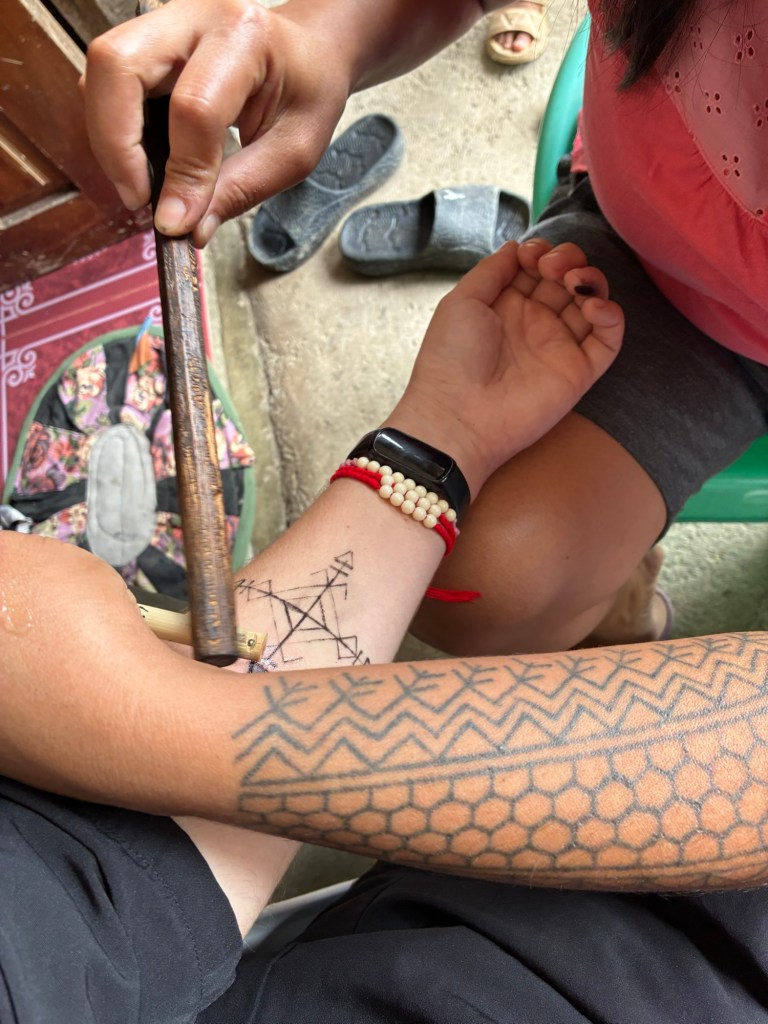
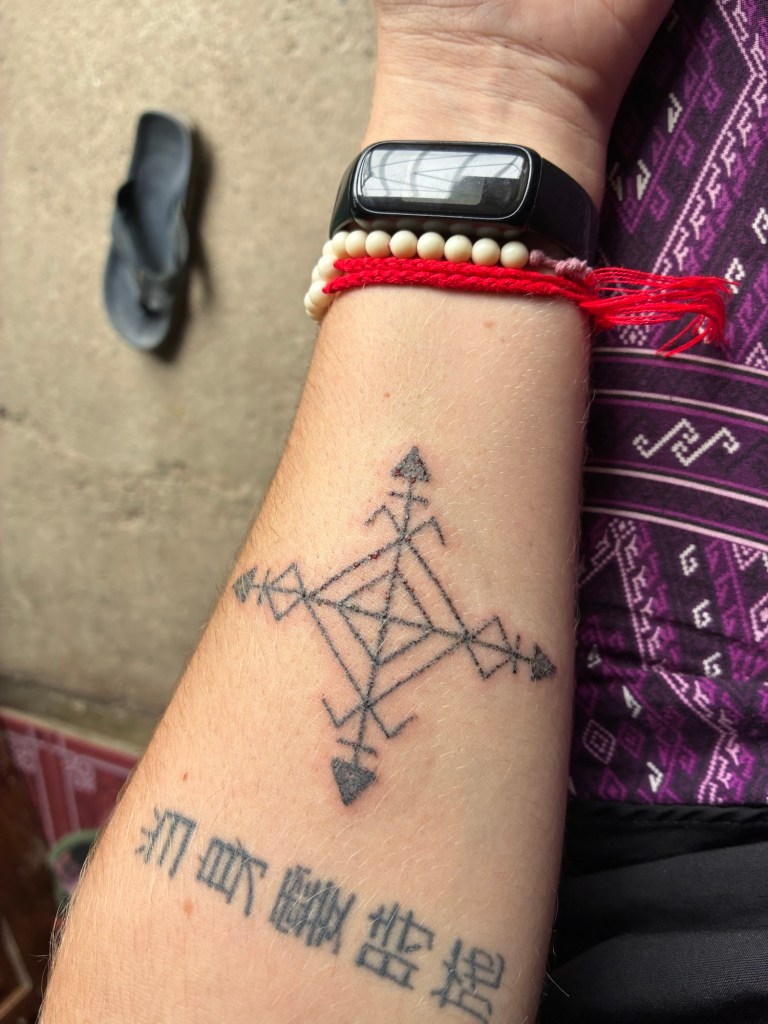
Halfway through the tattoo, it started to hurt. It didn’t help that I could tell Josie was starting to fatigue, as was my arm.
Happy place, happy place…
And then it was done. She handed me the twig; here, the twig I stabbed you with, as a memento. Still wet with blood. I cleaned it off with a wet wipe.
It’s hard to compare to my Sak Yant because the Sak Yant is in a location that’s hard for me to see, but this one definitely seemed… bloodier. I resisted the urge to wipe off the wet blood, and let it dry to a scab. Paul said lunch was at 1, so I crawled upstairs and into bed for my usual post-tattoo nap.
Around 1, I woke up and went downstairs for lunch.
The vibe here is super weird. I was shown a pot with some fish soup and a pot of fresh rice. I plated up a medium amount – depriving myself so I don’t have to use the facilities – and they seemed very concerned by this and tried to encourage me to eat more. Later on, it seemed that I had just been given the leftovers from their meal, because in the morning both pots were still on the table, untouched.
Guide Paul had disappeared by this point, so I went back upstairs, chatted with the Filipinos as they were getting inked, did my word searches and played on my phone (there was wifi). In the middle of the afternoon, I tried going for a walk, but I was quicky lost, partially because it was just so foreign here. I did head out to the rice terrace, but then I wondered if it was rude to be walking through someone’s livelihood. I went back to my room.
The walkways are stained red here. It’s not blood, it’s betel nut, the chewing of which is still popular here, and is presumably the reason every man over 30 is missing all his front teeth. You might notice signs in the city saying “no spitting of moma” and spelling variations thereof, and this refers to the betel nut.
At one point, a chicken decided the stack of bowls on a shelf looked like a great spot to sit, but of course the unbalanced bowls fell to the ground with a huge crash! It didn’t deter the chicken, which kept coming back. I also watched a toddler chase a rooster around, trying to pull the feathers out of its tail, and I wondered why the rooster didn’t try to defend myself. I was nervous for the toddler’s fingers and eyes!
Someone has a pet husky. I thought that seems terribly mean to a dog used to cold weather, but then I guess it never really gets hot in the mountains. Still. Where did they get a husky?
In the evening, the man who appeared to be the homeowner killed and started cooking a duck. He asked if I eat food like that (meaning, are you a vegetarian) which I interpreted as an invitation. An hour later, the sun was going down and no food had been served yet, so I started to second guess myself. Paul finally showed up and asked me what I was doing for dinner, so I asked him to guide me to the store. I bought a can of sardines; since the rice was still on the table, I can make a meal of it. As I sat down and opened the can of sardines, however, the man reappeared and seemed hurt that I wasn’t eating the duck it turns out he was cooking to share with me.
I give up!
I will say, it was a small can of sardines, so I ate both. The duck was fine. Filipinos have this terrible habit of breaking chicken (and duck) bones into their soup, so you’re constantly picking chunks of bone out of your teeth. I get that adding the bones to the soup increases the flavour, but why in small bits?
After I was done eating, I fled back to my room. I did try washing my dishes and was told to leave it. I fixed my backpacks strap again. It only has to last until I get to Taiwan…
It rained all night. I love the sound of the rain on the tin roof, snuggled safe and warm in my concrete bunker. The mattress, despite being on the floor, was very comfy.
I woke up around 6, still feeling a little tired. I debated rolling over and going back to sleep, but decided against it. I got up and packed up my things, and got dressed. At 6:50, I wandered downstairs. All the doors were still closed.
Shortly after 7, I smelled coffee. I went downstairs again; someone had finally put a bucket under the leak in the ceiling as well.
Someone poured me a coffee and I sat on the chair downstairs.
The group of young Filipinos got up and started cooking a feast. They got instant noodles, fresh eggs, and refried the rice from the night before. When they were all done cooking, they physically dragged me over to the table to eat with them and took another selfie of us.
Paul had showed up by this point. “Ready for Apo tattoo?”
I really thought about saying no. My arm really hurt from the other day, I was tired of being in this village and kinda just wanted to head out. But… I guess.
“What do I need?” I asked.
“Your needle.”
“Anything else?” I emphasized; does it cost money.
“No, ma’am.”
Alrighty.
I grabbed the pomelo twig out of my bag and we walked down to where Apo was.
This hurt.
I tried to tell her a location further up my arm where it would hurt less, but she ignored me and put her tattoo closer to my wrist, which already hurts a lot even when it isn’t a 109 year old woman sawing into you with a pomelo twig and fading eyesight (jeez I sound ungrateful). The first dot I managed to keep it together, the second I tried to find my happy place, and the third I could no longer pretend I wasn’t fidgeting from pain. Paul noticed and said something to her.
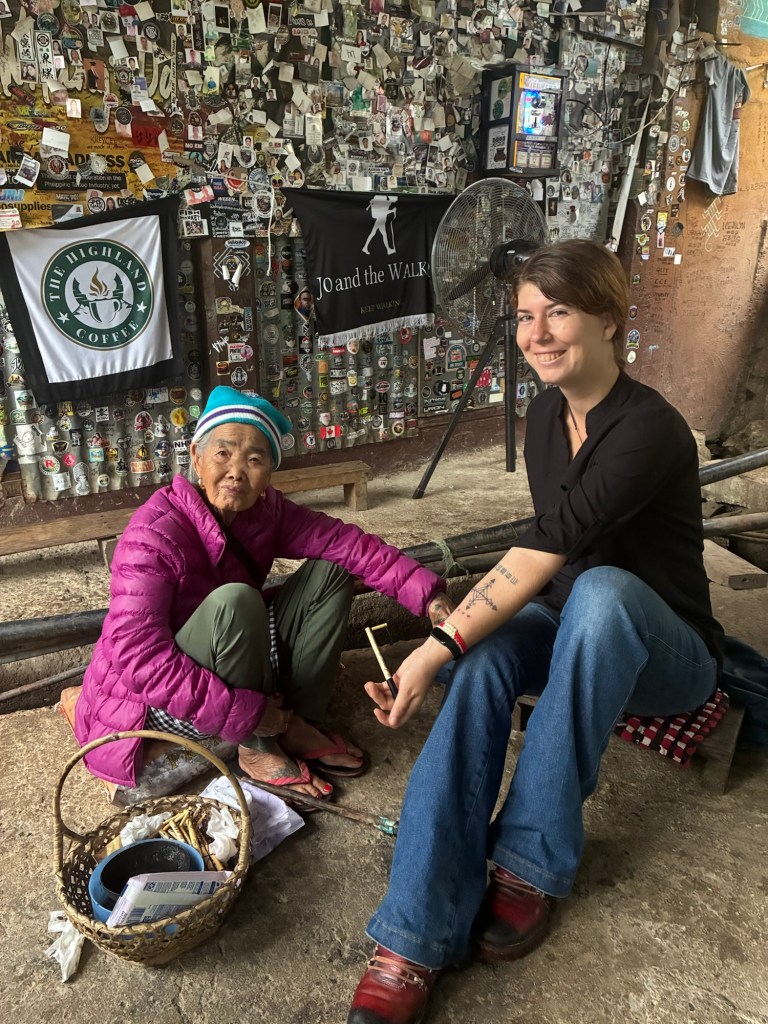
He snapped a photo and then she held her hand out. Oh, it does cost money.
I turned to Paul, “I asked you what else I needed! The money is back in my luggage.”
Click. “Ah, is ok. We’ll grab your luggage and come back. You wanted to leave early anyway, right?” He leaned in and said a few words to Apo, who looked upset. Oh no!
We went back to the house. I paid for the homestay, and paid Paul, and we grabbed my bags and headed out. The usual tours were starting to arrive and the town was hopping with Filipino tourists. He paid Apo and we kept walking.
I got back to the police station between 8:30 and 9. I’d missed the first Jeepney – I should have said no to the tattoo – and now I had to wait for the next one.
The wait wasn’t too bad. I really had nowhere to be, anyway, I just know the last Jeepney leave for Sagada at 2, so I need to be in Bontoc before then, and I don’t want to be here anymore! The cops were all local boys, and nice. They chatted with me and offered me free hot coffee. I watched van after van arrive and disgorge young Filipinos. The police dress up in all their gear, carrying around giant shotguns again.
Around ten, the next Jeepney arrived. Jam packed.
“It is full. On top, ma’am?”
I froze, terrified. Ordinarily, I wouldn’t necessarily argue about riding on top of a jeepney; it’s really no more dangerous than sitting in a bus or a motorcycle, unrestrained. But my left arm was still sore and presumably handicapped by the tattoo, and we weren’t cruising along the city streets in gridlock at 20 clicks an hour; we were racing along mountainsides recently softened by the rain, the abyss yawning away below. Losing my strength doesn’t mean falling onto the road and breaking a leg; it means falling hundreds of meters to my death. Not to mention the risk of a landslide, either from above or below. Some of the jeepneys have proper luggage racks, but this one did not, and what anchor points existed on its roof were occupied by something being tied down under a tarp.
But these were my two options; ride on top, or give up on making it to Sagada, which also means forfeiting what I paid for my accommodations there. Because the next jeepney wouldn’t come until after it was too late to make the connection.
I swallowed. “Can I at least throw my luggage inside?”
“There’s no room, ma’am.”
I’m sure there’s room for a single suitcase – it’s not like I’m overloaded – but somehow, I find myself and my bag being hoisted on top of the jeepney. The man on top gallantly moves so I can have his spot, which is unfortunately overlooking the rocky river valley. I’m seated next to three girls who look like they’re not even in high school yet, seated casually, like this is no big deal. Of course, they also have the benefit of youth, and having not had their abs cut open by a surgeon. I wrapped one hand around the strap of my luggage, another around one of the ropes, and wedged my left foot under the steel bar welded to the roof. None of it was likely to stop me from flying off into the void, but hey, I tried.
We went along for about 3 kilometers, through the area that had been hit the worst by the slips. My ankle ached from being twisted at an awkward angle, and the straps cut into my fingers. I thought of every time I had refused to do something dangerous at work, and here I was, being stupid for free.
We stopped at the same store as the day before, for a long time. I didn’t dare check the time. I barely dared to change my position to delay the inevitable fatigue. I did adjust the cargo strap on my luggage; one of the girls had chosen to drape herself across it – I will say, it is fairly comfy as a pillow – and I moved the buckle so it wasn’t digging into her. This meant she leant on it even more, and I had to contend with her weight as well, whenever the luggage shifted as we went around a corner.
When we were most of the way to Bontoc, a tuktuk driver idling by the side of the road stopped and hailed the jeepney. They talked for a minute, and then everyone started climbing off the roof.
What? Why?
They started walking down the road. I followed them for a second, then stopped. Where are we going? I went back to the jeepney. The back door flew open and someone beckoned me inside. I clambered in and found a seat magically empty.
“Don’t feel like walking?” Someone asked, as the jeepney started moving again.
“I don’t understand why.”
“Police station.” Someone pointed. “They’ll fine the driver 5’000 peso if he has people riding on the roof.”
Do you think that’s maybe for a good reason?
We stop within view of the police station and everyone starts climbing back on. They offer for me to stay down there, but ain’t no way am I leaving my bag unsecured atop the jeepney. I climb up to get it, but then the jeepney starts moving again. I’m stuck up here.
The view is amazing, if nothing else.
The other man on the roof tells me I’m beautiful and asks where I’m from. When I say Canada, his eyes light up, “Ah, Canadians always most beautiful.”
“Why?”
He thinks about it for a few minutes. Eventually he says, “You have winter.”
Wait wait wait… we’re the most beautiful because winter makes us pale!?
Somehow, eventually, we arrive in Bontoc.
I clamber shakily off the roof, stretch, and take off down the road. Bontoc is not a big place. I’m hungry and debating food, but I’m not risking being on the roof again. I find the stop for Sagada and climb inside.
The jeepney is also busy, but no one climbs on the roof. Someone gets told to wait for the next trip, and off we go. It’s a short ride to Sagada.
I pay and head off down the road to my homestay.
So, probably because most travel blogs are white, my only impression of Sagada was “has a single point of interest” and I assumed it was a quiet village. Turns out, that was very wrong and I should have booked like 3 nights in here and skipped the night in Buscalan and the night in Baguio. Sagada is a big tourist draw for Filipinos, so much so that it has a central tourism council and you have to register with it and everything.
The first thing I noticed, wandering down the walled street that reminded me of rural England, is that yogurt and lemon pie are big here. Every eatery advertised that they sold yogurt and lemon pie.
I turned down this quaint walking path and found myself at my accommodation. I was early, but the host didn’t mind. She was an OG AirBnb host; this was also her home and my room was next to hers. She was curious but not overly surprised to see a white girl travelling alone. She told me to call her Nana.
I flaked out on my bed for an hour, destimming, then my stomach growled.
Let’s get some yogurt!
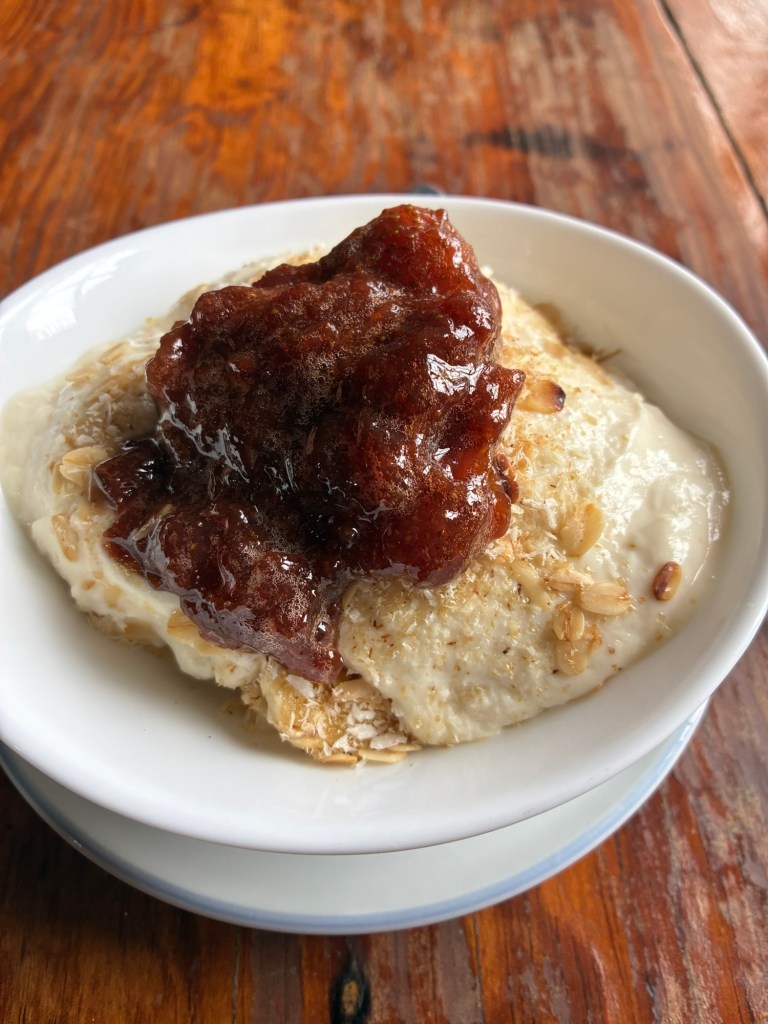
The first place to start the yogurt craze is Yogurt House, on the main road. Their yogurt was very good, but service was lacking. I presume either the mother wanted the day off or she was trying to teach her daughters to run the business, because I was served by two surly teenagers who didn’t want to get off their phones to deal with me. The mother was finally summoned and she chased them out of kitchen to make them work. The yogurt, when it did arrive, was honestly some of the best I’ve ever had and came with lots of fixin’s included.
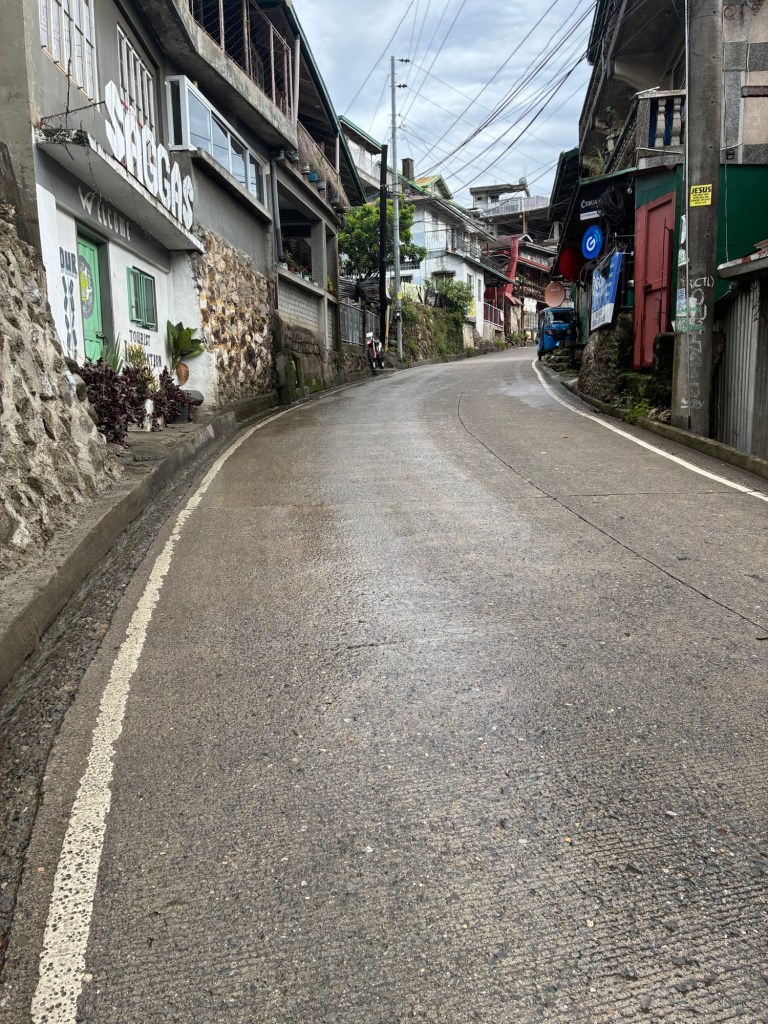
That consumed, I went up the road to the tourism council. You have to pay 100 peso to register, which helps prevent rampant overtourism. You can only register approved accommodations, and the tour guides and attractions won’t let you in unless you have your registration slip.
Now with the list of approved tour guides, I wandered off down the road to see who was bored.
I stopped at the first one I found. Too easy? Meh, who cares.
I hopped up the steps and plastered on a smile. “Hello!”
Five heads shot up instantly. Two girls seated at a desk glanced at each other. “Would you like a tour, ma’am?” They asked, as if they were sure I was lost.
“Yes, I would like to see the hanging coffins.”
Still seeming confused, they gave me the same speech as the tourist office had, before asking to see my registration. In the corner of my eye, I noticed one of the guides smile, get to his feet, and start getting ready to head out.
Once everything had been agreed to, the girls said, “Who wants to take her?”
“I am.” He replied, standing by the stairs. He gestured down them, “Ma’am?”
As we walked back up the street towards the main intersection, he said, “My name is Patrick. And yours?”
“Lucy!”
We talked a bit. His grasp of English was decent but not great. I asked and he confirmed that Sagada mostly gets Filipino tourists, not foreigners. He was nice, patient and knowledgeable, but to be honest, there was something about his smile that seemed slightly patronizing.
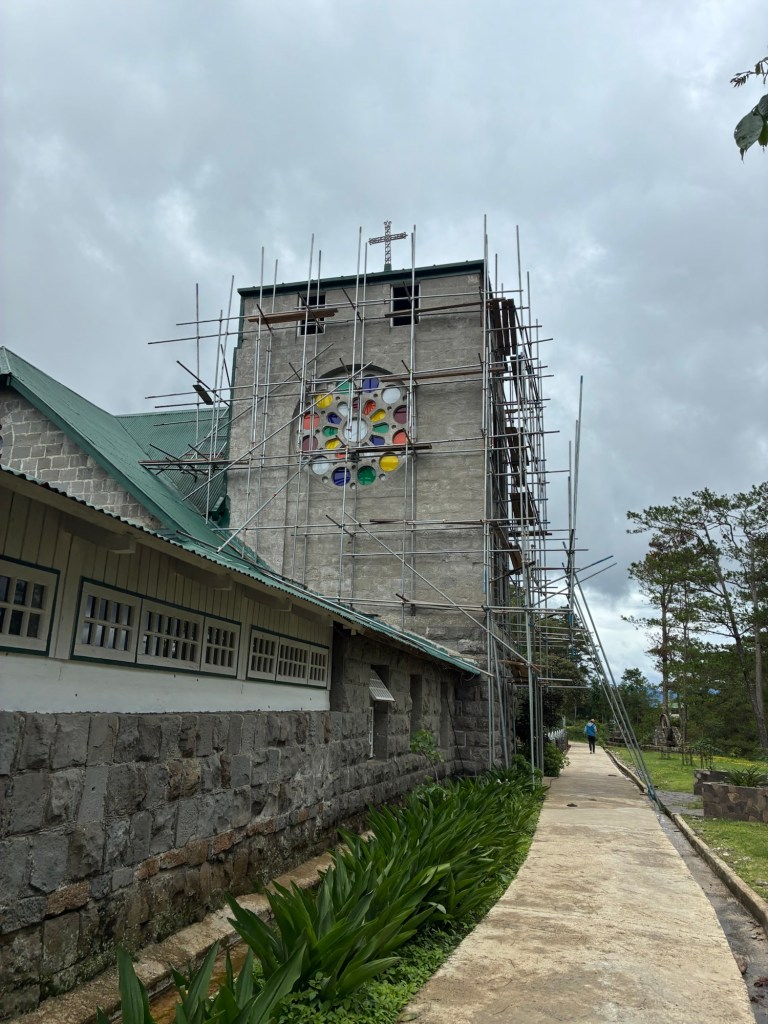
It’s not a long walk around to the coffins. We stopped first at the Anglican church, which he was a part of. It’s very nice. It’s here that I found out Sagada was bombed during World War 2, and the Americans built the church while they were helping rebuild.
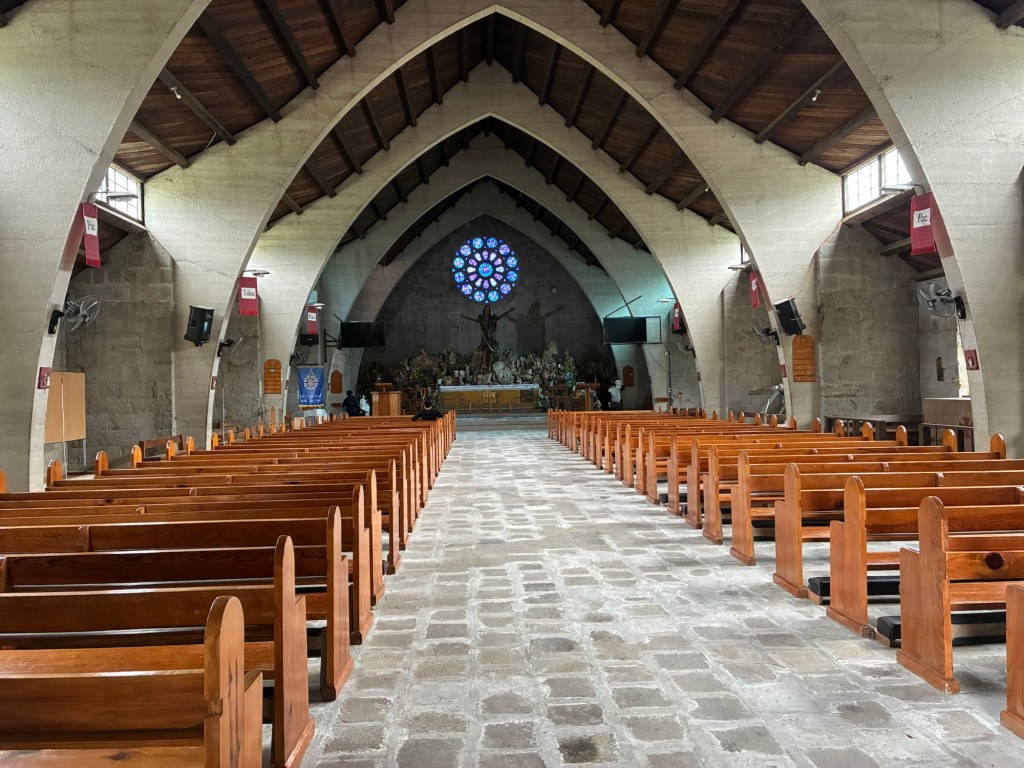
Maybe 200 meters down the road was the Anglican cemetery. 10 peso for “enviromental fee”. There was a woman shelling peanuts on the stairs and they chatted for a moment. He waited for me to take pictures, but I declined.
“Isn’t it weird for you to take tourists through the place you’ll be buried one day?” I asked him.
“Nope, not weird.” He said, somewhat proudly.
One through the gaveyard was the so-called “Silent valley”, where the funeral rites and burial used to take place. We stopped at a lookout and he gestured to some other hanging coffins on the far side.
“Those are oldest coffins here.”
“How old are those coffins?” I asked.
I watched the wheels spin in his eyes for a minute before he answered, “Centuries.” In his usual placid way. I wonder if he didn’t know how old they were, or if he couldn’t find the English words for it.
Then we descended into the limestone valley, almost every other tourist was a Filipino.
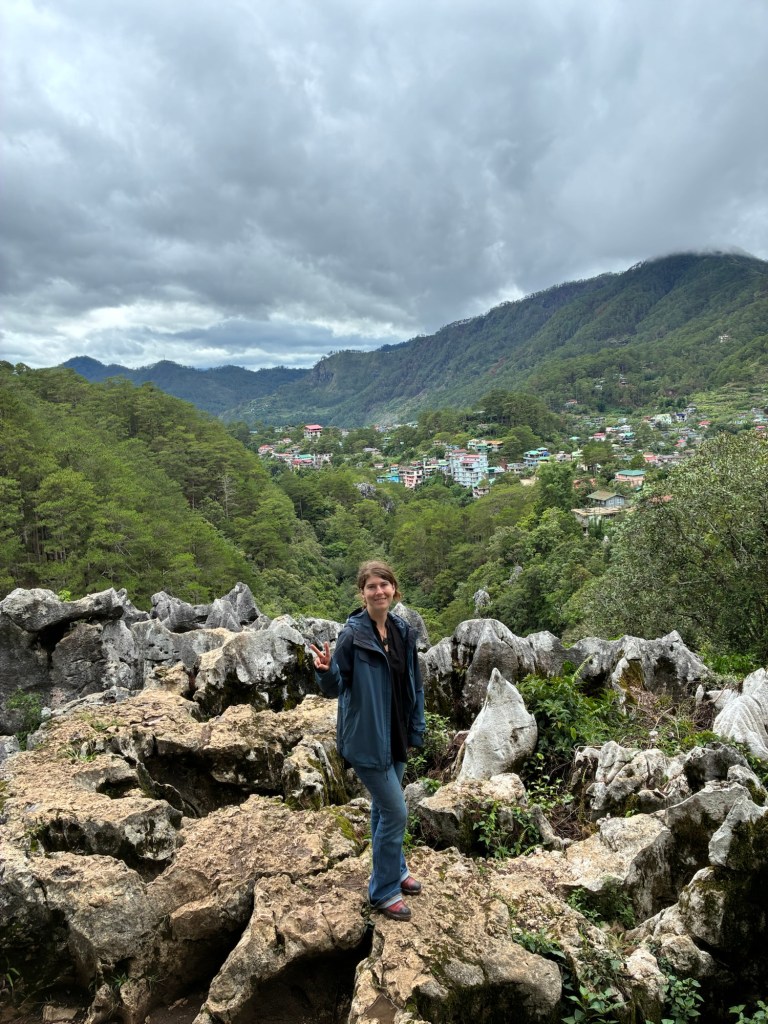
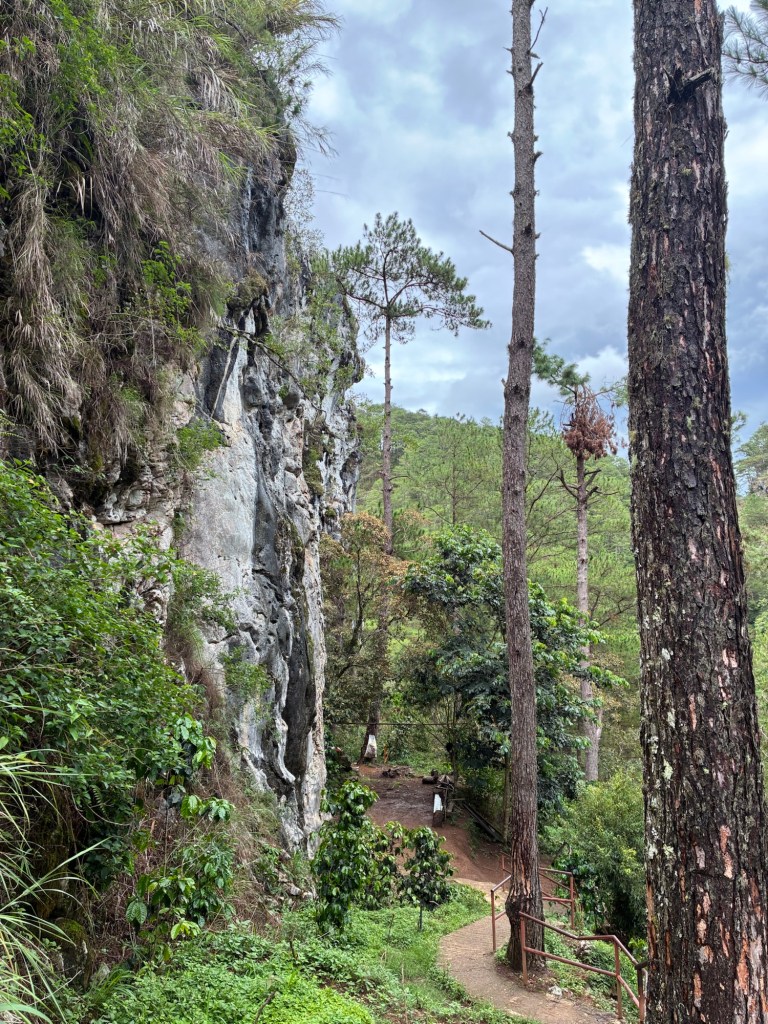
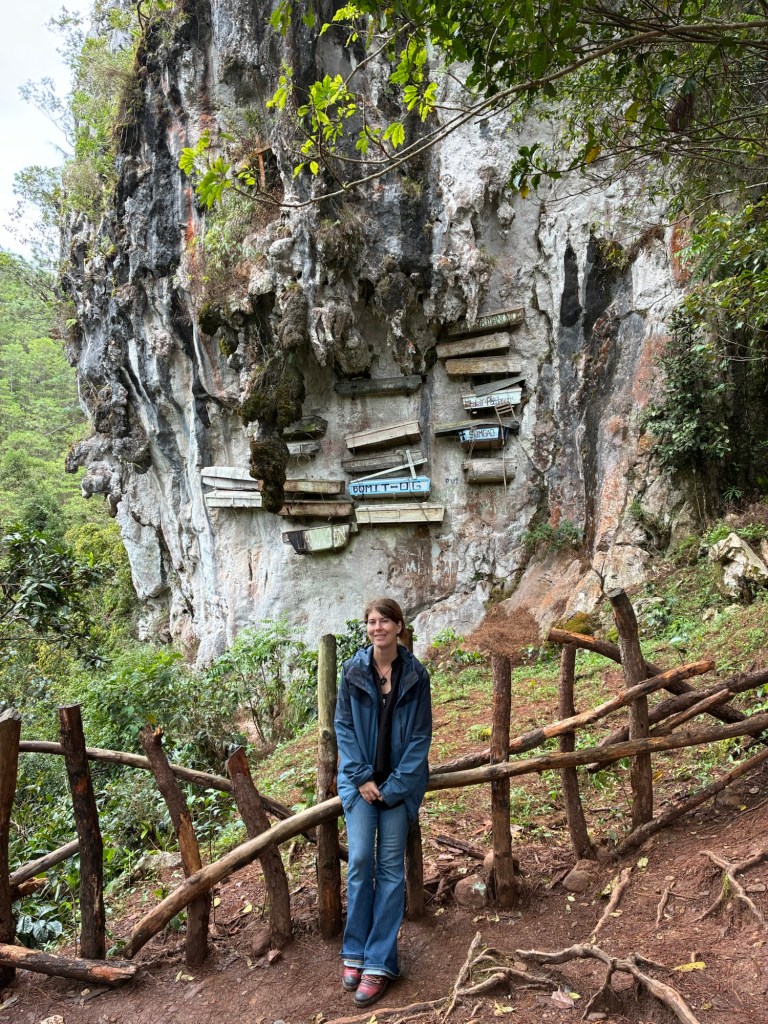
The coffins tourists are allowed to visit are the most recent ones; the last hanging burial took place in 2010, then the government outlawed it for public health reasons. Which is too bad; it’s fairly unique. No other tribe in the Philippines does this. Location? Stronger ties to an ancient custom?
It also seems beautiful for the involvement. Most men carved their own coffins, which are wide instead of long. The Igorot funeral rites includes tying the deceased to a chair so that they sit at the table during the immediate mourning period. As a result, the bodies are frozen in a roughly fetal position and need wider coffins. Patrick also informs me that the bodies are carried down here wrapped only in a blanket, and that everyone in the village comes out to help pass them along; getting the juices on yourself is considered good luck.
Take photos, chat, head back up. Patrick asks me a lot of questions about Buddhism; he hasn’t really heard about it before. Not a lot of Filipino Buddhists.
As we walked down the steps of the graveyard, the lady shelling peanuts said something in the local language and gestured behind us. There was a group sitting on the steps. He asked me to wait for a minute, then walked up the steps with a sheet of paper, and started writing down their information (they were all speaking English).
In a quiet voice, she said to me, “They didn’t register at the office, and they don’t want to walk back to town to do it.”
Oh. Sweet deal for Patrick, then, as he collected the money. They have to wait for him to come back with their registration slips before they can go anywhere. A captive audience.
We walked in silence back to the registration office, Patrick walking a little quicker now. I can’t say I blame him; my tour is over and he’s got marks waiting back there. We stopped in front of the office and I paid him.
“Thank you, ma’am Lucy.” He offered me his hand to shake, which I accepted. “You are lucky for me.”
“No customers all day, huh?”
“No, until you show up.” He grinned widely. “Have a good day!”
I smile to myself as I walked back down the walled street. Maybe a future Buddhist convert? It is funny how things turn out…
I went to a restaurant for dinner. Paolo recommended etag, smoked and salted pork that’s popular in the area. I found a restaurant that had a carbonara style dish with etag, which makes sense to me – etag instead of bacon or pancetta. I also ordered a yogurt drink – get while the getting’s good. However, the pasta was a let down. It was bland!
On the walk back to my hostel, I stopped at a cafe and grabbed a couple slices of lemon pie for breakfast.
Spent the night relaxing in my private room.
I woke up early for the bus ride to Baguio. It’s a 6 hour ride on a good day. I made my coffee in my travel bottle, which retains heat like you wouldn’t believe, and had the pie for breakfast. It was the worst pie I’ve ever had; it tasted nothing like lemon and honestly little of sugar. It was mostly just flat.
Nana was sad I was checking out already, but wished me well.
I left around 7. There’s a bus at 7:30 and a bus at 8:30, and since you can’t prebook tickets, in my mind I’d just arrive around 7:30 and get one of the first tickets for the 8:30 bus. But I managed to struggle up the hill at 7:20 and there was still roughly half the seats open on the bus, so I bought a ticket and sat next to a Filipino woman who had a small fluffy dog swaddled in a towel on her lap for the entire bus ride. Poor thing.
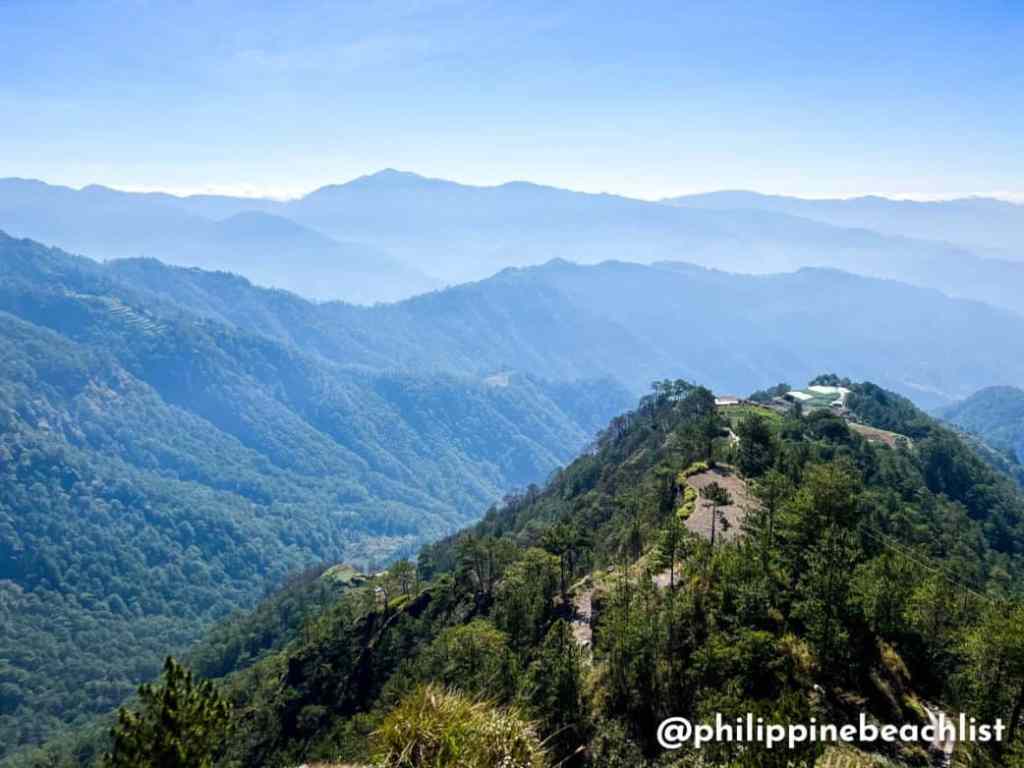
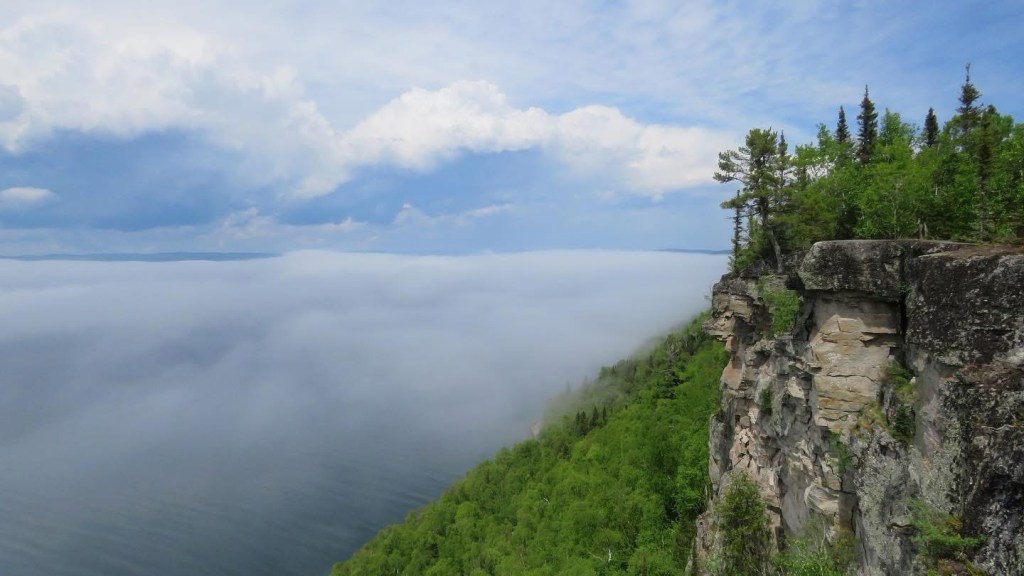
Down and up and down and up. We spent the first part of the journey above the sea of clouds, threading our way along the spine of the low-lying mountains. Villages perched precariously on the steep sides of the mountains, rice terraces carved steps down them. The bus stopped here and there to let people off or on. We ascended to the “highest point on the highway system”, near Atok.
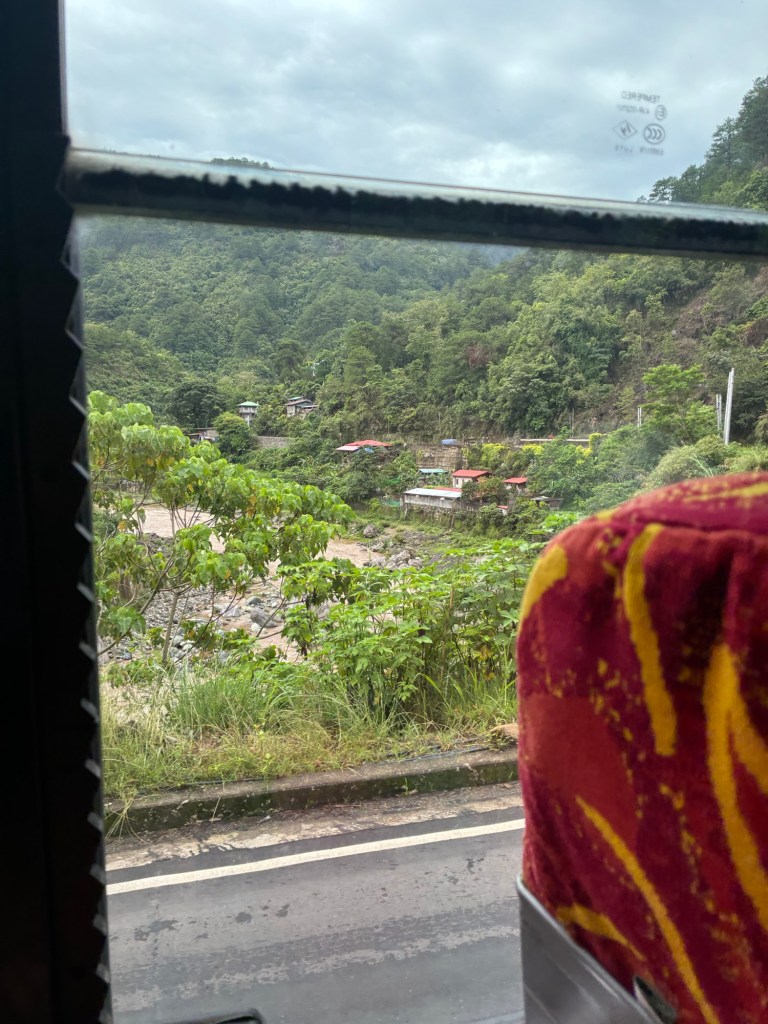
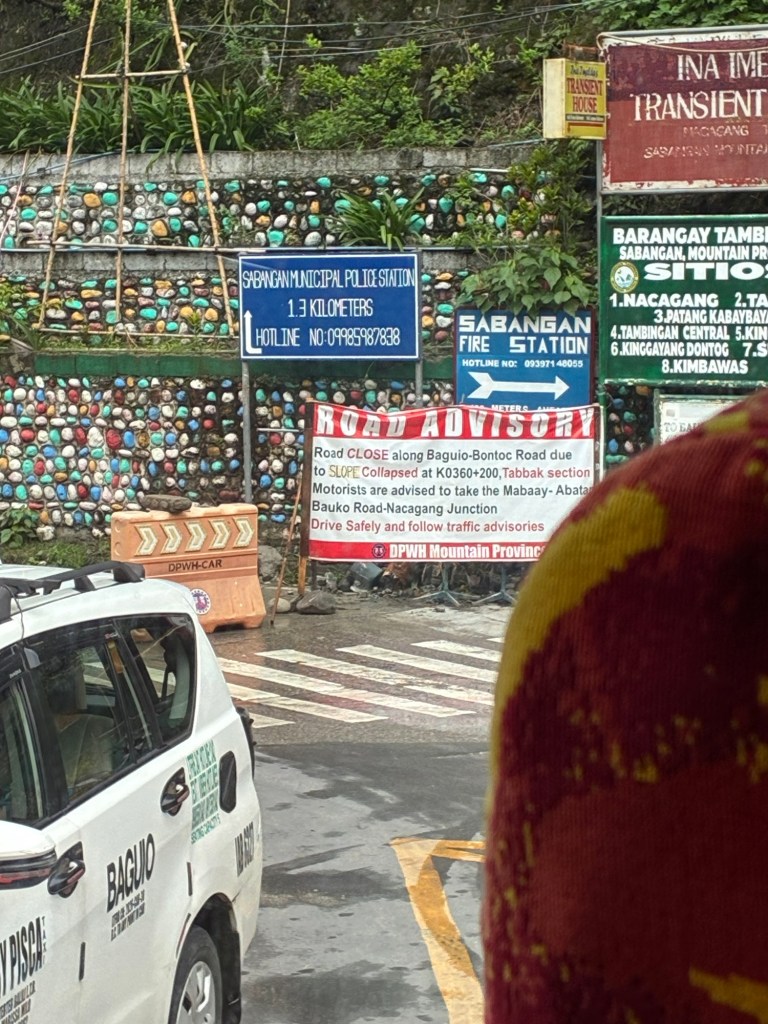
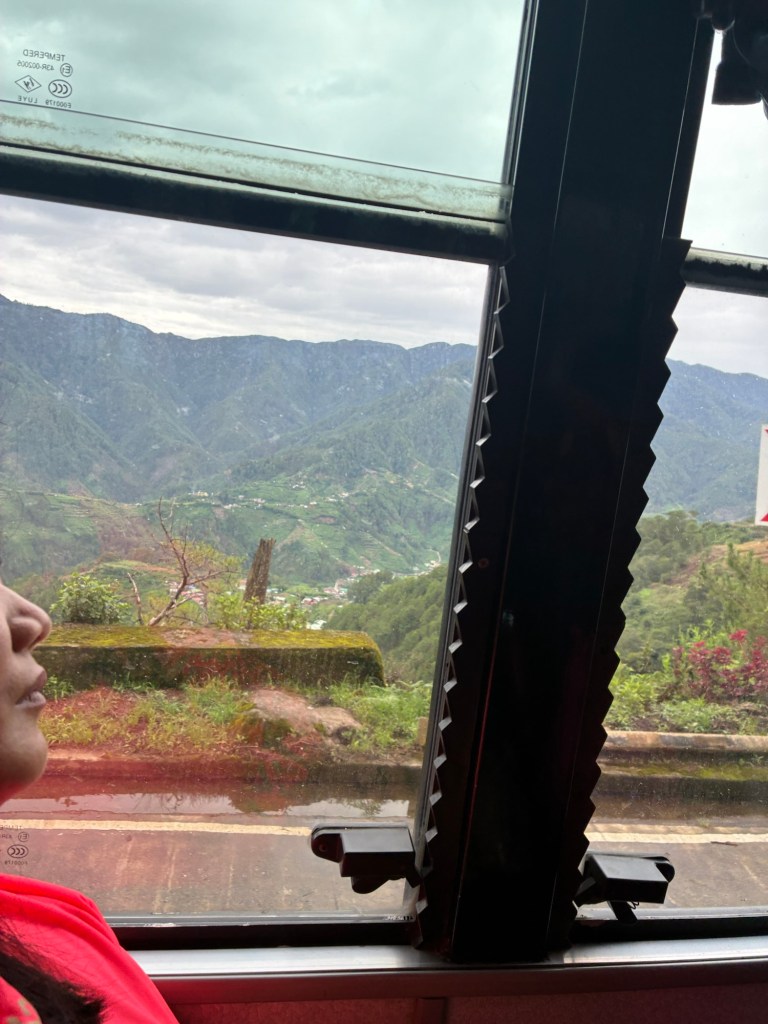
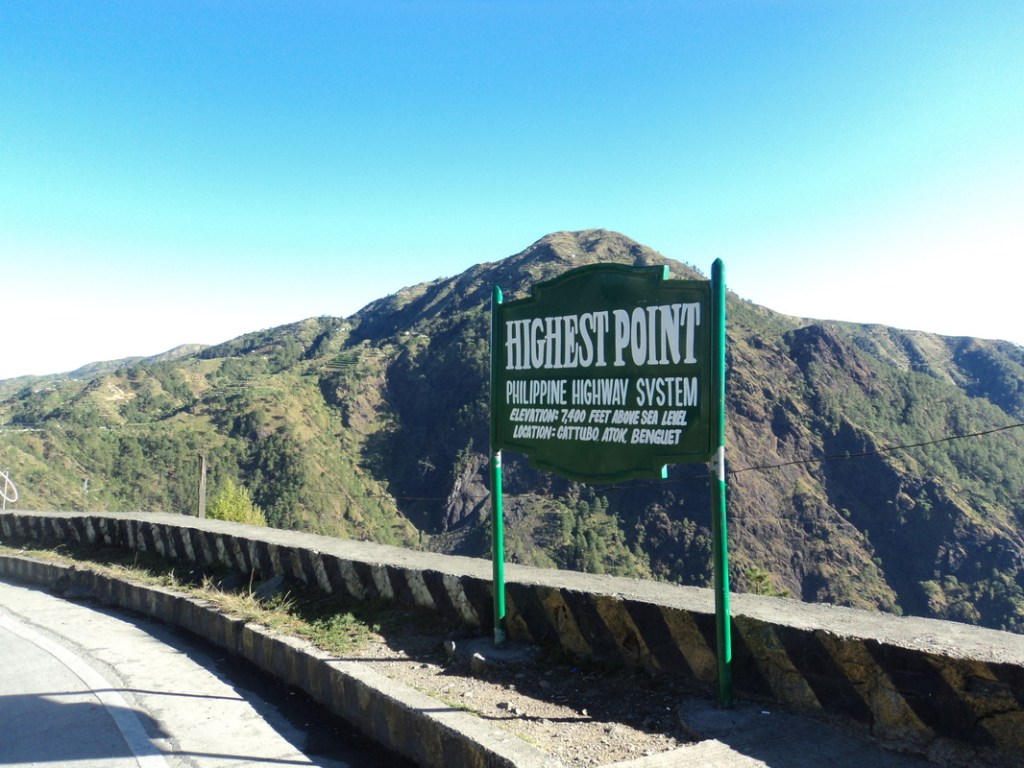
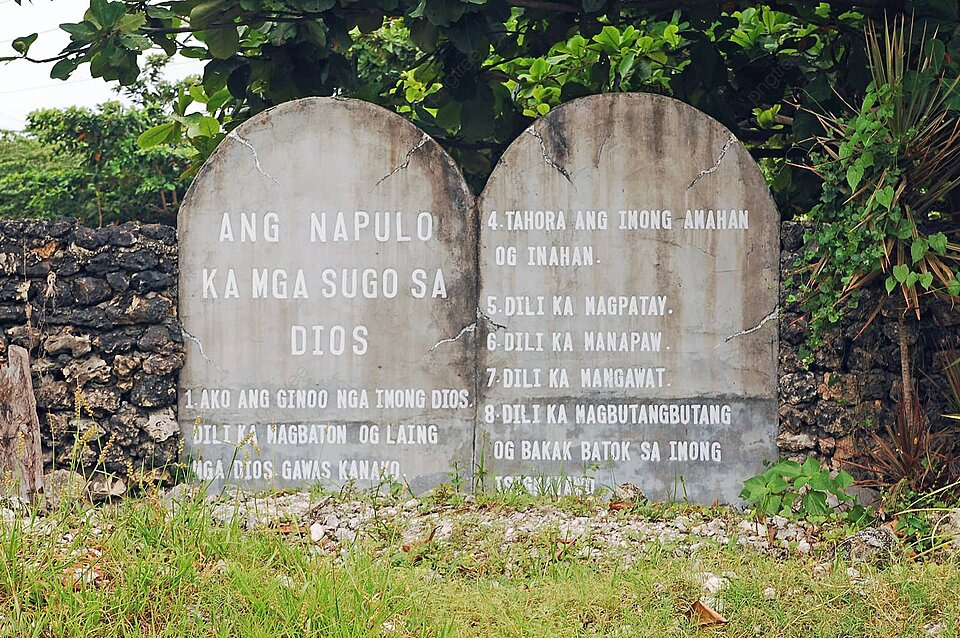
We also passed some hilarious Jeepneys, like one that was stuffed with lettuce. The mountain regions are the “salad bowl” of the Philippines, since it’s drizzly and cool year-round. Baguio is noteworthy because it’s the only place they can grow strawberries, but obviously strawberries are not a novelty in Canada, so I’ll pass.
We were forced to take a longer route than usual because the main road to Baguio washed away.
Around 11:30, we stopped at a station for lunch. I discovered here that, for some reason, they sometimes install toilets with no seats, for urinating. I guess the logic is that you can do a quick pee by hovering, but that didn’t work for me, so I was forced to go to the one stall labelled “defecation” to sit down properly. I’ve noticed a few toilets with no seats as we traveled across the mountains, but I’d just assumed the seat broke off or something, not that it was intentional. I can’t even imagine the logic behind it.
After thoroughly washing my hands, I bought a cheeseburger at one of the many stalls for 60 peso. Pretty yummy for a burger that didn’t even cost 2 dollars.
We got to Baguio sometime between 1 and 2. I was wiped from the four days of constant travel and my left arm was still deeply sore from the tattoo. I was starting to suspect they had pushed the ink too deep. I hiked down the block to my accommodations, which was cheapest place in Baguio.
I discovered why. It’s basically someone’s apartment converted into 6 pod beds, and pretty jankily at that. There were signs everywhere saying not to lean on the walls. Or the sink. They took my passport as a deposit for the room key, the first time that has happened since I left Vietnam.
However, they also sold sundries at the counter, which was nice. They sold individual toilet paper rolls for 20 peso.
I unpacked and discovered I’d forgotten my soap, shampoo and loufee in Sagada. It’s not much of a setback – I still have my spare bottle of shampoo – but it is annoying because I wasn’t going to restock until I got to Taiwan and settled down for 5 weeks.
I do enjoy the mountains. It’s cooler – I can wear jeans here – and calmer.
I didn’t venture out that night. I ordered a pizza to the hostel. That’ll keep me fed for today and tomorrow. I’m kinda over the Philippines.
I had a relaxing morning. I only found one place offering champorado, but when I went over, they wanted 430 peso for a serving. No rich for my blood! I went to 7/11 and got some yogurt and a boiled egg. Much better.
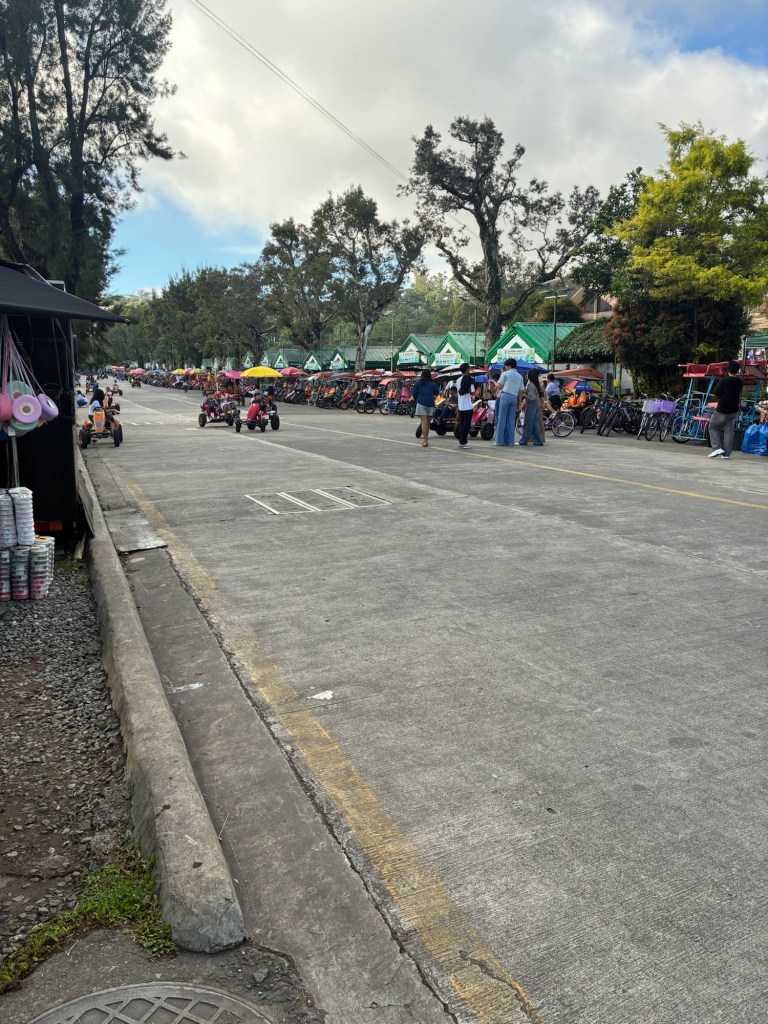
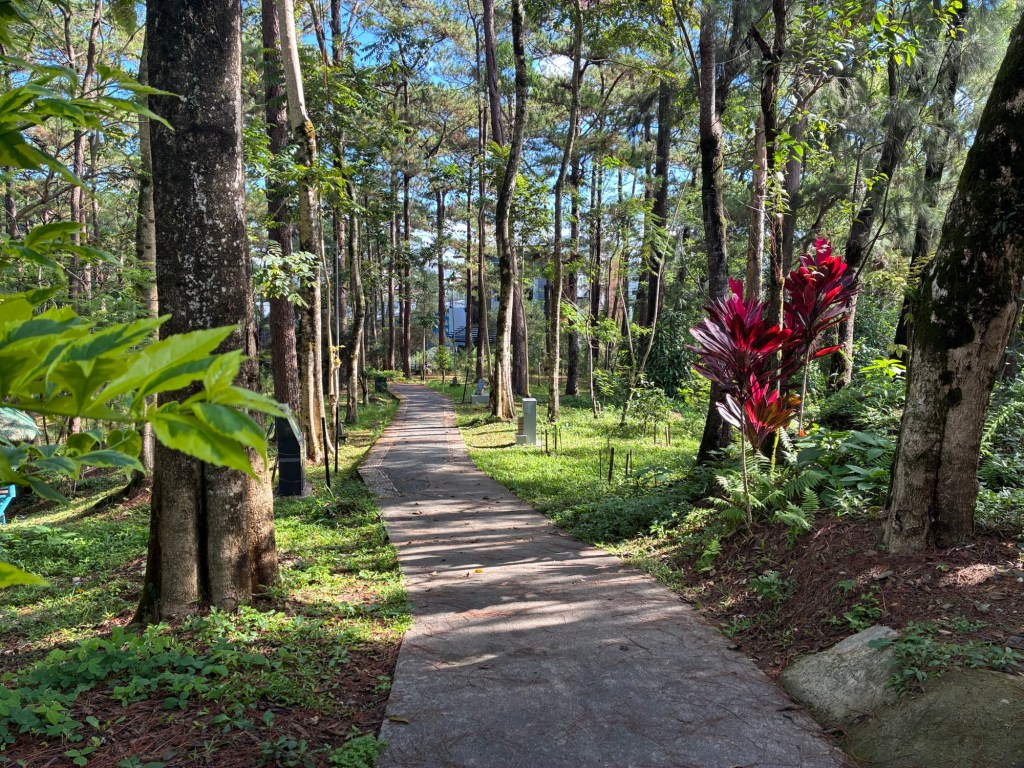
Baguio has a big park in the middle, which is a hub of activity. Groups of Filipinos power-walked around the exterior, or clumped into groups for jazz-ercise. There was a pond with swan boats, and a small paved area for pedal carts. At the far side was a garden called “Pines of the World”.
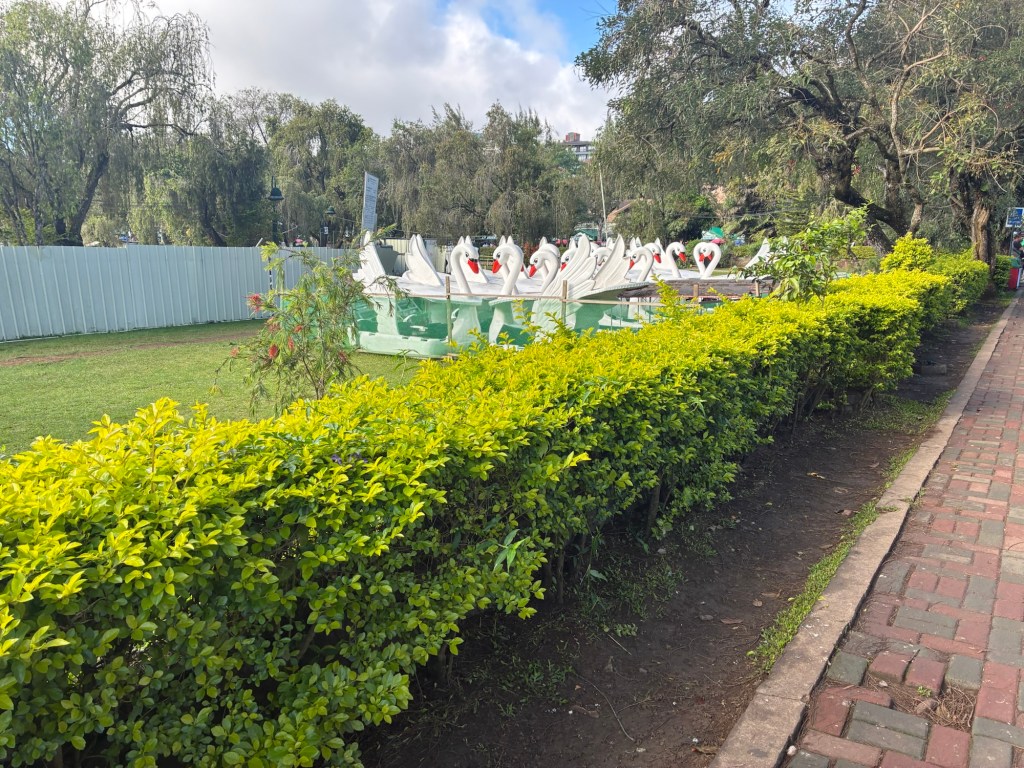
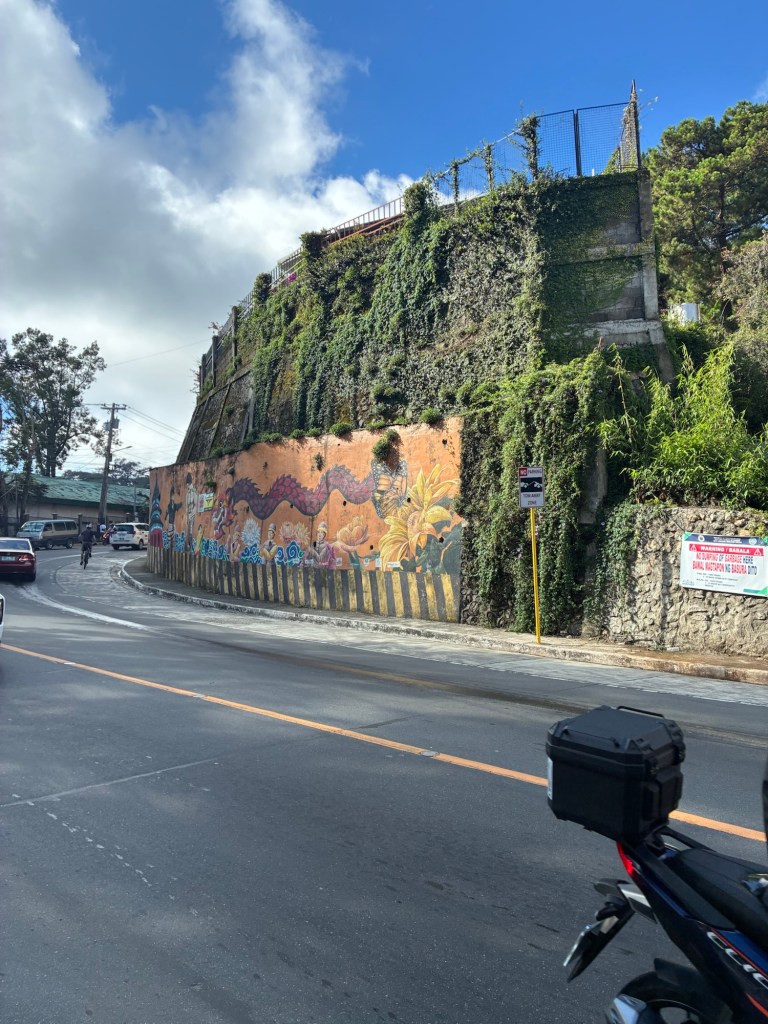
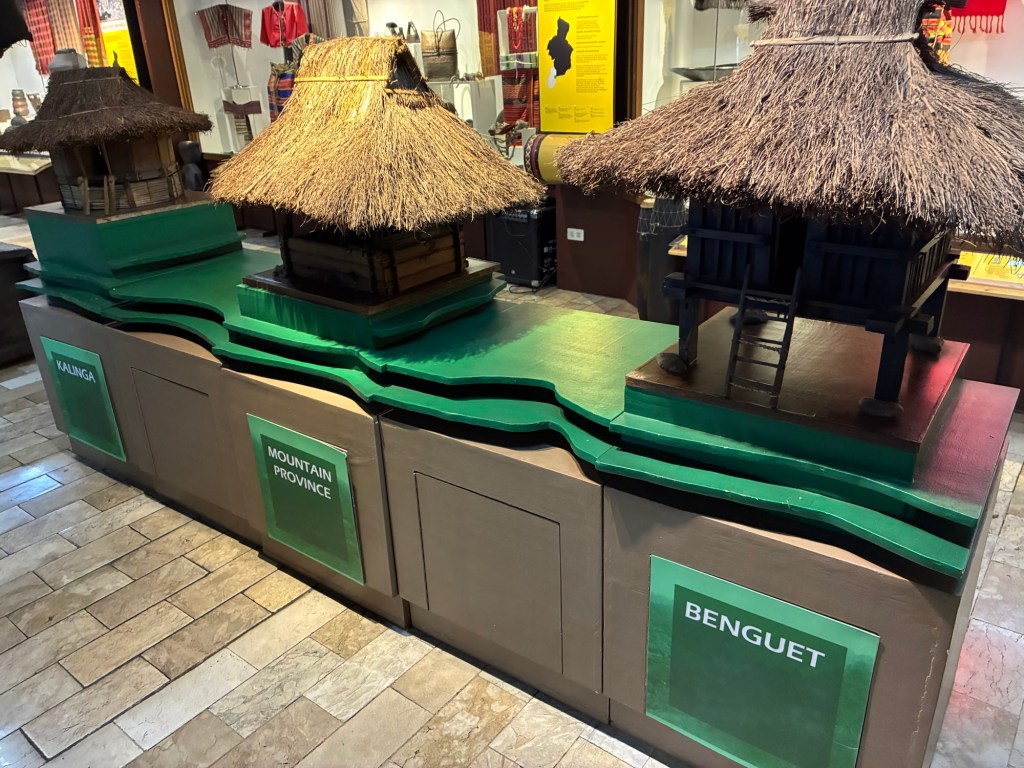
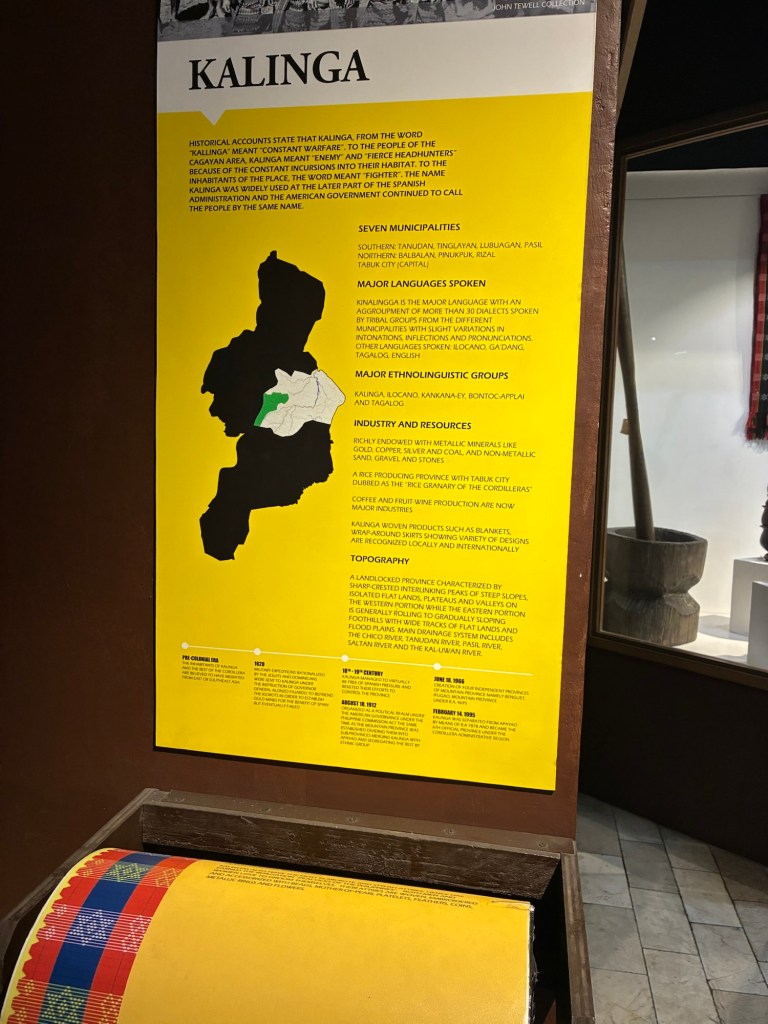
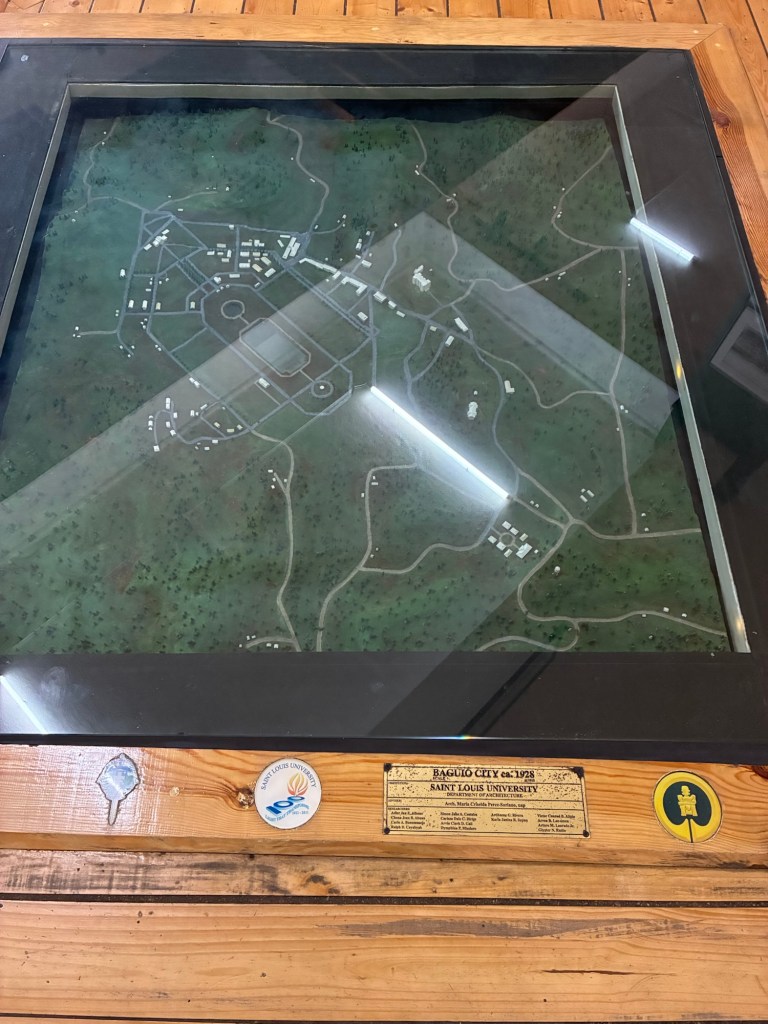
I also went to the Baguio museum, which is where I learned a lot of the history I’ve been repeating, so I won’t linger; this post is long enough. I did learn that the part of town my hostel was in is the oldest part of the city.
I relaxed in my hostel for most of the day. The wifi is pretty good here.
In the afternoon, as I was packing, I was forced to confront a truth; the purple pants I bought in Ayutthaya are dead. The elastic has stretched out and they stay on my hips but only barely. If I were home, I could fix it easily, but I’m not and I’m not dragging them around with me for 8 weeks to fix. I said goodbye and tossed them.
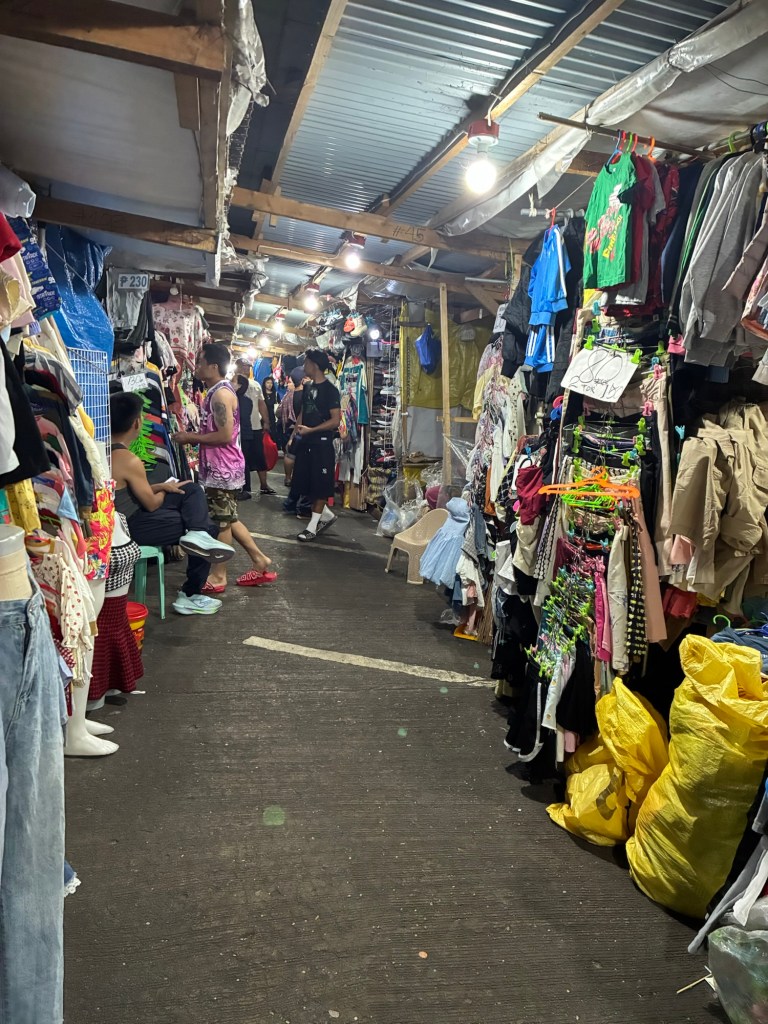
Outside my hostel is a market. A lot of reviews note the smell of the fresh fish and meat inside the ‘hostel’, but I barely noticed. What did catch my eye was the covered clothing market. This is my last chance to buy cheap clothes, and I need something business casual, ideally with pockets.
After doing a few laps, I was drawn to a pair of high-waisted pants with darts in the Asian style. They were black and formal, although the pockets weren’t great. 100 peso.
I need a white shirt to go with them.
I ran back to the hostel and changed into them. The owner complimented me; he even sleeps behind the desk. “You need white polo or something for those.” He observed.
I knew exactly where to go. I had found a stall that only sells white shirts, in every style, if not every size. I should find something a bit fitted so I can tuck it in, maybe with a statement sleeve…
I was distracted by a shirt with a cowl neck. It’s not a button up shirt, but it would go with the pants and look sort of glamourous.
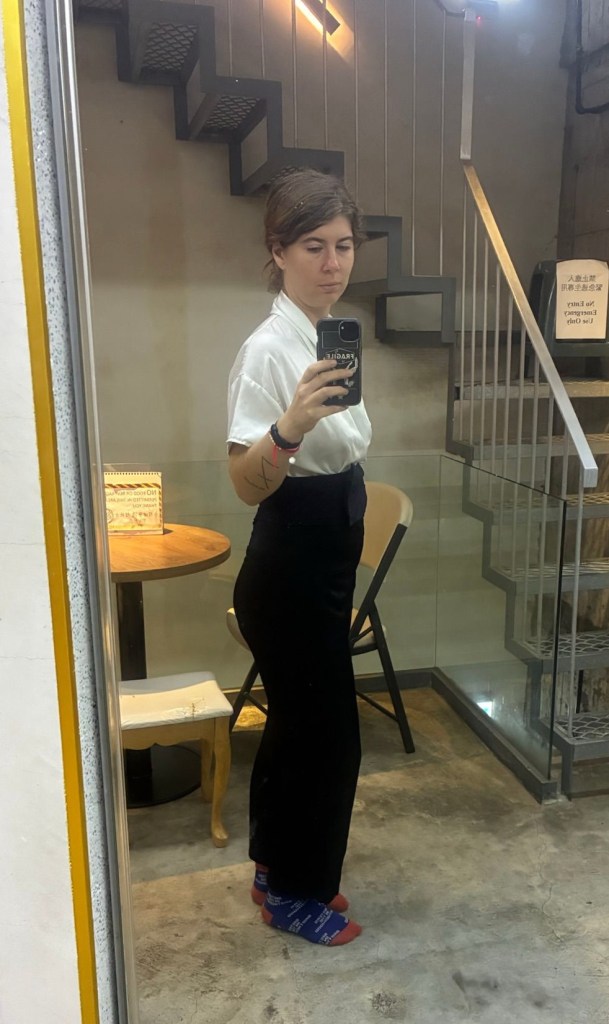
The owner let me throw it over my head to try it on. Sold.
Too many days of not washing my water bottle plus making instant coffee in it have given my water bottle a funny smell. My tattoo has reached the point of healing where it starts to peel. I grab a liter bottle of Pocari again. I’ll just fill this with water until I can wash my bottle. Also some bakery goods for breakfast.
As I chat with the owner, I realize what looks like a business license on the wall behind him, actually says it’s simply the purchase of the right to use the name of the hostel. At the bottom it explicitly says, “This is not a license to engage in any kind of business.” Dated August 2025. So this place is almost certainly operating illegally, which explains a lot.
Ok, back to rotting in my bunk.
Wake up early for the final bus. Back to Manila, yay.
I took a Grab to the bus stop, if only because the bus stop was uphill the entire way.
As the bus left, I noticed a Soroptimist sign for Baguio. Oh right, there was a club here. I kinda regretted not reaching out. I hadn’t heard back from Minda either. Later it occurred to me I’d forgotten to contact Teresita.
It took us about an hour to descend from Baguio to sea level. I noticed the sea shimmering off in the distance – I didn’t think we were that close, but there weren’t any lakes on the map in that direction. From there, it took another 4-5 hours to reach metro Manila.
The original Japanese hostel I’d stayed in was around the corner from the bus stop, which I hadn’t realized. I’d booked a cheaper hostel further away, also with the vain hope it might be a more walkable area.
When I get my bag back, I noticed the straps are damp with mystery fluid. The straps are the only part that absorb liquid, thank goodness. Not that I have a way to clean them now.
This hostel is nice. It’s missing two things; 1, a light of any kind in the bunks, and 2, a proper common area. There’s some seating around the lobby.
After I checked in, I discovered there had been an earthquake in the Philippines, with a tsunami warning extending to New Zealand. I checked with everyone, but no one I knew had even felt it. It mostly hit Davao City on Mindanao. No tsunami happened either.
I went down to the lobby to get my Pocari bottle filled with water.
The child behind the counter grinned at me and gestured for me to ring the bell. I did so and she giggled, before glancing through the door behind the counter. Some Tagalog drifted out.
“There is someone here.” She protested.
A woman stuck her head out, her expression of disbelief changing into a smile.
I asked for the bottle to be filled with water. She said “tumblers only”.
Really? What does that make any sense… I went upstairs and rinsed out my HI bottle as best I could in the hottest water the tap could muster.
Ordered Grab for dinner.
The next morning, I walked down to the 7/11 for breakfast. I have 1000 peso left.
Around noon, I went to get my legs done.
I didn’t do much. I’m ready to be in Taiwan. Filled out my arrival card and double checked my accommodations. Re-watched the original Oldboy to get myself in the mood (yes I know it’s from Korea).
For dinner, I went to the cafe next door, which opened 3 days ago for the first time. It’s… not great. They asked to take a picture of me for social media. I’ll live forever on random foreign social media.
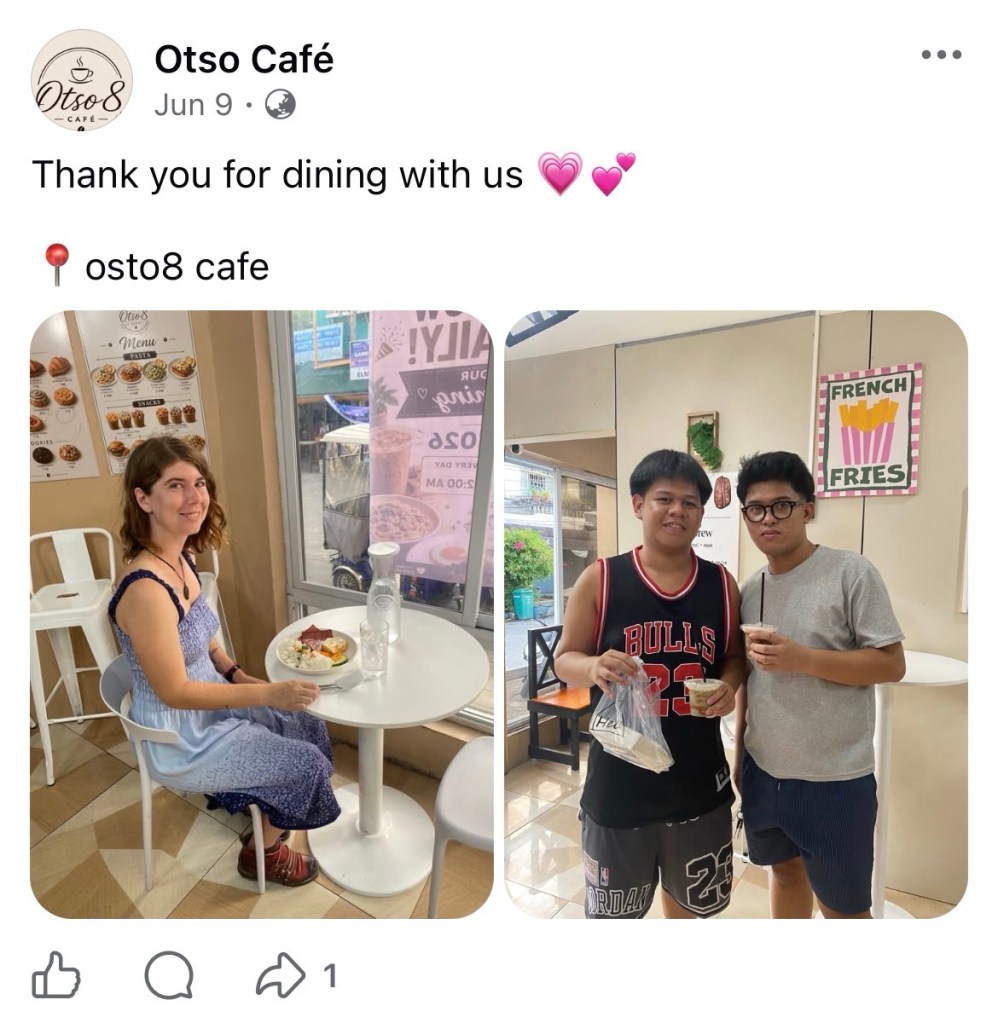
“You were fast.” The clerk says, when I get back.
“I just went to the cafe next door.”
“They just opened. What do you think?”
“I mean… they’re not going to last.”
He started laughing.
“It’s true, right? They sell the same thing as the carinderia across the road, and probably worse.”
“And more expensive.”
“Fantastic.” I glance in the fridge at the offerings. They have an official pre-mixed Moscow mule by Smirnov. That sounds pretty good, actually. I buy that and a bag of chips, which leaves me with 20 peso. I exchange my random change for a 20 peso coin as a souvenir, at the suggestion of the clerk.
It occurs to me that I forgot to try balut. Balut is usually a “pre-drinking” kind of food, but I’m always back in my hostel by 4PM so I’m never out late enough for the balut sellers. I only noticed one vendor selling them and that was in Coron. Oops.
I also forgot to purchase or send postcards.
Well, it’s too late now!
Off to Taiwan.

 Wanderjahre
Leave a comment